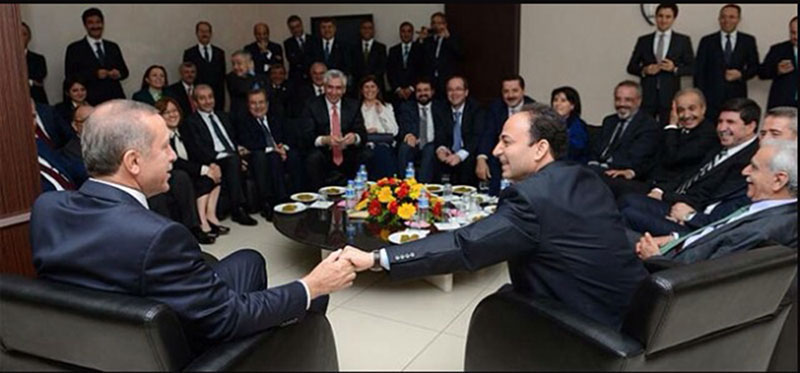
I cannot remember the exact date, but it must have been sometime in 2010. Then Prime Minister Recep Tayyip Erdoğan was on stage and was talking to active Justice and Development Party (AK Party) members of the Istanbul branch. There were thousands at this meeting, even the street representatives of the AK Party were there. He was the prime minister at the time and the Kurdish initiative was a babe in the arms of the AK Party government. It was the most controversial issue in the public sphere raising tension in the society. However, there was an unseen, silent group made up of both Turks and Kurds who did not voluntarily support the initiative, but did not resist it either - conservative Turkish nationalists and disappointed Kurdish people lacking trust in the promises of the state. For both elements in the group there was something wrong with the project - it was against what they had been taught and believed so far, but at the end of the day, it was Erdoğan, the leader they trusted, promising them that it was the only solution for achieving peace. The personal integrity of Erdoğan caused them to wait and see before rejecting the plan. Some people from the group were at the meeting that day.
There was an incredible atmosphere in the hall. AK Party volunteers were cheering and clapping after each of Erdoğan's sentences. In the midst of his vibrant speech, by referring to the Democratic Society Party (DPT), today's People's Democratic Party (HDP), Erdoğan said something like, "From now on, they should stop acting like a terror organization." This was a very normal phrase, since the majority of Turkey regarded the DTP to be an illegal movement with organic ties with the PKK at that time. Of course, this sentence was cheered and applauded by the thousands, again. Then, he stopped and said suddenly, "But it is time for them to be Turkey's party now." It was a moment that I will never forget. The passionate cheering suddenly ceased, and a silent moment met hundreds of questions in the minds of AK Party members. I am sure that this moment was not even noticed by most people there. However, it revealed a great deal about Erdoğan's transformative power concerning the Kurdish issue.
Both Kurdish and Turkish sides have constantly experienced similar moments from the beginning of the reconciliation process. Nobody denies the huge contribution of civil society and other political actors, but it is indeed Erdoğan personally in the eyes of both the Turkish and the Kurdish people who is the main force behind the on-going process. If today 70 percent of Turkish people are calling for a solution, I believe that solution is Erdoğan's charismatic leadership and reliability that has transformed the perspective of both parties on the Kurdish issue.
It is clear that Erdoğan is still standing somewhere close to that 'radical bet' where he initiated the Kurdish peace process. However, neither the HDP nor the Turkish and Kurdish public are currently where they started in 2009. They have gradually transformed and normalized during the process. Recently, many people were pleasantly surprised at the HDP's decision to run in the upcoming elections as a single party rather than with individual candidates. Apart from the HDP's election strategy, there is something else we have to focus on here - the new discourse and policy HDP Co-Chair Selahattin Demirtaş is willing to adopt - being Turkey's party.
If today, Demirtaş is referring to a "Turkishness" vision and this vision is supported by a wide range of public figures from seculars to conservatives, Kemalists to liberals, Islamists and socialists this would prove that Erdoğan has succeeded. Turkey has changed, and apart from all criticism and praise, Erdoğan is the architect of this change. Whatever the reason behind this support, at the end of the day, they are daring to support a politician who was once called a "terrorist" or "illegal" in the Turkish political sphere.
Political motivations and standards have transformed since 2002 in Turkey, and any politician who wants to survive in Turkish politics has to somehow adopt this change. A vision of "Turkishness" is only one of the products of this political evolution. After Demirtaş's move, the anti-Erdoğan camp in particular called for him to make the HDP a political movement, which finds support mainly in the west of Turkey. Clearly, now, they do believe that he is a "legal" political figure in the eyes of majority of Turkey; and of course, they are aware of the fact that marginal Kurdish nationalism is not selling anymore.
Apparently, we have to note that while supporters of Demirtas's election strategy backed him because they think this might be the only way of decreasing Erdoğan's political power and self-confidence; opponents are against this project because they believe a failure of overcoming the threshold can result with the loss of all battles against Erdoğan. But, what is more striking here is that since the architect of this transformation is Erdoğan, even his political rivals or opponents are using the language set by him and inevitably apply narratives formulated by him. So it is still Erdoğan who is the main motivation at the center of any political debate, move or bet.
429: Undefined variable: show_disclaimer