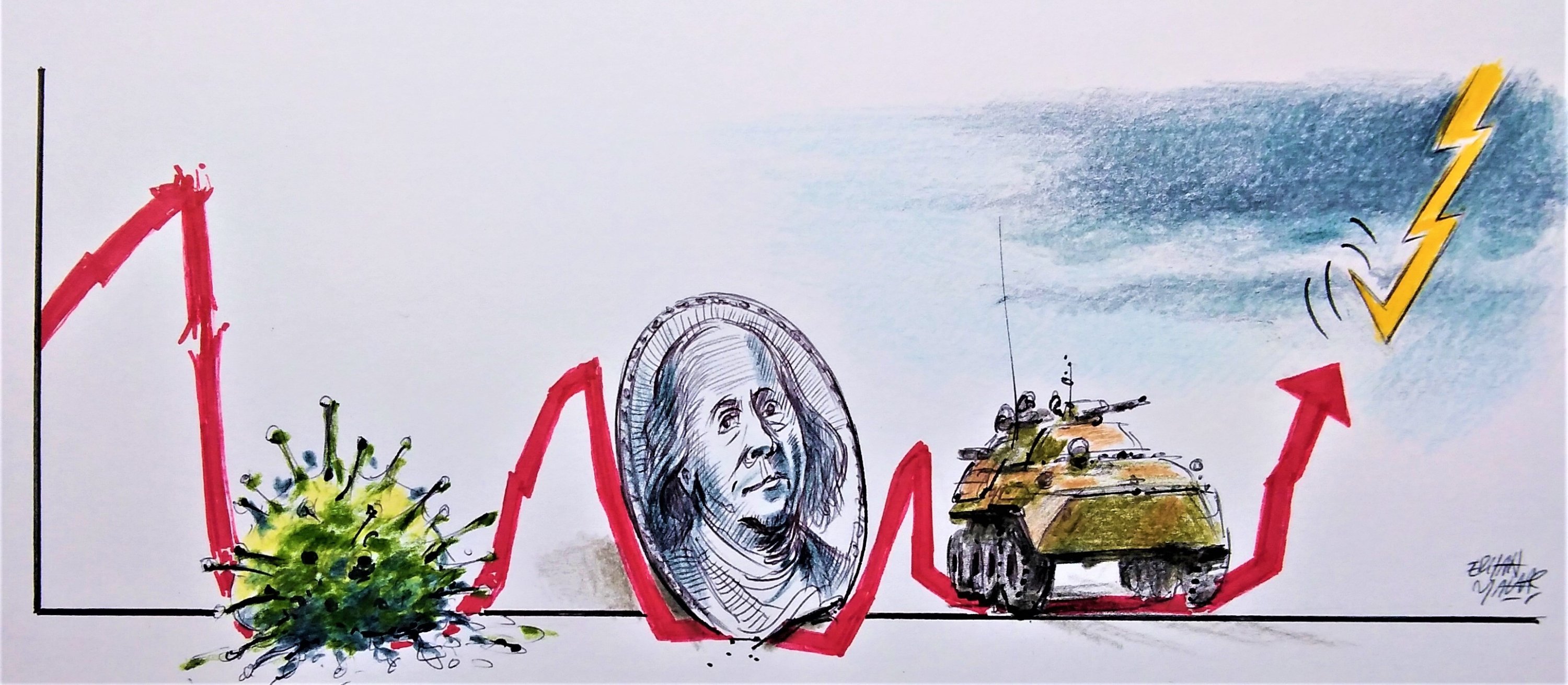
First of all, I would like to make one point clear: Economic policies are not designed independently of the situation in the world and countries' economies cannot succeed if they ignore the basic facts and macroeconomic conditions. Insisting on isolation would lead to heavier costs and difficulties both for national economies and the world economy. Serious discussions on the concept of "interdependency" in the world economy are being conducted. Since the second half of the 1990s, “globalization 2.0,” which was fiercely defended by leading international economic organizations such as the International Monetary Fund (IMF), the Organisation for Economic Co-operation and Development (OECD) and various international think tanks and platforms, has resulted in a global supply chain dependency on the production and consumption of goods and services between countries, as well as global financial system dependency.
Today, we are going through a period in the global supply chain in which such dependence on China and Asia is deeply questioned by Atlantic countries, and the interdependence in the international financial system is discussed in depth. This questioning had already begun with the 2008 global financial crisis. The coronavirus crisis has both accelerated and deepened this questioning. While the interdependence has risen, the concerns and reactions that the tightening monetary policy measures that the U.S. Federal Reserve (Fed) accelerated to reduce inflation by quickly cooling the American economy could be dragging not only the U.S. economy but also the world economy into a serious recession. Even stagflation is getting more and more intense. The latest report of the United Nations Conference on Trade and Development (UNCTAD) is a good example of this.
The UNCTAD points out that the continued increase of interest rates by central banks of developed countries such as the Fed and the European Central Bank (ECB) carries the risk of pushing the global economy into recession and then into prolonged stagnation. In the report, the UNCTAD defines any thought or approach to lower prices with higher interest rates without causing a serious recession as a careless gamble. According to the UNCTAD, the preference and insistence on the tightened monetary policy triggered by the Fed quickly nullify the possibility of a "soft landing" for the world economy, which is already struggling with the aftershocks of COVID-19. The UNCTAD prioritizes the warning that excessive monetary tightening may start a period of recession and economic instability in many developing countries and some developed countries in a period when real wages are falling. It also points out that fiscal tightening, financial turmoil and multilateral support and coordination are insufficient, reminding us that the Fed's possible interest rate hikes may cause a decrease of $360 billion in national income of emerging markets, excluding China, and could lead to more problems in the future.
In the report, like the UNCTAD, which called on developed countries to reconsider their fiscal policies in this direction, the IMF points out that a global recession can only be prevented if the fiscal policies of governments in developed countries are consistent with the tightening of monetary policy. It also reminds us that there may be countries that will go into recession in 2023 due to the current situation. IMF Director Kristalina Georgieva calls on the Fed to be extremely cautious in its policies and to be mindful of its impact on the rest of the world in light of the above-mentioned findings and states that the Fed's responsibility is "very high." It is important for economists who persistently advocate pure neoliberal orthodox policies and only tightened monetary policy measures to keep this in mind while the UNCTAD and the IMF are issuing serious warnings.