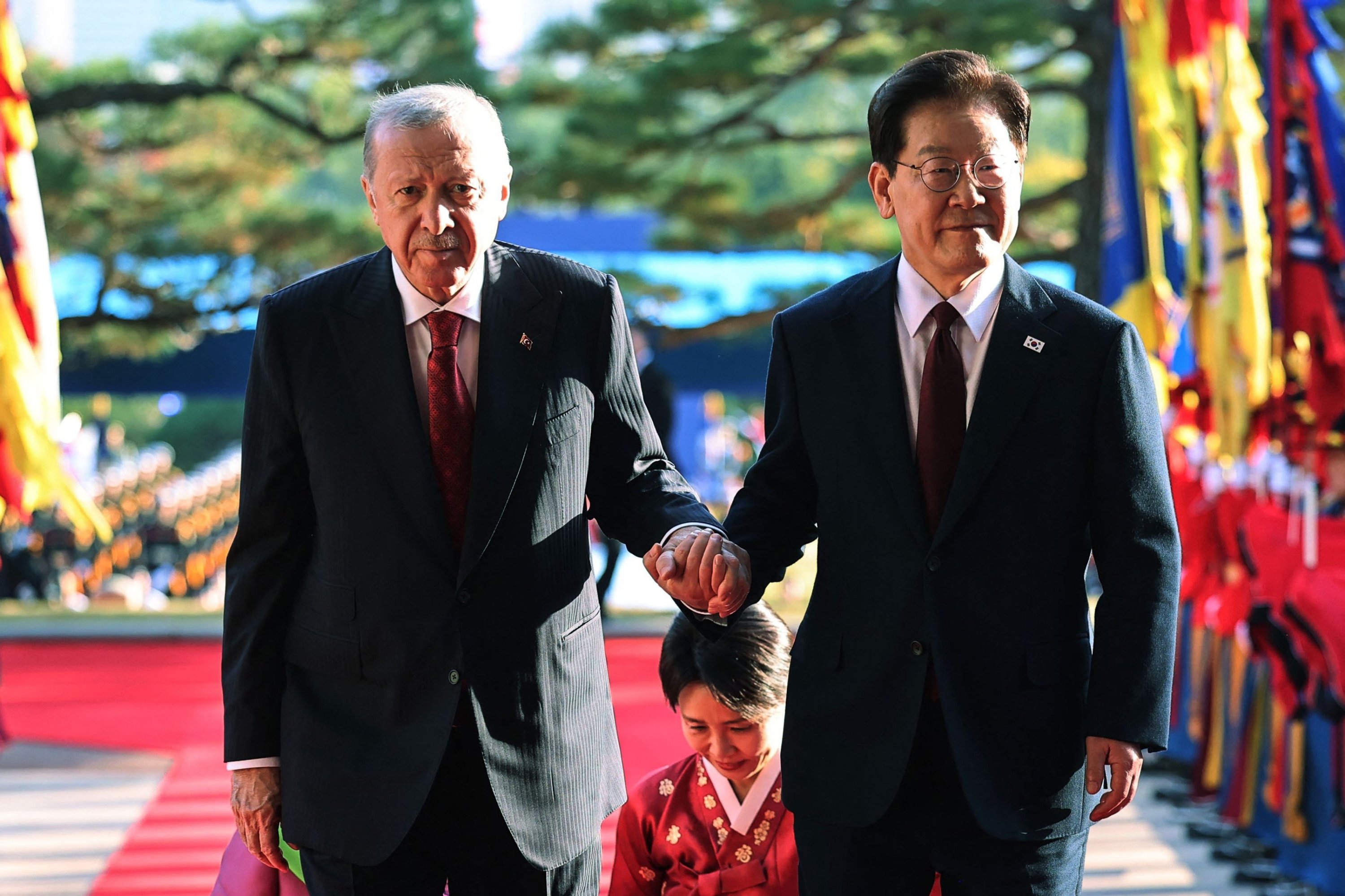
We are in Seoul, South Korea, with President Recep Tayyip Erdoğan's delegation. Last November, South Korean President Lee Jae-Myung paid a state visit to Türkiye and most recently attended the NATO Summit. President Erdoğan, for his part, last visited South Korea in 2018. The Turkish delegation received a warm welcome in Seoul. The streets, where Turkish and South Korean flags fly side by side, also reflect the depth of the historic friendship between the two countries. Discussions of Türkiye-South Korea relations usually begin with an emphasis on the "historic brotherhood" dating back to the Korean War. During this visit, too, the same emphasis came to the fore in the opening remarks.
Relations between South Korea and Türkiye have always been strong on an emotional level. However, given the potential of both countries, this closeness has yet to translate into economic relations to the extent expected.
With the agreement signed in Ankara last year, both countries declared their intention to elevate bilateral relations to the level of a strategic partnership. Türkiye and South Korea have set a bilateral trade target of $15 billion. However, while Türkiye exports $1.14 billion worth of goods to South Korea, it imports $10.26 billion worth of goods from the country. Consequently, bilateral trade remains heavily imbalanced, with Türkiye facing a significant trade deficit.
Koreans generally prefer to approach discussions on foreign policy from an economic perspective. Within this approach, discussions may lead to practical proposals for expanding bilateral trade. South Korea recognizes Türkiye's strength in manufacturing infrastructure and access to regional markets. Korean companies therefore recognize and value Türkiye's considerable economic potential.
The determination to establish partnerships in strategic sectors stood out on the agenda of Erdoğan's visit, which came after an eight-year gap. The four agreements signed during the visit underscore that achieving a more balanced economic relationship is one of the key priorities.
More than 400 Korean companies operate in Türkiye. This represents significant potential. In the new period, it appears that the two countries will prioritize new joint projects that draw on their experience in the areas where they are strong in production.
Among the four agreements signed, the memorandum of understanding (MoU) on science, technology and innovation aims to prioritize areas where the two countries can jointly develop their industrial capacities. Joint battery production, semiconductors and artificial intelligence are the priorities.
The MoU on the financing of the nuclear energy project prioritizes a new investment. Last year, an MoU laying the groundwork for this cooperation was signed between the Turkish Nuclear Energy Company and the Korea Electric Power Corporation. One of the most concrete headlines that also stood out in the Korean press was the nuclear power plant partnership, with the Sinop Nuclear Power Plant mentioned by name.
Another prominent topic was expanding procurement and deepening cooperation on existing defense industry projects. On this issue, Erdoğan said: "The defense industry is one of the foremost areas in which our strategic partnership is producing concrete results. During my meeting with the president, we emphasized the need to increase the number of successful joint projects, such as the Fırtına self-propelled howitzer and the Altay tank." Erdoğan's visit is set to conclude today following a series of one-on-one and group meetings with business representatives.
South Korea is a technologically advanced country, and it stands out in certain fields. Türkiye's progress in various technology fields, notably the defense industry, is also attracting South Korea's interest. It is therefore acknowledged that Türkiye's technological know-how will contribute to South Korea in many areas. Türkiye's weight in both the global and regional systems is particularly emphasized. The diplomatic capacity Türkiye has developed is valued, especially in terms of reaching new markets.