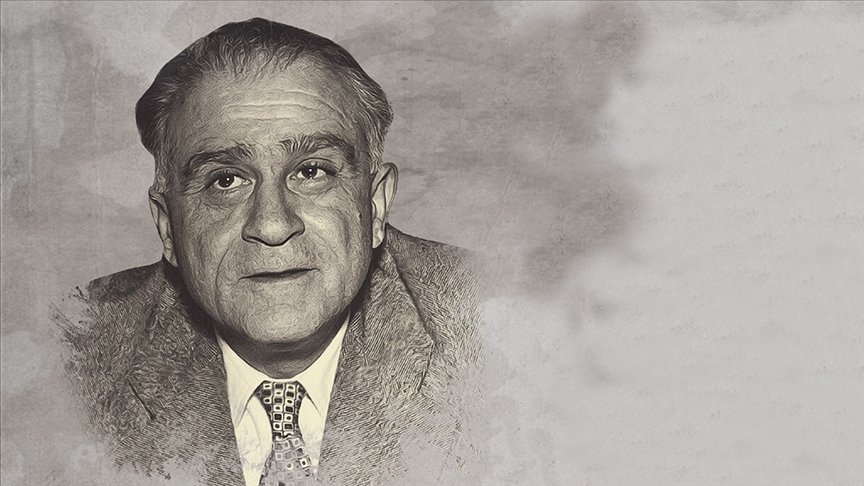
Prominent Turkish author Ahmet Hamdi Tanpınar’s novel "The Time Regulation Institute" tells us much about the transformation of both people and their surroundings in the context of broader societal change. While reading the book, what struck me most was the contrast and ongoing tension between the old and the new, as represented by the characters Hayri Irdal and Halit Ayarcı – their differing perspectives, ways of thinking and approaches to life. Irdal leads a life deeply intertwined with everything from the past – Nuri Efendi, Seyit Lütfullah, Dr. Ramiz, Tunusluzade Abdüsselam Bey, Aristidi the pharmacist, Naşit the hunter, Ferhat Bey and others. His life is marked by poverty and a sense of drifting from one place to another through these connections. What ultimately brings Irdal and Ayarcı together is the clock, though in the new, symbolic sense that Ayarcı attributes to it.
The people Irdal meets through Ayarcı also embody the new meaning that the clock comes to represent – flesh-and-blood manifestations of this redefined value: “His Excellency was by no means the kind of man who would torment himself with matters of the soul or self-discipline, who would blunt his fortune, or renounce the pleasures of this world for the sake of eternal bliss. On the contrary, he was of the sort who seized what pleased him, took it, consumed it, digested it, and then sought something more – and grew irritated when he couldn’t find it...” Upon his first encounter with this new circle, Irdal struggles to adjust to the meaning that this new life imposes upon him – he even finds it unbearable at first: “To be honest, I just wanted to go home. I was tired of this life that didn’t belong to me, of these entertainments. I wanted to return to my home, to myself, to the things that were mine – my sufferings, my poverty.”
In the face of Irdal’s frequent inner turmoil and ambivalence toward his new life, Ayarcı never gives up. He continually urges Hayri Bey to embrace the benefits – and ultimately the meaning – of this new existence: “Poor Hayri Bey, you’re a strange man. The standards you speak of belong to the past. They were, as you just said, letters passed from master to master. But we are no longer living in that classical age.” As Irdal observes the lies and the fictions upon which the new project he is expected to join is being built, he grows increasingly astonished and hesitant. Yet he is not left alone. At each retreat, Ayarcı counters him with a new argument explaining the new logic: “Being a realist does not mean seeing the truth as it is. It means determining our relationship with it in the most beneficial way. So what if you’ve seen the truth? What good does it do to make a heap of judgments that have no meaning or value on their own? What else can you do but compile an endless list of deficiencies and needs? Does that change anything? On the contrary, it diverts you from your path. You become pessimistic, paralyzed, crushed. Seeing the truth as it is... In other words, being a defeatist... Yes, that’s what defeatism is – it stems from this. You are a man poisoned by words; that’s why I said you belong to the past. The realism of the new man is different. The real question is: What can I do with this material, this object, as it is, with its current features?”
And eventually, Irdal surrenders to the new meaning: “Ever since I was born, everyone had been asking me to look through the wrong end of the telescope. I kept refusing. I was stubborn. But what good had it done? My whole life had turned into a mess. What harm could it do to try it their way, just once?” Thus, the Time Regulation Institute project is launched. New buildings, new people, and a new meaning formed around the concept of timekeeping. The project continues to grow. Although the fragility of this new meaning occasionally causes Irdal to hesitate, the abundance, prosperity, and rising visibility in society that come with it are too enticing to ignore:
“Even if I was involved in many lies, there was one undeniable truth – a great truth. The Time Regulation Institute had saved my life.” Consequently, much like the young, ambitious lawyer in the film "The Devil’s Advocate," Irdal begins to fulfill what is expected of him – gradually and with increasing willingness. It is as if Irdal is that young lawyer, while Ayarcı plays the role of the law firm’s charismatic boss (the Devil himself). The dialogues between the two unfold in this very vein.
Of course, the price soon follows. And Irdal begins to resemble Ayarcı: “You’re changing, Hayri Bey, you’re changing... And that’s exactly what should please you the most... A new life, a new man... Since you can’t be born again, you have no other choice.” They begin to complement one another, becoming co-architects of this newly constructed meaning. Still, the fundamental difference remains: while Ayarcı fully believes in the project and the meaning it carries, Irdal never feels quite as comfortable – he continues to question both the work being done and its significance. Yet for Ayarcı, the one thing that is absolutely intolerable is lack of belief. When Irdal objects – “I’m doing everything you ask. Isn’t that enough? Why do I have to believe as well?” – Ayarcı’s response is sharp and unforgiving: “Don’t do anything – just believe. That’s enough for us.”
Still, Irdal continues to carry out most of his tasks without truly believing in them. The work he is asked to write about the life of Ahmet Zamani Efendi – a man who never actually existed – is produced amid these inner fluctuations. Every lie gives rise to new ones: “I had never known a person named Ahmet Zamani Efendi. In fact, I was hearing the name for the first time. ‘Oh Lord, why didn’t you give me my daily bread directly, instead of turning me into a lie invented by others!’ And indeed, that’s what I had become. I was a serialized lie, whose full extent I did not know, encountering a new piece of it every day.” Ayarcı, as always, comes swiftly to his aid: “Everything that has a name exists, Hayri Bey!” he said. “Therefore, Ahmet Zamani Efendi exists. He exists partly because we want him to exist. In fact, now our great patron wants it too. Don’t worry at all... Just work.”
It is not only Irdal – Ayarcı is the one who writes the roles, assigns them, and expects everyone in the project to perform them within this new meaning: “How strange it was – we were all like puppets in Halit Ayarcı’s hands. He would bring us to the point he wanted and leave us there. And then, we would act as if we had memorized our roles in advance. Inside me, rage, hatred, rebellion, and admiration for him all swirled together.” Within his own family, everyone except his son Ahmet quickly adapts to the new situation. They play their new roles with such conviction that even Irdal is taken aback: “There’s something else—everyone around me has changed so much.”
And eventually, Ayarcı confronts Irdal head-on, proclaiming that he has already crossed the critical threshold of transformation and there’s no turning back: “Let me tell you your truth! You can’t go back. Because you can’t give anything up. Despite all your criticisms and disdain, you have a comfortable and lovely wife, a mistress who drives you mad, and I’m sure you’d sacrifice yourself at any moment for your daughter or your son. On top of that, even in matters you consider absurd, you love movement, action. In short, like an octopus, you’ve latched onto the world with countless arms! You can’t detach yourself from anything. So how will you return?"
It is no longer possible to actively participate in the new life while still holding on to the meanings of the old. Irdal feels the pain of this contradiction deeply: “Surely, one of them would eventually suit me, and I would become like those around me. I had to. If I didn’t, living would be too hard.” Yet Irdal still attempts to bargain with life. He wants to enjoy the rewards that come with fulfilling the demands of this new meaning, while also remaining virtuous. But no way of life can tolerate such duplicity. Ayarcı, once again, forces this truth upon him with brutal clarity: “So, you’ve come to bargain! But this is not something you can bargain over! At this table – whether you bet one or a thousand—the winning side always plays on the same terms and loses everything in the end! Gains may be accidental, but what we lose is certain and complete. The moment you enter the game, you’ve lost it. Virtue is not something that can be bargained over.”
And he calls on Irdal to make a genuine decision – if he is truly sincere, then he must stop playing meaningless games: “In this world, no commitment, no attachment comes for free. They all demand the same sacrifice. And one can move from the best to the worst in a single step. Are you willing? Are you backing out?” Of course, Irdal cannot back out.
This time, in the Clock Houses project, it is not Irdal, but everyone around him – except him – who begins to question the meaning they had collectively constructed. And so, the one who begins to question is Ayarcı himself: “How can this be?” he kept saying, “How is it possible? How can people working in the world’s most modern institution, under the most perfect and up-to-date conditions, surrounded by so much innovation – how can they not understand this work? Then what are they doing in the institute? Why did they applaud the new building? Why did they congratulate us? That means – they’re lying!” Ayarcı cannot tolerate the questioning of the very meaning he helped construct: “No,” he said. “You know very well, I no longer have any real connection with the institute. It has renounced me.” And three days later, the order comes: the institute is dissolved.