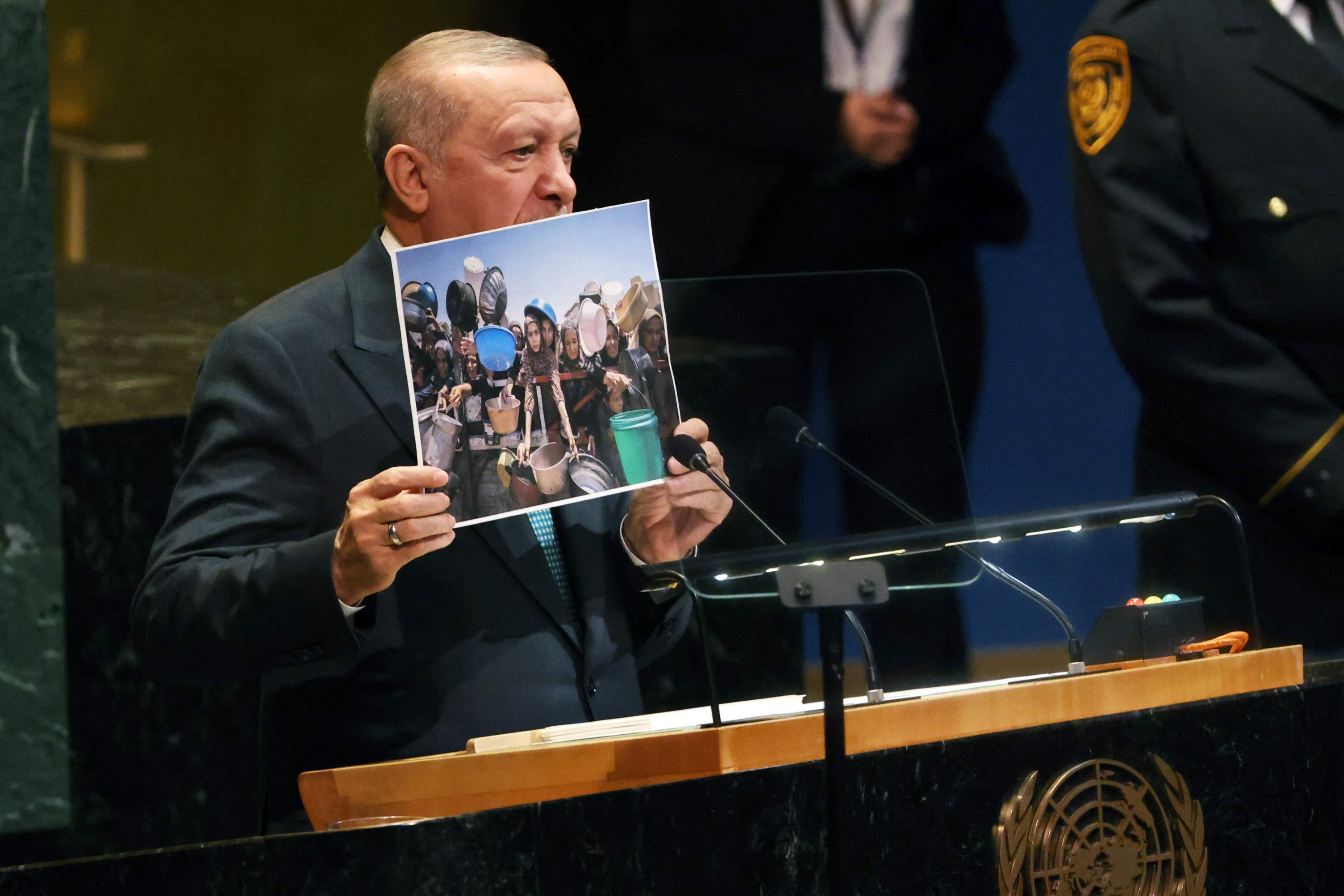
The U.N. General Assembly convened last week, with world leaders addressing humanity from its podium. To condense the entire atmosphere of the gathering into a single sentence: Palestine and President Recep Tayyip Erdoğan's voice echoed through the U.N. assembly, dominating the agenda.
For two years now, the genocide in Gaza has continued. In the early stages, many states were cautious about labeling the campaign in Gaza as a war crime or genocide. But the bandit named Benjamin Netanyahu is continuing to commit violence upon violence, massacre upon massacre in Gaza every day, by turning Israel into an apartheid regime and a mafia state, doing exactly what Hitler did in the 1940s.
Particularly, the U.S. stood behind Israel like a fortress, constantly supplying tons of bombs, providing weapons, and even sending massive bulldozers for the invasion of Gaza. In fact, in one respect, the U.S. has become a powerful supporter and a major partner in the genocide committed by Israel.
Step by step, reactions came from around the world. From Scandinavian countries, European countries, and especially from Islamic nations like Pakistan, Bangladesh, Indonesia and Malaysia, there were collective demonstrations and reactions.
No matter the circumstances, two of the world’s poorest people have openly sided with the war’s victims. On one side, the oppressed in Gaza, and on the other, the destitute in Yemen – one of the world's most underdeveloped countries – did not hesitate to confront Israel.
Amid the ongoing violence, whenever international public opinion has gained momentum and anti-Israel sentiment has strengthened, Netanyahu has responded with even greater severity, escalating the situation. With each surge of global protest, he has attacked a nation and violated its sovereignty.
The most recent attack by Netanyahu, as is known, was directed at Qatar. This assault also served as a direct message to the U.S., conveying the following: "I do not accept the security guarantees you provide to another country. No matter how many trillions of dollars you receive in an attempt to protect Qatar, I will strike it whenever I wish."
In recent months, France and the U.K. have shifted their stance toward Israel. While many question the underlying rationale, the explanation is straightforward: the Israeli state, under Netanyahu, demonstrates no more respect for these former colonial powers – once the world's most influential nations – than it would for an African tribal chief. Israel neither remembers nor respects "the empire, once, on which the sun never sets," nor does it acknowledge its sovereign rights.
The move by the U.K. and France to recognize Palestine, rallying their former colonies beside them, is in part a reflex aimed at proving their sovereignty still exists – and in this regard, they have taken a significant step.
Everyone has now had their turn at the U.N. podium to voice their position. Notably, the prime ministers of Spain and Chile, the leaders of Arab nations, and Syria’s President Ahmed al-Sharaa, among others, have all delivered impassioned speeches condemning Israel and denouncing its actions as genocidal.
Today, friend and foe alike, along with the newspapers of the oppressed and the Palestinian people themselves, are pondering this thought: "There has been no leader who has articulated the Palestinian cause more openly, clearly and comprehensibly than Recep Tayyip Erdoğan."
Recently, the subject of a Nobel Peace Prize has been discussed. While figures like U.S. President Donald Trump often consider themselves worthy during such times, my conviction is that Spain's Prime Minister Pedro Sanchez and President Recep Tayyip Erdoğan currently stand as the two world leaders most deserving of the award.
Just yesterday, the grip of Zionism – which controlled the world's media, commanded vast financial power, and exerted influence over politics and nations like the U.S., the U.K., Germany and France – began to crack.
If humanity is to live in a world of sovereign states, it has now become clear that the Zionist hegemony has been wounded; it can no longer act with absolute impunity.
In the face of Israel's aggressive policies, the people of Gaza, who have defended their land from the very beginning and fought for the rights and honor of Quds (Jerusalem) and Al-Aqsa Mosque, continue their resistance despite having suffered 100,000 martyrs. May God grant them all mercy.
Yet, the sacrifice of these 100,000 martyrs resonated powerfully from the U.N. podium, elevating the Palestinian cause. Within that forum, it was Palestine, Erdoğan and Sanchez who emerged with significant moral authority.
Following the U.N. assembly, a meeting of some Islamic nations – convened with the participation of heads of state from Indonesia, Qatar, Saudi Arabia, the United Arab Emirates (UAE), Jordan, Pakistan and Egypt, and notably chaired by Trump and Erdoğan – transformed into a platform dedicated exclusively to the issue of Palestine.
On every stage, Erdoğan has stood as a defender of the rights of Palestinians, Gazans and the world's oppressed. It is widely believed that this was also one of the central topics of discussion in his bilateral meeting with Trump. And so we conclude with this thought: from the U.N. podium to the White House, the voice of global conscience – that is, Erdoğan – has made its mark.