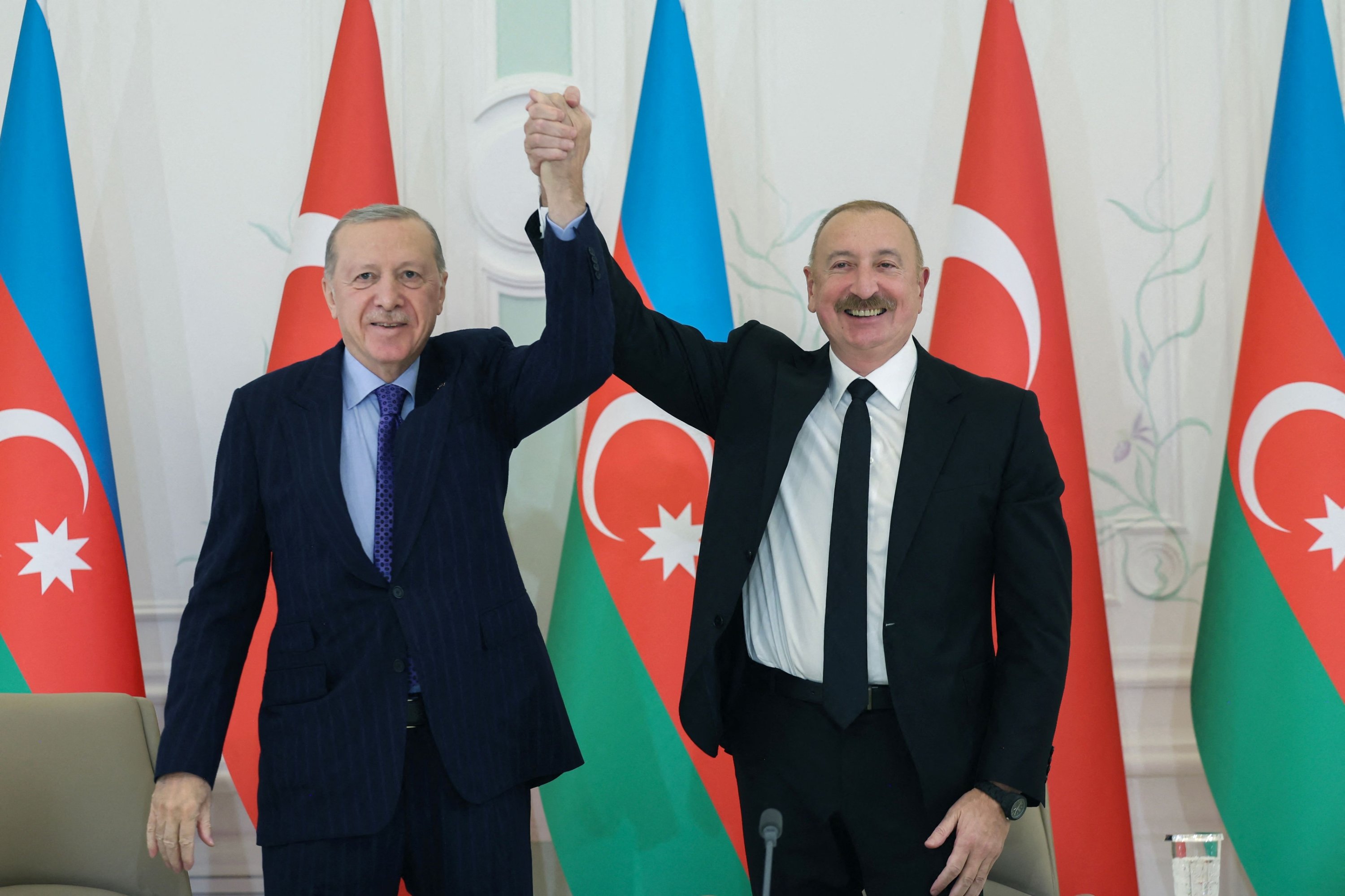
On the sixth anniversary of Azerbaijan’s Victory Day, Nov. 8, I joined President Recep Tayyip Erdoğan’s official delegation on a visit to Shusha. In recent weeks, the bilateral relationship, long defined by the principle of “one nation, two states,” has undergone a serious test. Erdoğan began his press conference by noting this, saying that, “As you all know, relations between Türkiye and Azerbaijan have passed various tests throughout history.” Azerbaijan’s President, Ilham Aliyev, concluded his own remarks with the following words: “The people of Türkiye and Azerbaijan are brotherly peoples. There are no other nations in the world who are as devoted to each other as we are. Nor are there any other states like ours. This is our greatest wealth.”
That the visit would take place in a positive atmosphere was already evident during the welcoming ceremony at Fuzuli International Airport in Karabakh, where Aliyev and his wife personally greeted President Erdoğan and his delegation. The fact that the meeting was taking place in Shusha, a symbol of Azerbaijan’s victory in Karabakh, was itself highly significant. It was here that Türkiye and Azerbaijan had signed the Shusha Declaration, establishing the formal framework for their alliance.
In their respective speeches, both leaders connected past achievements with future responsibilities, emphasizing that the bilateral relationship must be carefully preserved and strengthened. In his address, President Aliyev notably recalled Erdoğan’s support in the early hours of the war. He also underscored that Türkiye’s publicly expressed solidarity with Azerbaijan had given his country strength and encouragement.
It is no secret that recent disagreements between Türkiye and Azerbaijan have made the bilateral relationship somewhat fragile. Unfortunately, some comments on Turkish social media regarding the headscarf ban in Azerbaijani schools were blown out of proportion by certain groups and media outlets in Azerbaijan, which presented these views as Türkiye’s official stance. Moreover, certain circles failed to exercise due care in handling issues concerning the bilateral relationship.
To be clear, the prevalent view in Türkiye was the complete opposite. While AK Party spokesperson Ömer Çelik clearly announced that the social media users targeting Azerbaijan did not act on behalf of his party or the Turkish government, Foreign Minister Hakan Fidan visited Baku, where he advocated addressing disagreements as brothers and sisters, and warned against their exploitation on social media.
In this regard, he conveyed Türkiye’s concerns directly to President Aliyev. Meanwhile, Binali Yıldırım, head of the Council of Elders of the Organization of Turkic States (OTS), reinforced this argument by stating that Azerbaijan, as an independent state, was entitled to make its own decisions. As Erdoğan sought to maintain the positive momentum through phone calls and messages, Türkiye handled the situation with due care and consideration.
Although Aliyev’s decision not to attend the OTS Summit in Türkiye could have further strained relations with Ankara, Erdoğan announced aboard his return flight from South Korea that he would attend the Victory Day celebrations in Azerbaijan, demonstrating his commitment to maintaining and strengthening bilateral ties.
It is important to recall that Ankara’s official position consistently favored containing the disagreement and preserving the alliance. It was no secret that third parties were actively seeking to undermine Türkiye’s bilateral relations with Azerbaijan. It was also clear who would benefit from any deterioration in these ties. All in all, the Turkish leader’s visit marked the official restoration of bilateral relations after several weeks of disagreements. It is also noteworthy that Aliyev has decided to attend the COP31 Summit in Antalya this week.
One can measure the value of a relationship not only by the degree of solidarity shown in difficult times but also by the care exercised in the face of differences of opinion. Erdoğan’s visit to Karabakh has clearly demonstrated this commitment. Now is the time to redouble efforts to bolster mutual trust and further strengthen our fraternal bonds.