Washington is rediscovering an old playbook for Latin America, but it is doing so in an era that looks very different from the days when the United States could reshape the hemisphere at will. The publication of the new National Security Strategy (NSS) reveals a clear ambition: to “restore” U.S. preeminence in the Western Hemisphere, strengthen military presence and prevent China from consolidating economic and technological influence across Latin America. It reads less like a fresh strategic vision and more like a revival of a century-old doctrine, updated for a world Washington no longer confidently dominates.
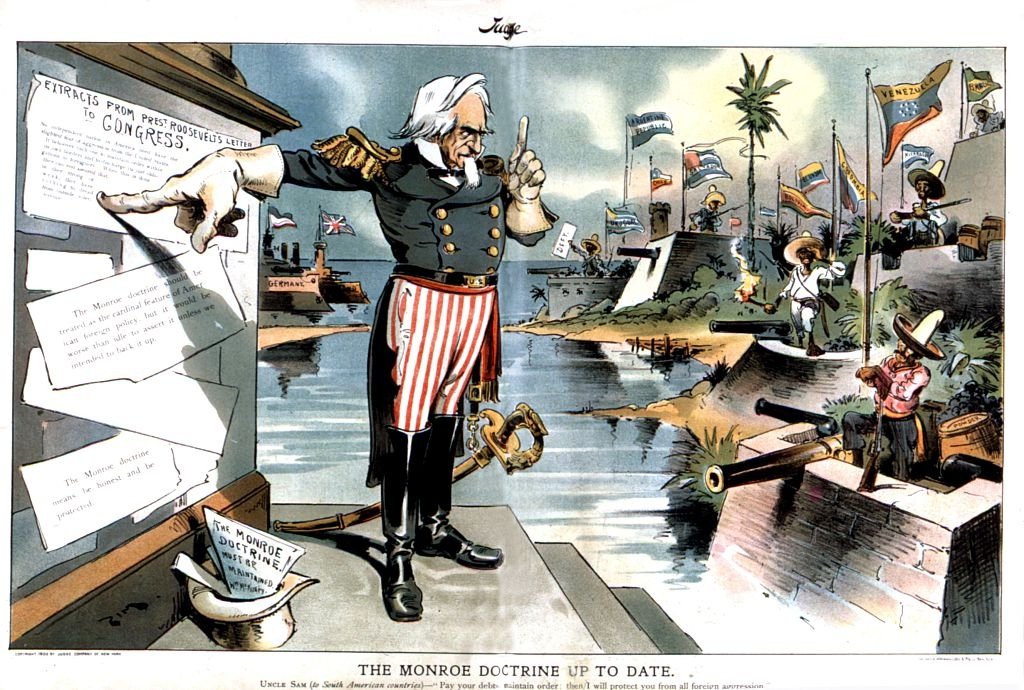
The analogy that inevitably comes to mind is the Roosevelt era. In the early 20th century, President Theodore Roosevelt translated the Monroe Doctrine into practice with a kind of muscular nationalism that combined idealistic rhetoric with interventionist realism. The Western Hemisphere was proclaimed a U.S. sphere of influence, and Washington acted accordingly, deploying naval power, reorganizing economies and redrawing political realities. Roosevelt embodied a style of leadership rooted in personal force and strategic ambition, animated by a belief that American supremacy was both possible and desirable.
Donald Trump is not Roosevelt, and his administration does not operate in the geopolitical landscape of 1905. Yet the new strategy echoes that earlier era in tone and intent. It frames Latin America not as an afterthought, but as a “priority theater” in which the U.S. must reassert its role. It links economic influence, security policy and military tools into a unified effort to shape outcomes in the hemisphere, this time to blunt China’s rapid expansion.
The NSS openly proposes “enhancing military presence,” “establishing access to strategic points,” and, when necessary, “the use of lethal force.” It also emphasizes cooperation with select governments to build regional security capacity. In essence, it is a 21st-century version of gunboat diplomacy, more dispersed, more outsourced, and wrapped in contemporary strategic language, but unmistakably backed by coercive power.
At the same time, U.S. policy is no longer only about projecting force. It is also about controlling markets, resources and supply chains. The strategy explicitly seeks to identify partners for critical minerals, rare earths and manufacturing chains, as well as to redirect Latin American economies toward U.S. technology and standards. This is not missionary imperialism; it is geoeconomic competition. China, not Europe, is now the “external actor” from which Washington seeks to shield the hemisphere.
This marks a crucial difference from Roosevelt’s era. In 1900, the U.S. was rising. In 2025, it is reacting. The first Monroe Doctrine was designed to keep others out of “America’s backyard.” The new one responds to the fact that others – above all China – are already present, financing ports, digital infrastructure, rail lines and energy grids.
In that context, Trump’s assertiveness is less about expansion than anxiety. The U.S. is attempting to reshape a hemisphere it no longer fully controls, while facing partners who increasingly practice strategic hedging rather than automatic alignment. Latin American governments are no longer passive recipients of U.S. policy; they are transactional actors navigating a multipolar world.
Still, the symbolism of a president with a towering persona leading a hemispheric project is hard to ignore. Trump’s style – combatant, theatrical, unapologetically nationalist – carries faint echoes of Roosevelt’s “big stick” approach. Where the comparison breaks down is in institutionalism: Roosevelt built the administrative machinery of American power. Trump challenges and bypasses institutions, acting through personal networks, bilateral deals and pressure tactics.
The result is a doctrine that feels both familiar and transformed. It borrows the swagger and language of primacy, but applies them in a context where U.S. leverage is uncertain, contested and increasingly dependent on economic coercion rather than raw force.
Whether this strategy will succeed is unclear. It may strengthen deterrence and revive U.S. leadership, or it may accelerate the diversification of Latin America’s partnerships, pushing states further toward Beijing. What is certain, however, is that Washington has abandoned the idea that the region will naturally gravitate toward it. Influence must now be asserted, defended and, if necessary, imposed.
The Monroe Doctrine has returned, but this time, not from a position of unchallenged power, but from a fear of losing it.