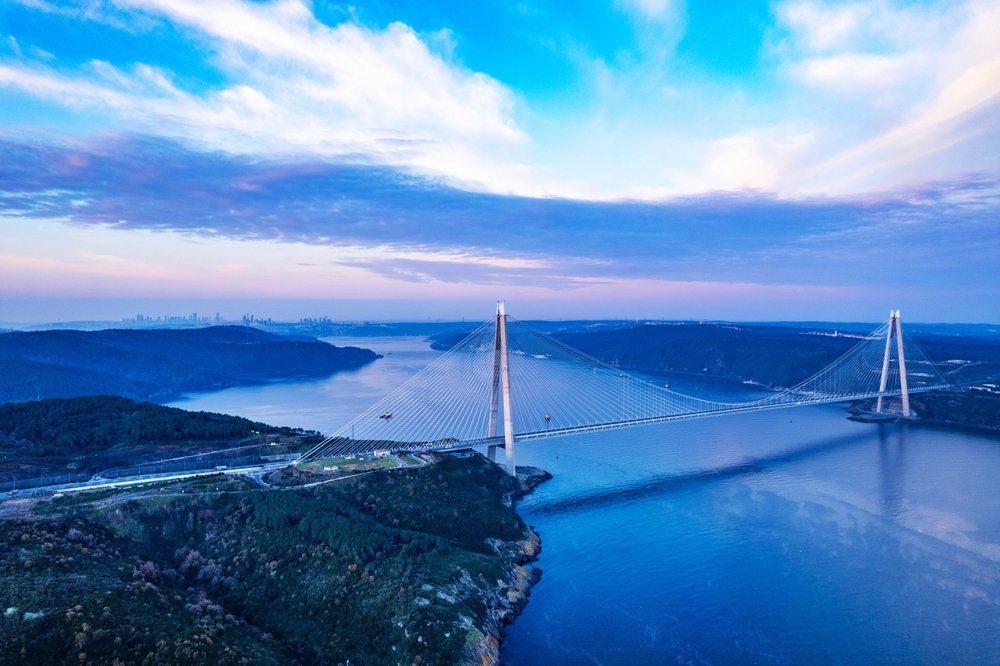
One of the biggest stories to come out of Türkiye this year barely made headlines. In April, Treasury and Finance Minister Mehmet Şimşek signed a massive financing agreement with the World Bank for a railway across the Yavuz Sultan Selim Bridge. It was the third-largest project ever approved in the bank's history and anchors a $6.75 billion (TL 340.15 billion) financing package from six multilateral lenders. There were no crowds and no viral clips, yet few decisions made this year will shape Türkiye's place in the world as much.
In the age of social media and influencers, some developments are destined to receive disproportionately little attention because they are not “sexy.” Railways, ports, agriculture and power lines are mostly left to trade journals. In the long run, however, it is these “unglamorous” things that decide which countries matter.
Here’s a quick recap: In May, the Akhalkalaki-Kars railway was opened to Armenian exports and imports. Armenian Prime Minister Nikol Pashinyan thanked Türkiye and Georgia, and Ankara's special envoy for normalization, Serdar Kılıç, rightly called it a new step in the normalization process.
A few days later, Türkiye, Azerbaijan and Georgia held an official ceremony launching the Baku-Tbilisi-Kars (BTK) railway's operation at full capacity. Meanwhile, in the east, construction continues on the Kars-Iğdır-Aralık-Dilucu line, which will connect Türkiye directly to Azerbaijan's Nakhchivan.
Put these pieces together, and a new map emerges.
BTK was designed as the backbone of the Türkiye-Georgia-Azerbaijan partnership. Its first freight train left in 2017, and today it runs at full capacity. The 224-kilometer (139-mile) line to Nakhchivan, launched in August 2025 and backed by $2.8 billion in green financing, will carry up to 15 million tons of cargo and 5.5 million passengers a year once completed. And the Zangezur Corridor, whose framework was agreed at the Washington summit in August 2025, will link Nakhchivan with mainland Azerbaijan through southern Armenia.
When these links are complete, goods will travel by rail from Central Asia across the Caspian, through Azerbaijan and Nakhchivan, into Türkiye and on to European markets. As President Recep Tayyip Erdoğan has put it, this is not only a geopolitical but also a geoeconomic revolution. Turkish goods will reach Central Asia and China faster, and shipments between Europe and China will pass through Türkiye. For the Turkic world, it also means establishing a physical connection of nations that share a language, a history and a future.
Yet a chain is only as strong as its weakest link, and for years that link has been Istanbul. Today, every freight train crossing between Asia and Europe has to squeeze through Marmaray, the undersea tunnel it shares with commuter traffic, with limited capacity and restricted hours. A corridor stretching from China to Europe cannot rest on a few nighttime slots under the Bosporus.
That is why the Northern Railway Crossing, which will run trains over the Yavuz Sultan Selim Bridge, is arguably the most important piece of the entire puzzle. The bridge was built with provision for a double-track railway, a piece of foresight that is now paying off. The new line will start at Çayırova near Gebze, pass Sabiha Gökçen Airport, cross the bridge, continue past Istanbul Airport and reach Çatalca, where it will join the high-speed line being built toward Europe. By bypassing central Istanbul, the new line will allow round-the-clock freight operations. Once complete, it is expected to carry 30 million tons of cargo and 33 million passengers a year.
The financing tells its own story. Türkiye has secured $6.75 billion from six international institutions led by the World Bank, making this the largest foreign-financed railway project in the country's history. Lenders do not commit such sums to ideas; they commit them to routes they expect to carry traffic. The line will also serve more than the Middle Corridor. It will serve as a gateway for the Development Road, which runs from the Gulf through Iraq, as well as for Türkiye's trade with the European Union. When it opens, a container loaded in the Gulf or in Kazakhstan will be able to reach Europe through Türkiye without waiting for a slot under the Bosporus.
For years, skeptics treated the Middle Corridor as a nice idea that could never compete with sea routes. This year's war between the United States and Iran changed that. When the Strait of Hormuz was effectively closed, freight across Eurasia scrambled for alternatives, and traffic on the Middle Corridor surged. The Asian Development Bank authorized more than $9 billion in loans to develop it. Overnight, a route that avoids Hormuz, the Red Sea and sanctions exposure looked less like an idea and more like insurance.
This is where Türkiye's patient investment pays off. While others debated, Ankara built. Its railways, logistics hubs and political relationships across the region make it the indispensable link between Asia and Europe. In a world of chokepoints, the country that offers a reliable alternative gains weight, not only in trade but also in diplomacy.