The U.S.-Israeli war against Iran is not a crisis that Türkiye can observe from a safe political distance. It is a war unfolding across Ankara’s immediate strategic environment, pressing at once on Türkiye’s borders, economy, diplomacy and internal security. That is why the central question for Türkiye is not whether it has the luxury of disengagement. It does not. The real question is how it can resist the regional logic of war without becoming one of its belligerents. That is the essence of Ankara’s current policy: neither passive neutrality nor military alignment, but a calibrated strategy of non-belligerence, containment and diplomacy.
For many outside observers, Türkiye’s position appears ambiguous because it does not fit neatly into the binaries that usually define wartime alignments. But this is a misreading of Ankara’s strategic environment. Türkiye is a NATO ally, yet it also shares a long land border with Iran. It hosts NATO military assets, yet it also has deep geographic, commercial and political interdependence with Tehran. It opposes destabilizing regional escalation, yet it also understands that the collapse of Iran or the uncontrolled widening of the war would not produce a more orderly Middle East. It would produce a more fragmented one. In this sense, Türkiye’s posture is not ambiguous. It is a response to geopolitical complexity.
This is precisely why the war matters to Türkiye at a level beyond ordinary foreign policy positioning. Ankara is not simply reacting to a conflict. It is trying to prevent the emergence of a regional environment in which insecurity becomes structural, armed non-state actors regain strategic relevance and borderlands once again turn into zones of permanent contestation. Türkiye’s concern is therefore not only the conduct of the war itself, but the political geography it may leave behind. That broader concern makes the postwar reconstruction of the regional security order just as important for Ankara as the ongoing war.
The first reason Türkiye cannot ignore the war is security. The conflict has already demonstrated that it cannot be geographically contained. Missiles have crossed or struck Turkish territory, making clear that Türkiye is not merely a neighbor to the crisis but one of the states directly exposed to its spillover effects. Yet the more consequential danger lies in the way the war is reshaping Iraq and Syria, the two theaters where Türkiye’s strategic exposure is already deepest. Further fragmentation in Iraq would generate exactly the type of hostile and ungoverned environment Ankara has tried to prevent for years. In Syria, the war risks undermining an already fragile transition, complicating the future of the YPG file and reinforcing multi-theater military dynamics that weaken the prospects for sovereign state consolidation. For Türkiye, these are not secondary consequences. They are central security outcomes.
The second reason is economic. Türkiye has spent years trying to restore macroeconomic credibility through disinflation, orthodoxy and fiscal discipline. A prolonged regional war centered on Iran threatens that trajectory directly. Energy prices, transport disruptions, insurance costs and uncertainty around the Strait of Hormuz place pressure on every energy-importing economy, but they matter especially for a country like Türkiye that has been working to preserve a delicate stabilization path. For Ankara, this is not only about managing temporary volatility. It is about protecting the broader credibility of an economic strategy that remains highly vulnerable to external shocks.
The third reason is humanitarian and geopolitical at once. Türkiye is not yet facing a mass refugee emergency from Iran, but Ankara is fully aware that a deeper collapse of Iranian state capacity would create a displacement challenge of enormous scale and complexity. The risk is not limited to Iranians alone. Secondary migration pressures, including populations already buffered inside Iran, could quickly redirect westward. At the same time, the war has already exceeded the limits of a bilateral military confrontation. As Gulf states become direct targets and maritime chokepoints become theaters of coercion, the war turns into something much more consequential: a crisis over the future organization of regional order.
This is why Ankara’s policy must be understood in strategic rather than rhetorical terms. Türkiye is not merely trying to stay out of the war. It is pursuing three interrelated objectives.
The first is to preserve non-belligerence. This means preventing Turkish territory, airspace and political alignment from being folded into the offensive architecture of the war. Ankara understands that once it loses its non-belligerent status, it will also lose its diplomatic flexibility. More importantly, it would expose itself to deeper retaliation and strategic overextension in a war whose political end state remains uncertain.
The second objective is to prevent the full entry of Gulf Arab states as active co-belligerents. Once that threshold is crossed, the conflict ceases to be a contained war over Iran and becomes a broader struggle over the future balance of power in the Middle East. For Türkiye, this would represent a major strategic rupture. A war that fully regionalizes would no longer be manageable through selective diplomacy. It would trigger wider military alignments, deepen great-power intervention and accelerate the militarization of regional politics.
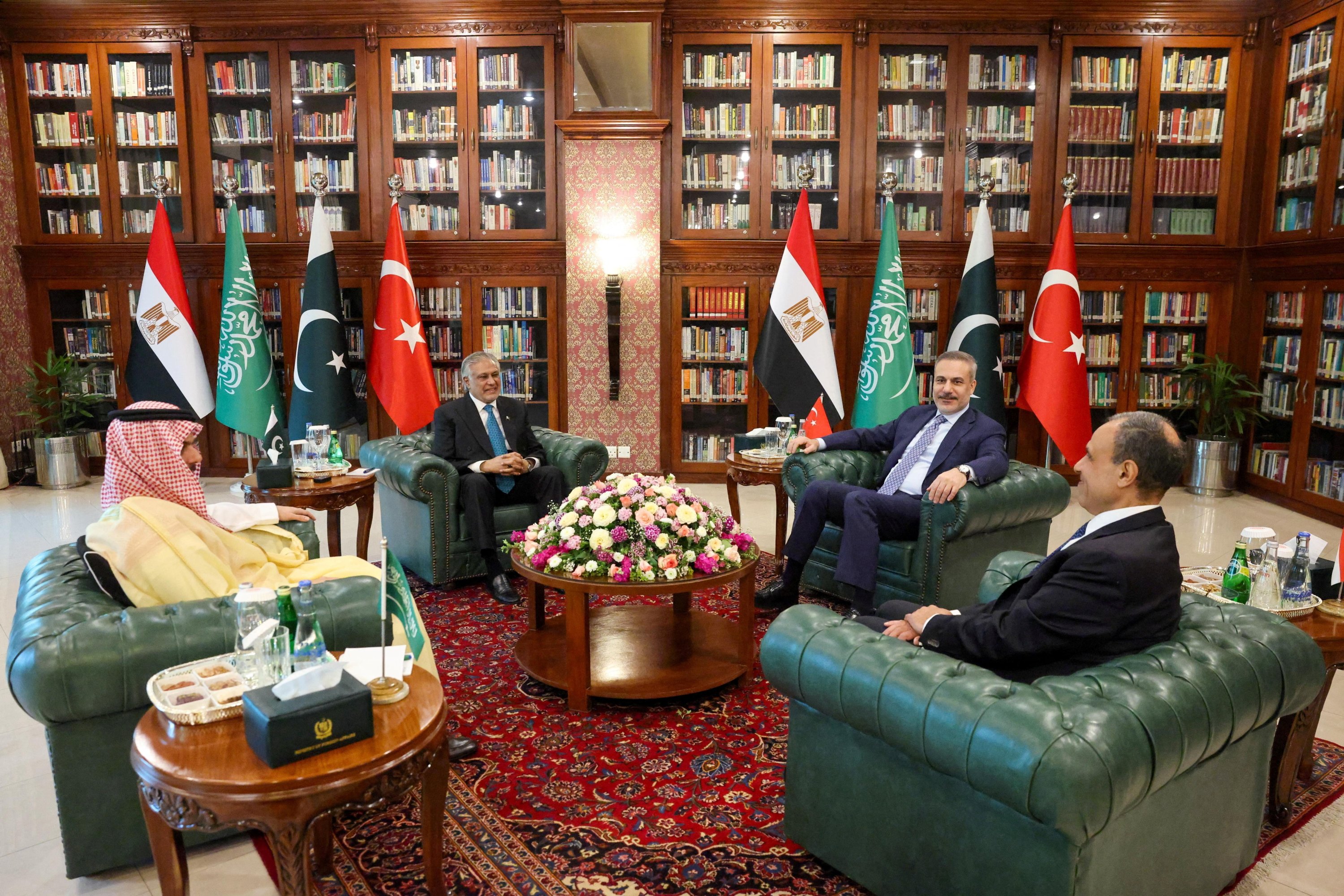
The third objective is to sustain a functioning mediation architecture with actors such as Pakistan, Egypt and Saudi Arabia so that diplomatic channels remain open even as battlefield logic intensifies. This is an important part of Ankara’s strategy because wars of this scale rarely end simply because one side decides to de-escalate. They end when military exhaustion begins to create space for political negotiation. Türkiye is trying to ensure that when such a moment arrives, a diplomatic infrastructure still exists.
Seen this way, Türkiye’s role is not that of a passive middle power calling generically for peace. It is acting as a state that is simultaneously vulnerable to the war and indispensable to preventing its expansion. Ankara cannot force Washington to negotiate. It cannot compel Tehran to step back. It cannot fully determine Gulf strategic choices. But it can do something highly consequential: it can help prevent total diplomatic collapse. In wars of this kind, that function is not marginal. It is often the difference between a conflict that eventually exhausts itself and one that transforms into a new, more permanent regional order built on fear, fragmentation and militarized competition.
This is also why Türkiye’s discourse has combined principle with pragmatism. Ankara has placed primary responsibility for escalation on Israel’s wider military logic while also condemning Iranian retaliation against Gulf states and warning against the further regionalization of the conflict. That dual position is not contradictory. It is what allows Ankara to preserve both moral clarity and diplomatic utility. A mediator without principles has no credibility. A principled actor without diplomatic flexibility has no influence. Türkiye is trying to retain both.
There is often a temptation to interpret Türkiye’s approach through the language of balancing, hedging or ambiguity. Yet none of these fully captures the strategic burden Ankara carries. Türkiye is not maneuvering for tactical advantage at the margins of the conflict. It is trying to prevent a war in its neighborhood from becoming the organizing principle of a new Middle East. That is a much larger challenge. It requires not only crisis management, but also a clear view of the regional order that should follow the crisis.
This brings us to the point that deserves far more emphasis: for Türkiye, the postwar restoration of regional security order is as important as the war itself. The strategic problem Ankara faces is not limited to how this conflict ends. It is also about who will shape the political rules, security arrangements and power hierarchies of the region once the fighting subsides. If the postwar environment is defined by weakened state structures, normalized cross-border strikes, militia empowerment and open-ended external military entrenchment, Türkiye will inherit a far more dangerous neighborhood even if active hostilities decline. A cease-fire alone would not solve that problem. It would merely freeze instability in place.
That is why Ankara’s concern extends beyond de-escalation to the architecture of what comes next. Türkiye needs a regional order in which sovereign states recover political functionality, border security is restored, proxy warfare is constrained and extra-regional military interventions do not become the accepted mechanism for reshaping the Middle East. It also needs a framework in which Gulf security is not permanently separated from the broader question of regional coexistence, and in which Iran’s future is addressed not through state collapse but through a political-security balance that prevents further fragmentation. In Turkish strategic thinking, order is not the absence of conflict in a narrow military sense. It is the restoration of a minimally functioning regional equilibrium.
This is why the Iran war is one Türkiye cannot ignore. Its consequences are already reshaping the environment in which Turkish security, economy and diplomacy must operate. Ankara’s task is therefore twofold: to prevent the war from widening today, and to prevent its logic from defining the region tomorrow.
This is the deeper meaning of Türkiye’s current line. It is not indecision. It is strategic selectivity under extreme pressure. And as the war continues, its real measure will lie not only in whether Türkiye avoids entanglement, but in whether it helps keep alive the possibility of a postwar regional order that is less violent, less fragmented and more politically sustainable than the one now under assault.