The current international environment, marked by intensified global rivalry and uncertainty, the collapse of the world system, and the return of power politics, forces small and middle states to initiate regional initiatives to increase their resilience and deterrence against external threats. Neither the hegemonic powers, the United States, nor the global international organizations, such as the United Nations, can solve regional and global problems. Western countries selectively intervene in international issues. When non-Western powers began to imitate the Western global powers and intervene in the domestic affairs of other states, the global problems rose further.
All these threats and dynamics led to the rise of regionalism and the establishment of regional organizations. There are two ways for states to initiate regional processes. If they share common characteristics, they may come together to establish regional platforms. Alternatively, even without shared characteristics, states can unite around specific common interests. In other words, having common traits is not a prerequisite for initiating regional cooperation.
When examining the main reasons states initiate regional processes, it becomes evident that most regional platforms are driven by economic concerns. Traditionally, most states come together to overcome economic hardships and to achieve economic development. However, recently, with the rise of global instability and uncertainty, security concerns began to dominate regionalization efforts. New types of security threats require new types of regional solutions, decreasing dependence of these states on global powers and increasing their autonomy in international politics.
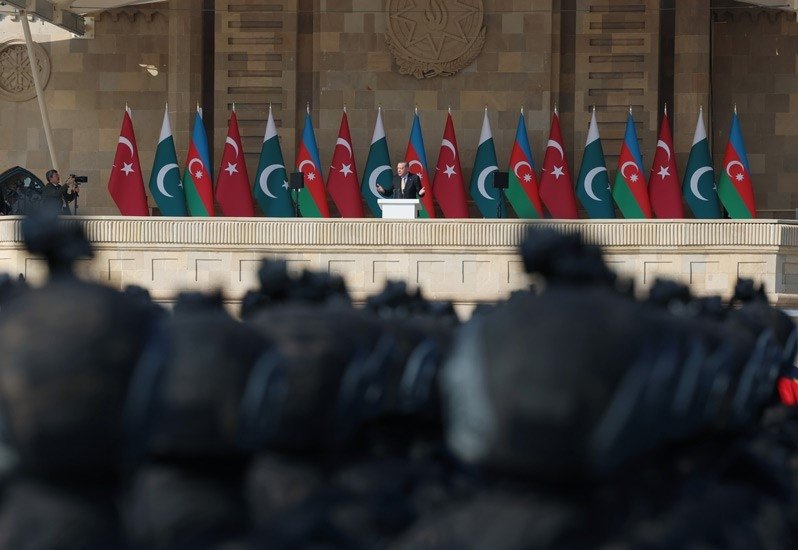
Türkiye, Azerbaijan and Pakistan came together to form a new type of regionalism with a security platform. These three like-minded states initiated a trilateral cooperation platform after the Second Karabakh War in 2020 based on shared identity, strategic concerns and long-term collaboration.
The first concrete step was the Shusha Declaration signed on June 15, 2021, between Türkiye and Azerbaijan. The declaration laid the foundation for subsequent trilateral and multilateral engagements, embedding the region into the broader geopolitical strategies of Türkiye and Azerbaijan. This created a nexus of attraction for other states. Pakistan became the first state to join this strategic alliance.
The most important step was taken when the leaders of three states, President Recep Tayyip Erdoğan, Azerbaijan's President Ilham Aliyev and Pakistani Prime Minister Shahbaz Sharif met in Astana on July 3, 2024, on the sidelines of the 24th Meeting of the Council of Heads of States of the Shanghai Cooperation Organization.
The second trilateral summit meeting was held on May 28, 2025, Azerbaijan’s Independence Day, in Lachin. Erdoğan, Aliyev and Sharif have decided to strengthen regional unity and strategic ties. Three countries have decided to increase their respective trade volumes and to improve their common stance toward regional issues. They have emphasized the importance of cooperation among the three states in the struggle against transnational and regional threats.
The third summit meeting was held on Nov. 9, 2025, in Baku to commemorate the fifth anniversary of the Second Karabakh War and the liberalization of the long-occupied Azerbaijani territories. The joint participation of the leaders of Türkiye, Azerbaijan and Pakistan is an indication of political symbols of trilateral brotherhood.
These three countries developed the strategic, brotherly culture of “three states, one nation,” a symbol of trilateral cooperation. By establishing a strong front of solidarity and a power center, they expressed their intention to develop their capacity for joint action and strategic alliance. In addition, there is no significant negative agenda and no conflict of interest between these three states. Political perceptions of all three countries are quite positive. There is a high level of social congruence and harmony between them.
Ankara, Baku and Islamabad are three complementary states, each having strength in different issue-areas. While Türkiye emerges as a rising star in the defense industry, Pakistan is the only Muslim country that has nuclear weapons. On the other hand, Azerbaijan is an emerging regional economic actor with rich oil and natural gas resources. The three countries are determined to improve their economic relations by setting new targets to increase their cooperation in all economic issue areas.
Furthermore, the three countries decided to achieve a high level of cooperation in the security sector and also to increase their deterrent power against regional threats and global uncertainties. Within this framework, Ankara has been exporting high-tech weapons and ammunition, drones in particular, to the other two states. Recently, Türkiye built a national warship program, MILGEM.
In the near future, the three countries should seek new ways to consolidate their trilateral partnership in key areas such as trade, energy, transportation, education, cultural affairs and defense. For instance, Türkiye and Azerbaijan should invite Pakistan to become an observer member of the Organization of Turkic States (OTS).