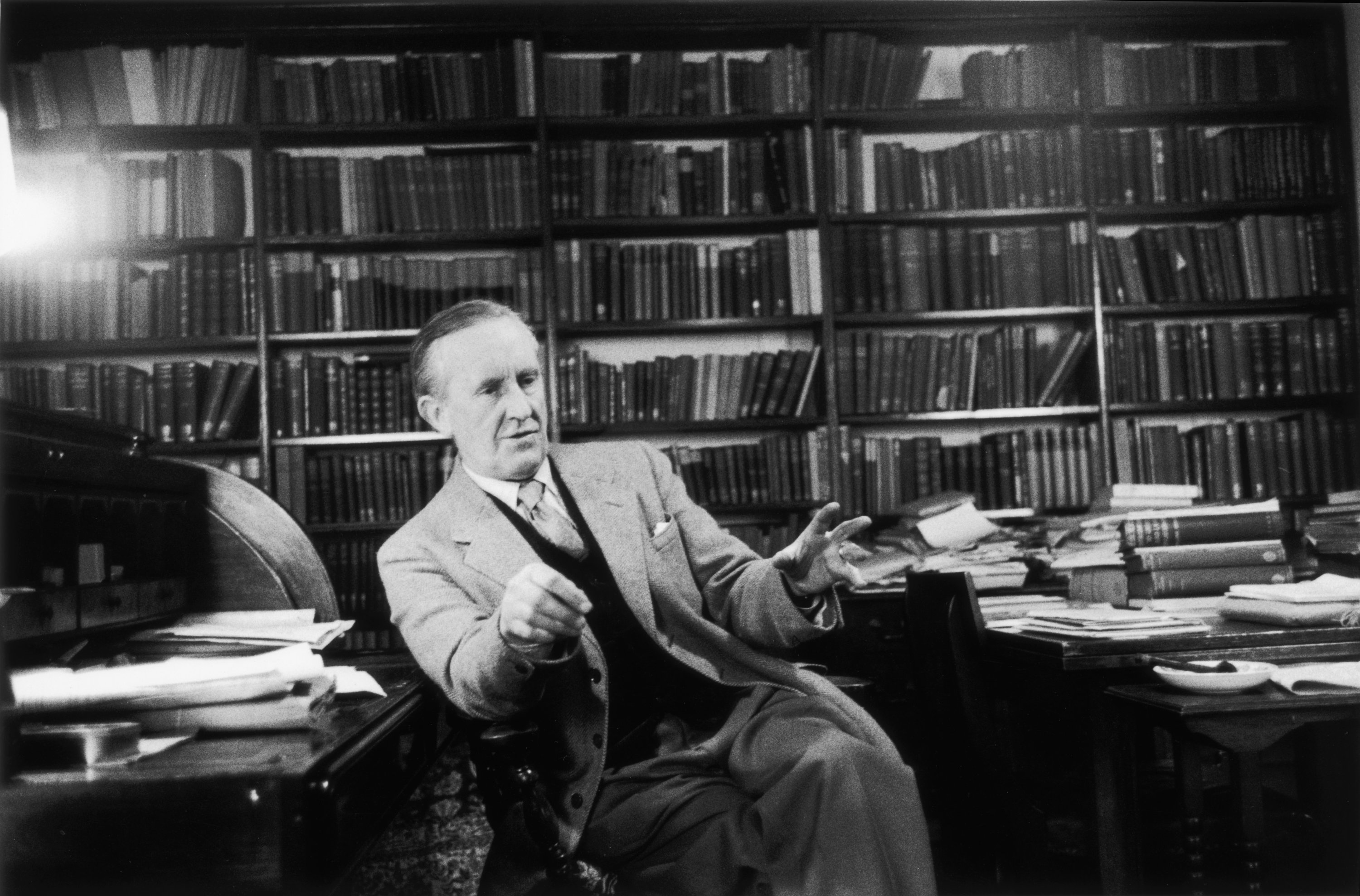
From the early 1930s to the late 1940s, an informal literary discussion group known as the Inklings occasionally gathered in Oxford’s St. Giles district. Comprised mostly of Oxford University dons, they met on Tuesday mornings at The Eagle and Child pub, commonly known as “Bird and Baby,” to debate the world of writing. Here, chapters that would later become best-selling fantasy novels were either praised or subjected to brutal critique. The only rule was to be frank.
Among the group’s brightest minds were J. R. R. Tolkien and C. S. Lewis, who were united in their love of storytelling, myth, epic and many matters of literature. Yet even they clashed over one enduring debate: the “necessity” of allegory.

“I cordially dislike allegory in all its manifestations,” Tolkien famously declared in the foreword to "The Lord of the Rings." For him, allegory was nothing less than “the purposed domination of the author,” an attempt to dictate the reader’s interpretation. A responsible writer, he believed, must only present characters and events with consistency and care, within the natural flow of the story; hence, Gandalf was created as simply Gandalf, not as a symbol or sermon. Lewis and others disagreed, but the conversation stayed where it belonged: within literature.
Not anymore. Once confined to the pages of fiction, allegory has escaped its borders. Today, it fuels political discourses, PR campaigns, social media storms, “cancel culture” and “woke” trends, widely and dangerously. To see why this matters, it helps to start with definitions.
Merriam-Webster defines "allegory" as “the expression by means of symbolic fictional figures and actions of truths or generalizations about human existence.” Britannica defines it as “a symbolic fictional narrative that conveys a meaning not explicitly set forth in the narrative.” Even a quick AI search will tell you it’s “a storytelling technique in which characters, events or settings represent abstract ideas, moral qualities, or broader political, spiritual or philosophical concepts.” In short, allegory belongs to fiction.
But today, fiction-like allegories are widespread in spaces where they don’t belong. On platforms like X, endless floods of posts recast public figures or ideas into symbolic villains and heroes, blurring fact with narrative. Instagram reels deliver the same effect, each one packaged with a “moral” agenda. Reddit is more unfortunate. What should be tools for communication turn into stages for symbolic theater.
Worse, allegory often arrives disguised. News outlets, even reputable ones, sometimes lace reporting with moral overtones and fictional framing. Seasoned readers cross-check headlines across platforms to filter out bias, but allegory slips through anyway, shaping not just what we know but how we’re told to feel about it. The New York Times has recently been at its best.
This leads to the second, even stranger problem: the demand for allegory everywhere. It’s no longer enough to post, speak or write plainly. Your words are expected to “carry a message.” Celebrities know this best. Share a photo of a happy moment without hidden meaning, and you may be accused of being shallow, agenda-less or out of touch. The absurd logic goes: If everything is narrative, then your refusal to spin one is itself a narrative, an unforgivable one.
Ricky Gervais was quite right when he lashed out at allegory lovers, aka the woke, in his opening monologue at the 2020 Golden Globes. “If you do win an award tonight, don’t use it as a platform to make a political speech.”
Call it the “do more” culture. Whatever you do, it must be bigger, deeper, more meaningful, preferably the most meaningful. Even if you win a Golden Globe Award, it is never enough. Life itself is to be staged as an allegory, every action reimagined as a symbol. It is insane.

Together, these two forces (the blurring of fiction and reality and the relentless expectation of symbolic meaning) breed exhaustion. They feed into what is now called “toxic productivity,” the compulsion to produce endlessly, never resting, always under assignment. Open a magazine for leisure, and suddenly you’re dragged into yet another fabricated narrative. Scroll through the comments, and you’re pushed toward the sides of an invented moral battle. You came for a simple read, but you leave with a new burden: to respond, to perform, to produce. You can’t just enjoy The New Yorker, for example.
It’s a treadmill as punishing as China’s notorious “996” work culture (9 a.m. to 9 p.m., six days a week). Allegory, like those endless work hours, demands more, more and more.
And yet, allegory does not belong everywhere. It belongs in literature, where it can be chosen, embraced or rejected. Outside of fiction, life should be allowed to remain literal, unburdened by symbolic agendas. Those who love allegory can find it in writers who wield it openly, like C. S. Lewis. Those who don’t should be free of it.
Tolkien, therefore, was perfectly right.