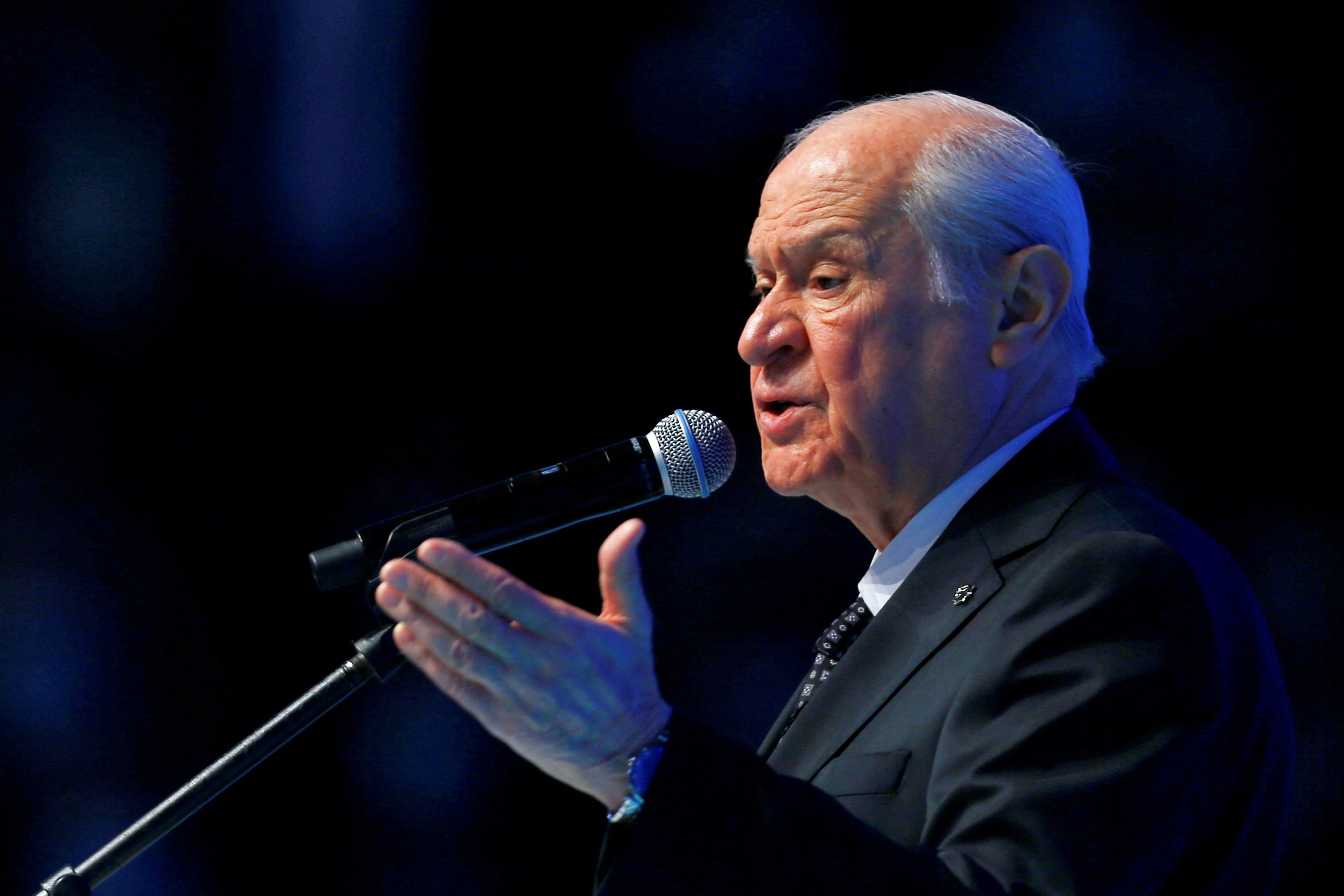
In the last week, a series of events has unfolded in Türkiye. First, the Nationalist Movement Party (MHP) Chairperson Devlet Bahçeli, one of the key partners of the People’s Alliance, made a surprise statement in the Parliament, demanding that PKK founder Abdullah Öcalan, who has been imprisoned in a high-security prison since 1999, call on the PKK to “lay down arms and end terrorism.” More interestingly, Bahçeli suggested that Öcalan should come to Parliament and make this call from the Peoples’ Equality and Democracy Party (DEM Party) party’s platform. This development has led to interpretations that a new process may have begun.
Immediately after Bahçeli’s statement, President Recep Tayyip Erdoğan made a more cautious comment, calling for a continuation of the detente/normalization process he had initiated earlier in a way that would include all parties. Erdoğan has been pointing to regional developments in the Middle East for some time, emphasizing the need to keep the domestic front strong.
While Bahçeli and Erdoğan’s statements were supported by the DEM party, the leader of the main opposition party met with Selahattin Demirtaş, a prominent figure in Kurdish politics, in prison and expressed support for continuing this new political climate.
However, on Oct. 23, a terrorist attack took place in Ankara, targeting Turkish Aerospace Industries (TAI), one of the main companies in Türkiye’s defense industry.
What do we know so far about the TAI attack in Türkiye?
Both terrorists involved in the attack are confirmed PKK members and were recruited within Türkiye. One of the attackers, a female terrorist, previously served as the chairperson of the Peoples' Democratic Party (HDP) (now DEM) in the central district of Hakkari before being recruited by the PKK.
Security sources believe that the attackers had recently entered Türkiye. It is suspected that they crossed into Türkiye from Syria, possibly using paramotors to facilitate the crossing. Both attackers are believed to have undergone specialized training in Syria.
Reconnaissance and surveillance for the attack were likely conducted using digital intelligence methods. It is also suspected that they received precise intelligence on the attack site, though other individuals may have been involved in this aspect.
Targeting TAI suggests that critical defense projects may have been the focus.
The timing of the attack is thought to be a PKK response to recent calls for the group to disarm. Türkiye’s airstrikes are currently targeting YPG military and infrastructure facilities in Syria, with operations expected to continue.
While the DEM party has condemned the attack, signaling support for an internal peace process, it is believed that maintaining this position may prove challenging for the party.
By focusing on the points highlighted above, we can analyze several issues. The first question is whether MHP leader Bahçeli’s call was planned or not.
President Erdoğan’s statements following Bahçeli’s remarks indicate that the government has not decided to initiate a new process. This strengthens the belief that Bahçeli acted independently.
Erdoğan’s call to keep the domestic front strong aims to foster a new era of political and social détente by reducing deep polarization among political actors in Turkish politics. However, Israel’s aggression against Gaza and Lebanon, along with the potential impact of an Israeli-Iranian conflict on Syria, are concerning to Türkiye.
Rather than adapting to scenarios likely to emerge from these developments, Ankara seems to have positioned itself to control the situation directly. The government has not deprioritized the fight against terrorism; on the contrary, after the TAI attack, it appears committed to a more intensive and comprehensive counterterrorism policy.
The solution/peace process (2013–2015) aimed for the PKK to finally give up its armed struggle and lay down its arms. This process was intended to end the PKK’s armed activities and find a peaceful solution to the Kurdish issue. Abdullah Öcalan, the PKK’s founding leader, called for a cease-fire from prison in 2013, and the PKK began withdrawing from Turkish territory. The government engaged in discussions with Kurdish political representatives and civil society organizations. The most critical part of the process was direct negotiation with the PKK.
However, by 2015, the process collapsed due to both domestic political developments and the impact of the Syrian conflict. Following a terrorist attack against two Turkish police officers, the government launched large-scale military operations against the PKK, and the conflict resumed.
There were many reasons behind the failure of the resolution process. Among the most important are the following: the lack of a comprehensive roadmap for a final solution, public opposition to negotiations with the PKK, lack of support from opposition parties, failure to take timely constitutional steps, the PKK’s view of the 2011 uprisings in Syria as an opportunity for the PYD and YPG to gain influence there; the PKK’s maximalist demands; the PKK’s policy of arming itself, radicalizing civilians and creating alternative power structures against state and security forces through youth organizations in many southeastern cities in Türkiye, despite the ceasefire; and failure to involve the Parliament in the peace process.
Considering the lessons learned from the peace process between 2013 and 2015, it seems unlikely that a new process will be similar. One of the most important reasons is that the government does not define the events of recent weeks as a new process. However, it is also evident that a strategic roadmap to simultaneously address constitutional and legal conditions, social and political conditions, intelligence mechanisms, security and military conditions and, most importantly, the dynamics created by regional and international actors have not yet been formed.
Another reason is the PKK’s stance. The terrorist attack on TAI shows that the PKK has no intention of laying down its arms and ending terrorism. Even if Abdullah Öcalan calls for disarmament, disagreements within the organization may prevent the continuation of a new process. In terms of Kurdish politics, there are also serious limitations on the DEM party’s autonomy from the PKK. The DEM party’s failure to sign the parliamentary condemnation of the TAI attacks illustrates these limitations.
On the other hand, the continued PKK presence in Syria seems to be one of the most significant obstacles to a new peace process. For example, even if the PKK disarms in northern Iraq, it is unclear how PKK elements within the YPG could be separated.
The main weakness of any new process may be social support. Gaining social support for a new process could prove challenging for all political parties.
Given the above, there are serious obstacles to launching a new process, and these obstacles are unlikely to be overcome in the near term.