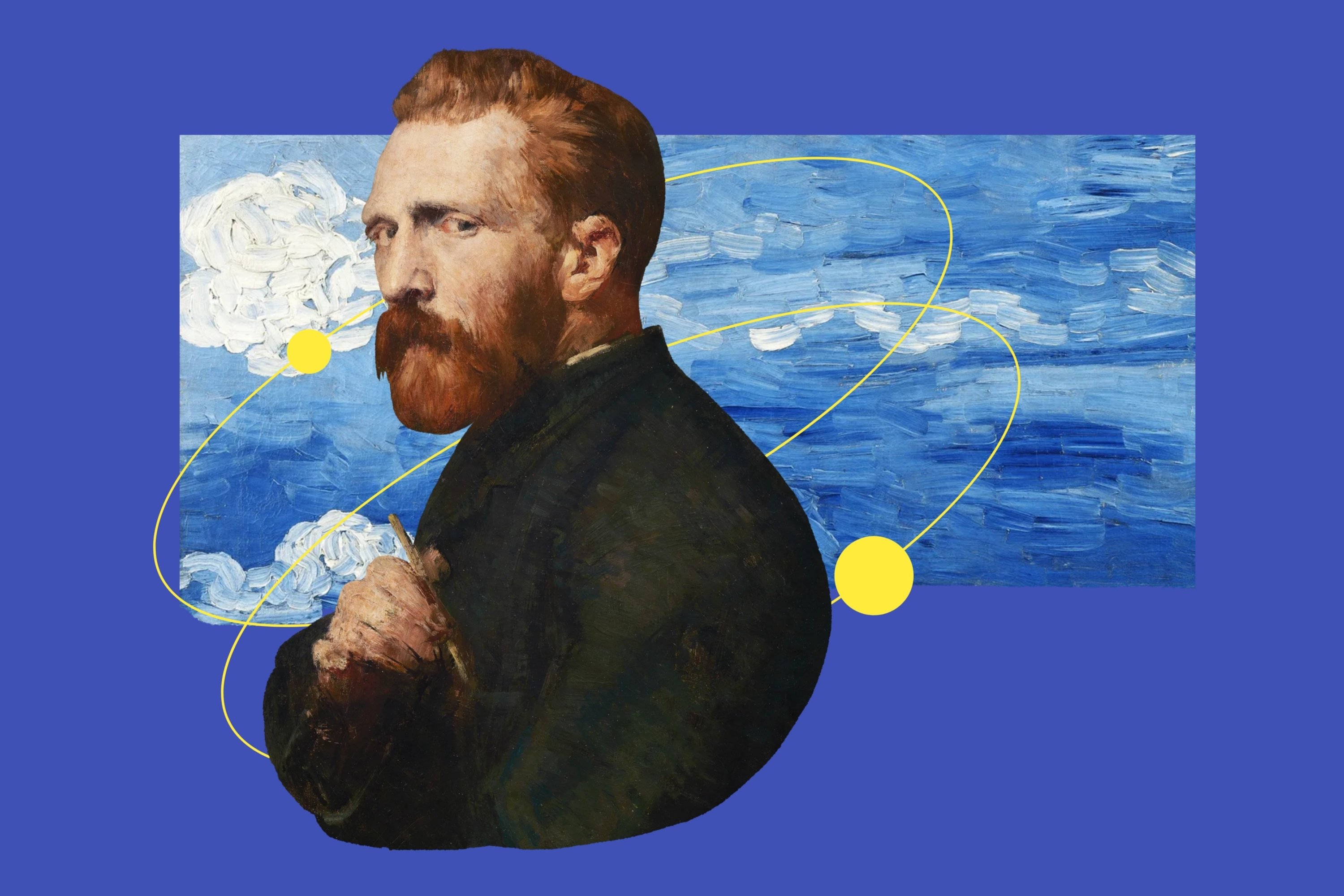
Vincent Van Gogh is an important painter whose life was marked by drama, and his works have often been interpreted through the lens of his personal struggles and the tension between madness and genius. Although he was the son of a pastor and a highly productive artist, Van Gogh hardly sold any of his paintings during his lifetime. Moreover, despite the fact that his brother Theo was a successful art dealer in Paris, this situation did not change. While Theo was generous in covering his brother’s expenses, he did not – or could not – show the same generosity when it came to commercializing Van Gogh’s works.
Costantino D’Orazio, in his book "The Van Gogh Mystery," offers an opening into this enigma by drawing on the diary of Van Gogh’s nephew – who shared his name – as he visits the places his uncle once passed through, searches for traces of his uncle’s memories, and reflects on the connections between his life, letters, and paintings, as well as the reasons behind his commercial failure.
Van Gogh did not receive any serious formal training in painting. His attempts at education consistently ended in failure. Yet he never gave up drawing, especially the nature studies to which he was passionately devoted. As his nephew describes, he continued to dig – with patience – the pit in which he would lay the foundations of his artistic career: “So, you see that I am working diligently, but for now I have not achieved very satisfying results. Nevertheless, I hope that these thorns will eventually blossom, and that this seemingly barren struggle will be nothing other than a labor of creation. First pain, then joy.” However, for Van Gogh, fate had only pain in store.
For Van Gogh, the people living on the margins of life – forgotten and worn down – were just as important as nature itself. Life pressed upon them and deformed them. He sought out “people whose faces bore the traces of the difficult lives they had endured.” Van Gogh wanted to capture the energy of their suffering, their deformation: “He wants to grasp and paint the deformations in them, because these deformations reveal the conditions under which they live. What interests Vincent is pain.” Thus, Van Gogh did not merely want to paint. He sought to capture the emotions reflected in the image: “I want to make drawings that reveal the essence of people, the essence of things.” In attempting to do this, he drew the same subject countless times, trying to grasp the transformation of pain over time or perhaps to touch the essence that does not change with time: “I hope to be able to draw the cradle insistently, a hundred more times.”
In doing this, his greatest aid was not technique but color. Colors helped Van Gogh touch the essence of nature, natural events, and human lives: “For example, it is impossible to say how many greenish grays there are, because the variations are endless... And to grasp this clearly is more valuable than having more than seventy tubes of paint; because with the three primary colors plus black and white, you can obtain more than seventy different shades and tones.”
The pain he sought first manifested in his own life. As his life became enveloped in suffering, it became much easier for him to empathize with these marginalized groups and to capture the sorrow and anguish in their lives. As his nephew describes, his relationship with painting acquired a mystical atmosphere: “Van Gogh experiences a kind of intoxicating satisfaction in close contact with nature and natural phenomena.” Perhaps the more accurate expression is a state of ecstasy (vecd). So much so that “from time to time, a kind of sigh or groan must escape from that pile of wood.” When he painted the weavers, he was trying to bring that sigh and groan onto the canvas. Naturally, he first had to feel them himself. As his nephew emphasizes, “He did not merely paint it; he lived it." Or, as his nephew notes elsewhere, “Van Gogh is a sponge that transforms what he observes into a new form with incredible immediacy.”
This state of ecstasy would exhaust Van Gogh at the end of every painting attempt and intensify his pain. As his pain increased, whether he was observing nature or a group of people, his penetration into the inner essence of what he saw on the surface deepened. Van Gogh tried to carry the inner world into the outward appearance. It is no coincidence that he painted nature and vulnerable people whose lives were exposed to hardship. In both cases, beneath the visible lay an intense, swirling energy and powerful tensions. Van Gogh was captivated by this motion. His fascination with colors, their mixtures, and their brightness levels was likely connected to his concern with expressing this very movement. As his nephew put it: “Once again, the objects being depicted are unnecessary. What matters is the colors.” What is hidden becomes visible through colors. Therefore, there is nothing strange about Van Gogh seeing the night as richer than the day in terms of color – quite the opposite of convention: “Often, my impression is that night is richer in colors compared to the day.”
During his brief time together with Paul Gauguin in Arles, this difference became even more pronounced. In a letter Gauguin wrote to Theo, he revealed clues to this contrast: “In Arles I feel like a foreigner; I find everything small and miserable, the place and the people ... As for colors, he seeks, like Monticelli, the randomness of thick paint. As for me, I detest technical confusion.” Gauguin is a man of the surface. He grows weary of small towns. Van Gogh, however, is not confined to the surface. He clings to the outward appearance only to reach the inner realm, which he then experiences in a state of ecstasy, overflowing with emotion.
As his nephew puts it: “Perhaps we can see Vincent, so to speak, more as a Symbolist artist: Symbolists are visionaries who, while painting what they see, ponder its hidden meaning. Their images are doorways to other worlds.” For this reason, while technique matters for Gauguin, it is color that matters for Van Gogh: “He allows errors in composition, because the power of his painting lies not in form, but in the colors, which become increasingly arbitrary and intense at every moment. ... Everyone would fall into a kind of delirium before these color vibrations. Van Gogh is already the victim of such a state.”
Attaining the state of ecstasy requires complete devotion: “Even at family dinners he eats in his own way: sitting in a corner with his plate on his lap, lost in thought before the canvas he has just painted and propped against the chair in front of him. Squinting his eyes, he measures with one hand while bringing food to his mouth with the other. As he had done since childhood, he cuts the bread he eats dry into large slices. He prefers to pour his own tea or coffee. Immersed in his thoughts, he does not even notice what he is eating. All he thinks about is how to create contrast between one color and another, and how to find a balance between colors and figures.” Or as he wrote in one of his letters: “When I receive money, even if I haven’t eaten anything for days, my first hunger is not for food: my urge to paint is much stronger, and I immediately go hunting for models until I spend my last penny.”
Van Gogh’s mystical relationship with painting eventually evolves into a different level. When he connects with the essence he tries to capture, the painting releases itself, as he puts it: “I exaggerate, I sometimes make changes in the subject, but in the end I never invent the whole painting. On the contrary, I find it already made in nature; but it needs to be released.”
We see the same level of experience in Michelangelo, not with painting but with sculpture. Michelangelo also believed that the story was not in his mind but hidden inside the marble, and that when a strong bond – or a state of ecstasy – was established with the material, the story within the marble would reveal itself to him. Thus, he believed that he only had to work persistently to extract the meaning embedded in the material: “At that time, a new belief about my work began to grow within me. Until a few years earlier, I had always perceived sculpture as a physical activity, a struggle between my body and the block of marble. I used to instinctively attack the stone, which yielded obediently to my strikes. After seeing the Laocoön, I realized that the sculptor’s task was something different. The sculpture was already inside the stone, like a fetus inside a woman’s womb: I had to grasp it and pull it out with the chisel. I could only do this by following the signs coming from the mind. What figures had I seen in the marble blocks waiting for my intervention? What stories did they have to tell me? I only needed to allow these to come out.”
It is impossible for someone like his brother Theo, an art dealer, to truly understand Van Gogh. For this reason, a sentence in his last letter to Theo hangs in the air like a cry: “What do you want from me?”