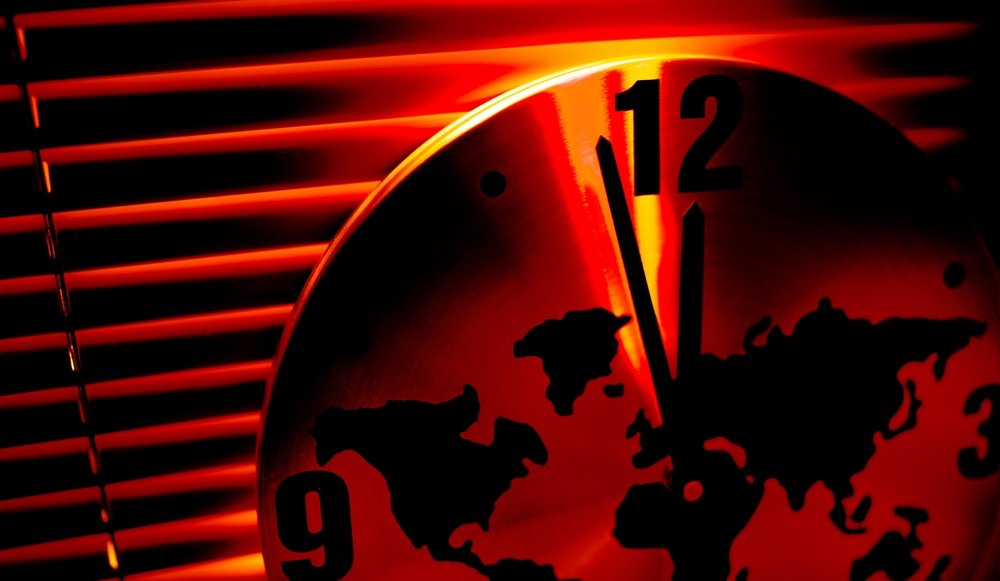
When I sat in my elementary school gymnasium decades ago in Canada, a burly guest speaker placed a wooden clock on a table and set it at three minutes to midnight. As it ticked in eerie silence, we watched without moving. Tick. Tick. Tick.
When time ran out, he raised a hammer and smashed the clock into pieces. “There’s no time left!” he cried. Some children cried. Others stared in shock. I never forgot that moment. Today, it feels frighteningly close to reality.
Originally conceived in 1947 by the Bulletin of the Atomic Scientists, a collective of deeply concerned nuclear experts, the Doomsday Clock was designed to measure humanity’s proximity to global catastrophe, particularly nuclear annihilation. The closer the clock moves to midnight, the more imminent the existential threat becomes. Recognizing that danger in the modern era extends beyond weapons alone, the Bulletin wisely expanded its calculations in 2007 to include climate change as a central driver of planetary risk.
Today, the clock endures as one of the most powerful symbolic warnings in global politics, provoking urgent conversations about the interlocking crises confronting humanity from nuclear escalation and environmental collapse to emerging technological threats. Its annual time setting is not arbitrary. It is determined by the Bulletin’s Science and Security Board in consultation with its board of sponsors, a distinguished group that includes more than a dozen Nobel laureates alongside leading international experts in critical scientific and security fields. Collectively, these individuals represent some of the most informed minds on existential risk anywhere in the world, wisdom that demands serious attention.
Recently, on Jan. 27, 2026, the Bulletin of the Atomic Scientists set its symbolic Doomsday Clock at 85 seconds to midnight, the closest it has ever been to catastrophe since its creation in 1947. Midnight represents existential annihilation, and 85 seconds is the expert judgment of how precarious our world has become.
This near-apocalyptic setting is not a prediction of inevitability. It is a warning that reflects the convergence of multiple, intensifying crises. The first and most obvious is nuclear risk. Russia’s war in Ukraine continues to loom as a persistent threat, and tensions involving nuclear-armed powers, including the United States, China, India, Pakistan and North Korea, have escalated. The expiration of key arms control treaties and the fraying of diplomatic restraints have revived fears of a destabilizing arms race.
But the clock now accounts for more than atomic fears. It also integrates the existential danger of climate breakdown, which is no longer an abstract threat but a lived reality: fires, floods, droughts and melting ice are rewriting the map of possible futures. Rising global temperatures and record greenhouse gas levels are not just environmental headlines. They are drivers of mass displacement, conflict and food insecurity.
And then there are disruptive technologies. Unregulated developments in artificial intelligence (AI) technology, woven into every aspect of social and political life, amplify misinformation, erode trust and stoke division. As Nobel laureate Maria Ressa has warned, we are living through an “information Armageddon” where facts themselves are contested, making collective action increasingly difficult. Biotechnology also presents a dual-use danger: life-saving on the one hand and potentially devastating on the other. The global community remains poorly equipped to govern the ethical boundaries of powerful new biological capabilities.
This is what the Doomsday Clock measures: not just the likelihood of a single catastrophic event, but the erosion of global systems designed to prevent one. It reflects not only bombs and emissions but the breakdown of cooperation, the starvation of truth, and the abdication of moral leadership.
Across the globe, political forces are exploiting fear and identity to normalize violence. In Palestine, extremist rhetoric has given way to genocide. Communities that have endured decades of occupation now face an existential threat that should alarm every champion of human rights. In the contested region of Kashmir, Hindutva nationalism has fuelled repression and earned repeated warnings from international human rights groups. The Rohingya of Myanmar have already suffered genocide, and genocide denial persists in Bosnia-Herzegovina. From Yemen and Syria to Sudan and Afghanistan, unresolved conflicts continue to tear at the fabric of humanity. All of these crises are interconnected. They are not isolated tragedies, but symptoms of a global order, as Canadian Prime Minister Mark Carney loudly declared a "rupture."
Yet history also offers reason for hope. In 1991, after the Cold War’s darkest years, the clock moved to its farthest point from midnight – 17 minutes – after the United States and the Soviet Union reduced their strategic nuclear arsenals. In 2016, the clock was pushed back to three minutes before midnight following diplomatic achievements on nuclear limits and climate cooperation. When leaders chose negotiation over brinkmanship, the world became measurably safer. What we see today is not an inevitable destiny. It is, rather, a failure of political will.
A failure to bridge divides. A failure to confront humanity’s gravest threats with the urgency they demand. A failure to integrate ethical vision with scientific advancement. We cannot fix what we refuse to acknowledge. The Doomsday Clock is a call for agency, not a call for panic.
It demands renewed commitment to nuclear disarmament, sustainable climate action and international cooperation. It demands investment in ethical governance of technology and biosecurity. It demands that leaders recognize our shared stake in human survival and the power of collective decision-making. But most importantly, it demands action from us, the people.
History shows that collective pressure from citizens has forced profound change. The civil rights movement did not wait for courtesy. Apartheid did not collapse through silence. Colonialism did not end without persistent, global resistance. We must refuse to treat catastrophe as normal.
The clock is now at 85 seconds to midnight, closer than ever before. The question is no longer whether danger exists. The question is whether we will act together, decisively and with moral clarity before time truly runs out.