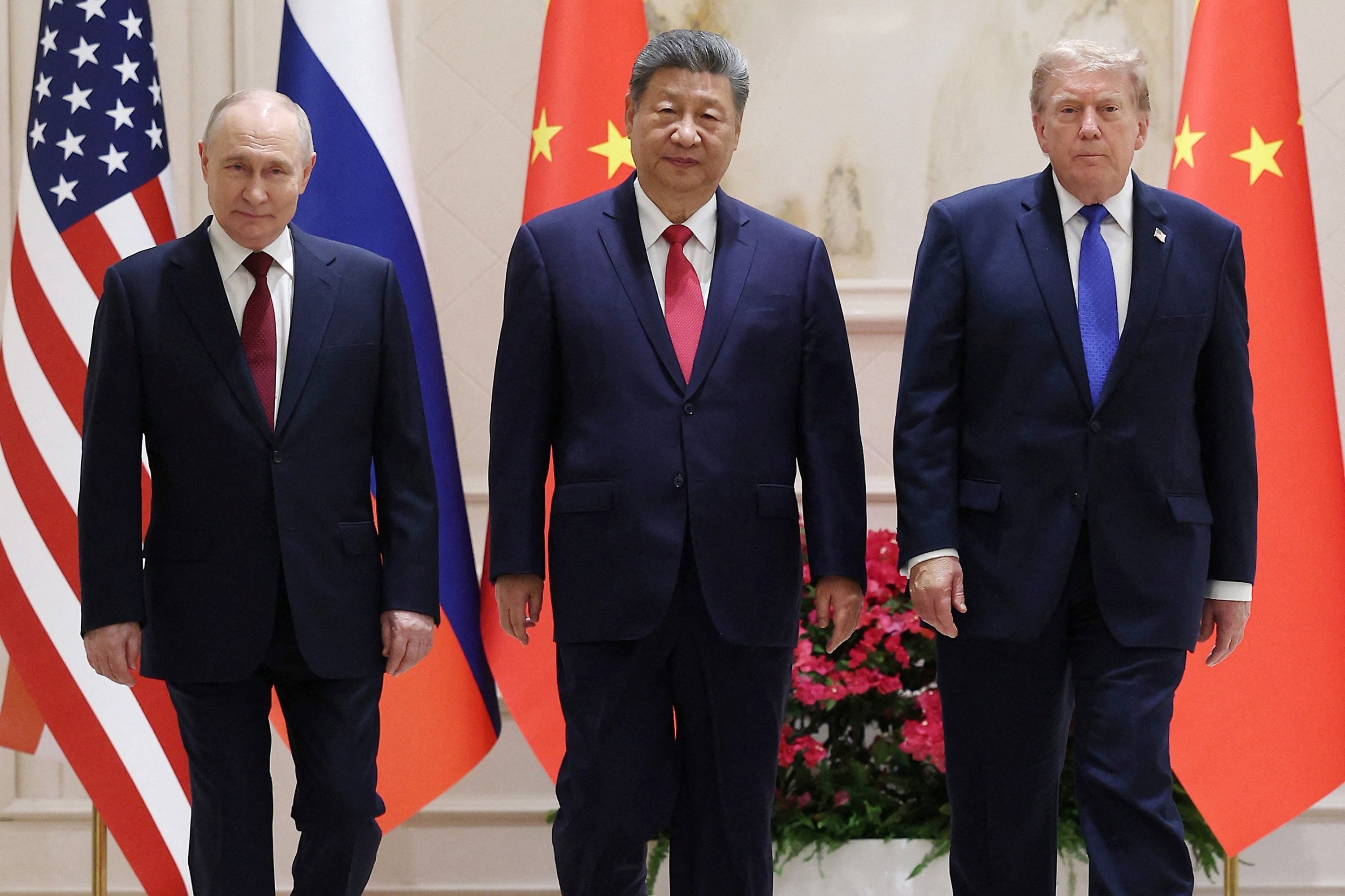
U.S. President Donald Trump, Chinese President Xi Jinping and Russian President Vladimir Putin’s meeting in Shenzhen prompted speculation about a new division of the world. While some anticipated a Yalta-style bargain over spheres of influence and regional wars, the summit produced a more limited outcome, establishing common ground on energy supplies, nuclear risk reduction and international institutions. The question now is what concessions will be needed to turn those commitments into policy.
An agreement on spheres of influence appears unlikely since the powers remain divided over Taiwan, Ukraine and Iran, while the countries concerned retain their own security interests and political choices.
Xi’s remarks offered the clearest account of how Beijing wants this relationship to work. He called on the three countries to respect one another’s sovereignty, territorial integrity and core interests, and to avoid crossing red lines on sensitive issues. He also urged closer communication and coordination to keep energy supply chains stable and uninterrupted.
These messages reflect China’s interest in preserving the conditions that allow its rise to continue. Direct conflict between major powers, disruptions to energy supplies and interruptions to trade would threaten Chinese growth. Xi was advocating for relations with Washington and Moscow that would minimize these risks and safeguard China’s continued growth.
Putting mutual respect into practice will be difficult. A demand one country considers essential to its security can restrict another’s freedom of action. China’s expectations over Taiwan affect America’s regional relationships and security commitments. Russia’s demands over Ukraine directly concern Kyiv’s sovereignty and European security. Acknowledging another government’s concerns is easier than taking the steps it wants.
The two leaders arrived in Shenzhen with different burdens. Putin is carrying the military and economic costs of the war in Ukraine, while Trump is dealing with the conflict with Iran. However, Xi has greater room for maneuver, having kept China outside both wars while continuing to develop its industrial and technological capacity.
In this respect, China recalls the United States in 1945. America fought in World War II, yet its industrial expansion gave then President Franklin D. Roosevelt considerable influence over the post-war settlement as European powers struggled with widespread destruction. China is now bringing its accumulated economic strength to negotiations with two powers burdened by war.
Xi’s meetings illustrated this advantage. He discussed economic relations with Trump while hosting the American and Russian presidents for talks on international security. Beijing can negotiate with Washington while competing with it, and maintain its close relationship with Moscow.
The bilateral meetings showed where the bargaining is taking place. According to China’s official Xinhua news agency, Trump reiterated that the United States does not support Taiwan’s independence. Xi urged Washington to avoid actions over Taiwan that could seriously damage the relationship.
Trump’s restatement of the American position matters to Beijing. Its political value will depend on subsequent decisions. Washington’s relations with Taiwan and its military posture in the region will determine whether China considers the message sufficient. Taiwan is one of the clearest subjects behind Xi’s appeal for respect for core interests.
On Iran and the Strait of Hormuz, it was Trump who described a common understanding. He said the U.S. and China shared an interest in maintaining energy flows through the strait and preventing Iran from acquiring nuclear weapons. His remarks identified an area in which Washington hopes to work with Beijing.
The joint declaration gave energy cooperation a more concrete basis. The three countries reaffirmed the importance of stable energy flows and announced plans to increase the production and supply of refined petroleum products. The scope of that undertaking will depend on the measures that follow, but energy security has become an explicit part of their shared agenda.
A common interest in energy supplies will still require difficult political choices. Washington may ask Beijing to use its influence over Tehran. China will calculate what such a role would mean for its relationship with Iran and what it might obtain from Washington in return.
China has strong reasons to preserve its relationship with Tehran, a major oil supplier. Its purchases from other Gulf producers also make secure passage through Hormuz essential.
Beijing may therefore seek a diplomatic solution that protects shipping while allowing it to retain its ties with Iran. The declaration creates a basis for discussion, while leaving the costs of cooperation to be negotiated.
Conversely, Russia’s war in Ukraine was not a central focus of the discussions. It featured in Trump and Putin’s bilateral meeting before the summit. However, the war was not discussed during the trilateral session itself, according to the Kremlin. No settlement emerged from the bilateral talks, leaving the difficult territorial and security questions unresolved.
Nuclear weapons present another set of competing calculations. Trump said the three countries had a special responsibility to reduce the number of weapons and the risk of their use. He also acknowledged how difficult it is to persuade nuclear-armed states to relinquish them. Xi called for nuclear weapons to be prohibited and destroyed altogether.
Their arsenals differ substantially. January 2026 estimates put Russia’s total inventory at 5,420 warheads, America’s at 5,042 and China’s at 620, including retired weapons awaiting dismantlement. Together, they hold approximately 91% of the world’s nuclear warheads.
Beijing’s expectation that Washington and Moscow should make the first reductions is understandable. But Xi’s call for complete nuclear disarmament is unlikely to find acceptance in Washington or Moscow. Both regard their arsenals as central to national security and their standing as major powers. Negotiations are more likely to focus on numerical limits, verification and reducing the risk of use.
Trump is concerned about China’s capacity to expand its arsenal. American military projections suggest that China could exceed 1,000 warheads by 2030. Washington wants to bring Beijing into an arms-control framework while that expansion is under way.
The joint declaration points toward this narrower agenda. The leaders reaffirmed that a nuclear war cannot be won and must never be fought, and agreed to conduct a dialogue on reducing nuclear risks and preventing proliferation. This gives the talks a stated direction. It leaves open the difficult questions of whether arsenal limits will follow, which weapons would be covered, and how compliance would be verified.
The declaration’s provisions on international institutions also deserve attention. The three countries committed to promoting United Nations reform. They stressed state consent and the immunity of state officials, and agreed that the International Criminal Court (ICC) and similar bodies must not abuse their jurisdiction.
That language reveals another area of common interest. Governments with substantial disagreements can still find grounds for cooperation when international institutions place constraints on their own conduct. The immunity provision is particularly significant for Putin, who faces an ICC arrest warrant. It also raises a broader question about how much authority these powers are prepared to grant institutions that may judge their actions.
Shenzhen produced a limited but politically significant common agenda. Energy supplies, nuclear risk reduction and the authority of international institutions are subjects on which the three powers have identified interests they can pursue together. Taiwan, Ukraine and Iran continue to expose the limits of that cooperation.
For China, the meeting may be remembered as a symbolic turning point in the translation of economic strength into diplomatic influence. Xi hosted the American and Russian presidents together, presented Beijing’s priorities and helped place energy security and respect for core interests at the centre of the discussion.
The balance envisaged in Shenzhen will depend on what each government is prepared to concede. Washington will need to decide what it can offer Beijing in return for cooperation over Iran and nuclear risks. China will weigh those gains against the costs to its other relationships. Moscow will calculate how far continued engagement serves its aims. Their willingness to moderate demands and fulfil commitments will determine how much room the three powers are prepared to give one another.