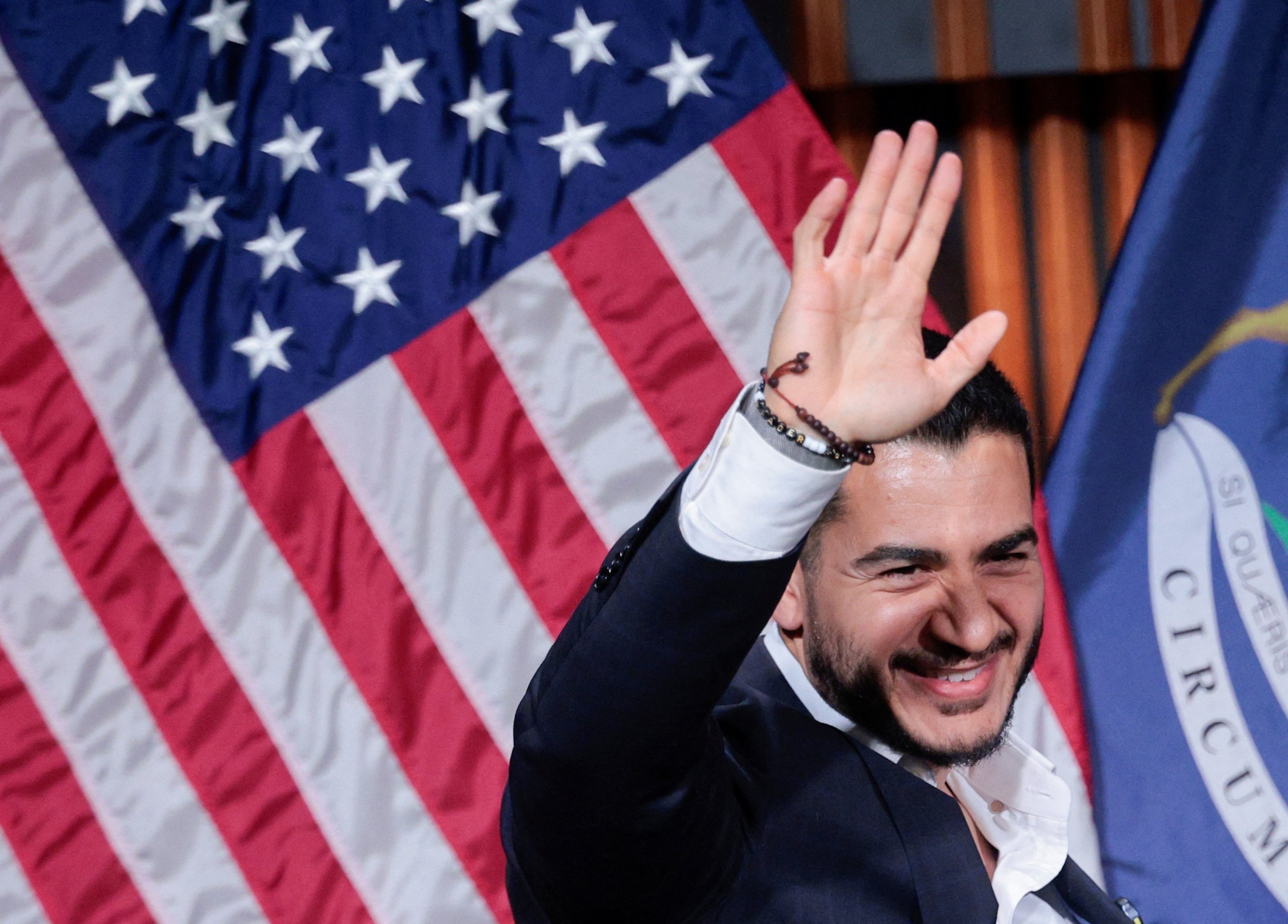
The American political establishment has long celebrated diversity as a national virtue as long as it does not challenge established interests. Abdul El-Sayed’s election to the U.S. Senate from Michigan exposes this contradiction. He becomes the first Muslim senator-elect in American history, but his victory means more than a religious first. It reflects economic discontent, generational change, foreign-policy dissent and the growing confidence of communities long kept on the margins. El-Sayed is not simply a Muslim candidate who overcame Islamophobia. His campaign raises unresolved questions about what America is becoming, whom its institutions represent and whose interests government should serve.
El-Sayed’s campaign was not built only around minority representation. A physician and former public-health official, he centered health care affordability, housing costs, inequality and corporate influence. His support for Medicare for All and criticism of corporate interests reflect a progressive challenge to the Washington economic consensus. This matters because voters are frustrated by the gap between America’s wealth and ordinary households’ insecurity. For millions, the question is not whether the economy grows in aggregate but whether they can afford health care, rent, groceries and a reasonable standard of living.
El-Sayed connected Arab Americans, young voters, working-class communities and progressive Democrats. His victory suggests identity and class politics need not compete; they can reinforce each other when exclusion is linked to wider economic concerns.
Still, his Muslim identity rose to prominence. His campaign unfolded in a hostile environment in which his name, faith and alleged associations were constantly attacked. U.S. President Donald Trump mocked his name and portrayed him as a security threat, including through alleged Muslim Brotherhood links. Reuters reported the allegations were unsupported, but still, “Abdul” became a rhyme for Islamophobes.
This reflects a deeper problem: Muslim political participation is treated as a national-security question rather than ordinary citizenship. A candidate’s program should be debated, but religious identity should not become grounds for questioning loyalty. That would put equal citizenship at stake. American democracy has expanded through struggles over voting rights, civil rights and representation of marginalized communities. El-Sayed’s victory belongs to that process: Muslim Americans are not merely participating in society but seeking to shape its institutions. Yet representation is not the disappearance of prejudice. A historic victory does not automatically dismantle the narratives that made it remarkable.
The most consequential dimension of his rise concerns foreign policy, especially Washington’s relationship with Israel. Michigan has a significant Arab American population and has become an arena for debates over Gaza, U.S. military aid to Israel and pro-Israel advocacy. El-Sayed’s opposition to unconditional aid to Israel and his naming and shaming of the Gaza genocide without hesitation put him at odds with much of the Washington establishment, including influential Democrats. His victory should not be read as a simple referendum on Israel or proof that voters have one position on Palestine. Electoral behavior is rarely simple; economic concerns, dissatisfaction with Trump, local dynamics and candidate factors all mattered.
Nevertheless, the political implications are difficult to ignore. For decades, support for Israel has been treated as one of the most durable points of bipartisan consensus in Washington. It has not yet disappeared, but it is increasingly contested, particularly among younger Democrats and voters who question the relationship between American domestic priorities and overseas military commitments. Even Trump is talking about cutting aid to Israel by the end of this year. This is a significant quake in U.S. politics. As videos of Gazan babies killed daily shake the consciousness of humanity, even the most resilient establishment supporter of this apartheid regime is drifting away slowly from this indefensible regime.
El-Sayed links foreign policy to domestic needs: Taxpayers should ask why public resources go to foreign military assistance while essential needs at home remain unmet. This argument can resonate beyond Arab and Muslim communities in a broader debate about foreign-policy accountability, resource allocation and organized interests’ influence over democracy.
El-Sayed’s victory also exposes tensions inside the Democratic Party. For years the party has balanced its progressive grassroots against traditional donors, institutional leadership and moderate constituencies. That arrangement is increasingly hard to sustain. Progressives argue the party cannot restore credibility merely by being a more competent alternative to Republican conservatism. It must respond substantively to economic insecurity, corporate concentration, health care inequality and wealthy interests’ political influence.
El-Sayed’s campaign reflects this: His language is not only anti-Trump but challenges the economic and institutional structures that make ordinary Americans powerless. Anti-Trump politics can mobilize voters short-term, but it is not a governing program. A credible alternative must explain what it will build, not only what it opposes. Michigan gives progressives a symbolic victory; whether it becomes legislative influence is another question.
One Senate seat does not change Washington’s balance of power or resolve the party’s divisions. Still, it strengthens the argument that the party’s future may depend on reconnecting economic populism with a politics of equal citizenship.
There is a temptation to describe El-Sayed’s victory mainly through “historical firsts.” That is understandable but insufficient. The deeper significance is that a candidate whose name and faith were used to question his legitimacy has won a place in one of the world’s most powerful legislatures.
His victory challenges the assumption that Muslim identity is an electoral liability and shows that political legitimacy must be established through democratic participation and accountability. It also tells parties that communities treated as peripheral can become decisive when organized around shared political and economic interests.
For America, this is both a democratic achievement and a warning. The country cannot claim to be a model of inclusion while religious identity becomes a proxy for suspicion, nor expect voters to accept symbolic diversity while material security is under pressure. The name Abdul will not by itself transform foreign policy, end Islamophobia or resolve the Democratic Party’s crisis. But it reveals that the boundaries of acceptable representation are changing.
Thus, the key question is not whether America is ready for its first Muslim senator. It is whether American democracy can treat every citizen’s participation as ordinary, legitimate and equal, regardless of name, faith or foreign-policy views. That is a larger test than one Senate election, and one American politics can no longer postpone. And the name “Abdul” is no longer a mocked name but a challenge to the establishment.