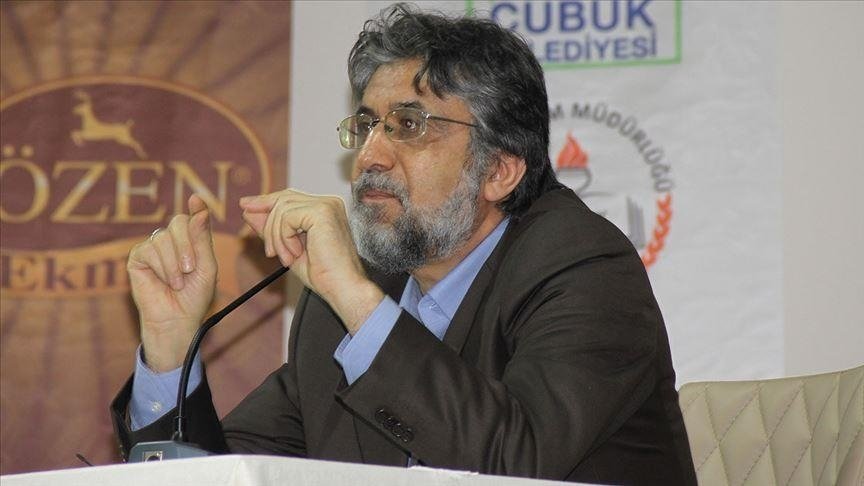
Akif Emre was a sincere and compassionate Muslim who deeply cared about the problems of the Islamic world and closely followed developments across the region. Among the regions he paid particular attention to were the Balkans, especially Bosnia. He frequently traveled to Bosnia, wrote extensively on the country, and conducted numerous interviews. Büyüyen Ay Publishing compiled his writings and interviews about Bosnia in a book titled "Aliya" while publishing all of Akif Emre’s works.
Emre seeks to understand the cultural codes and dynamics of Bosnia’s Ottoman heritage and how this legacy has been carried into the present day in a living and vibrant form. Transferred to the Austro-Hungarian Empire by the Treaty of Berlin in 1878 and fully separated from the Ottoman Empire in 1908, these lands displayed a remarkable resilience in preserving their connection to the Ottoman legacy. Especially in the 1990s, despite being subjected to a massacre that trampled all human values in the heart of Europe, Bosnia – under the leadership of a wise and dignified figure like Alija Izetbegovic, the “Wise King” – emerged from this process with its honor intact. It offered humanity a profound lesson in how to maintain a moral and virtuous stance even in the face of atrocities.
Throughout these periods, values continued to be preserved and passed down with great care, especially through families. Young people and intellectuals also kept this legacy alive on an intellectual level by coming together through various organizations. In this context, the Yugoslav Muslim Organization, founded in 1919 in Sarajevo under the leadership of Mehmed Spaho, and later, from the 1940s onward, the Young Muslims (Mladi Muslimani) organization, became the primary platforms for such gatherings. Educated youth, intellectuals, and academics would come together to discuss the problems of both Bosnia and the broader Islamic world. They published journals and newspapers, constantly generating content in this context. Their readings were not one-sided – they closely followed the West as well. For example, Alija particularly emphasized this multidimensional reading in his youth: “In the upper grades of high school, I had replaced all my schoolwork with reading. At the age of 18-19, I was reading all the major texts of European philosophy. At that time, I couldn’t appreciate Hegel, though my views would change later. The works that had a special influence on me were Bergson’s Creative Evolution, Kant’s Critique of Pure Reason, and Spengler’s two-volume The Decline of the West.”
As Emre also points out, due to more frequent exchanges with Egypt, especially for religious education, there was significantly greater access to the works of prominent intellectuals from that region. In this context, they were able to follow new debates through figures such as Muhammad Abduh and Jamal al-Din al-Afghani. These efforts provided crucial support in keeping alive the cultural heritage and transmitted through families. For a long period, these activities continued in a generally calm environment.
Alija was the most prominent figure of this period. He wrote down his thoughts and often published his articles in these journals under pseudonyms. When young people drew his attention through their writings or ideas, he would immediately reach out to them, offering constant support both intellectually and with whatever resources he had. He opened his home to these young individuals. For example, Bosnia’s national poet Cemaluddin Latic recalls that during his university years, Alija’s wife, Halida Hanım, acted like a mother to him. Alija worked like a true master to strengthen young people’s ties to this heritage and to guide their development. Thus, this period can aptly be described as the time of an invisible “Alija Academy.” Many of those who later took part in the front lines of the struggle or held positions in the state in Bosnia had passed through this academy.
With the onset of World War II, the pressures of the communist regime began to intensify. Investigations and arrests targeting young people and academics — those who provided the most crucial support in helping Muslim families hold onto their cultural heritage – became increasingly common. Naturally, Alija was among the first targets of this process. In 1946, at the young age of 21, he was arrested and sentenced to three years in prison. After his release in 1949, he first pursued a three-year education in the field of agriculture and then completed his law degree in 1956. He began working as a freelance lawyer. Although he maintained a quiet professional life for many years, he continued writing books and articles. As Akif Emre describes it, this was a time when Alija wove his own cocoon through a life of calm and stability: “This stable life continues well into the early 1980s. He is weaving his own cocoon, cultivating himself, developing his intellectual interests – without making much noise, not that he had the opportunity to make any noise anyway – but engaging with individuals directly, forming a circle. Why does this circle form around him? Because he is someone who possesses deep knowledge, dreams he constructs, and concerns as a Muslim. He is a person with intellectual depth, analytical power, and a distinct perspective. If the topic is poetry, he speaks on poetry; if it’s philosophy, then philosophy; if it’s politics, then politics ... He has a wide breadth of knowledge in these areas. He influences people quickly, educates and guides them – through books, through conversations – and in doing so, a circle naturally forms around him.”
In 1983, Alija was arrested once again and sentenced to 14 years in prison. He spent six years behind bars. His time in prison was marked by intensive reading. He said: “I could read 30 to 40 pages a day from different works. At that rate, I can say I read the equivalent of a 50,000-page library during my time in prison.” Alija categorized this new phase of his life, which marked his transition into politics and statesmanship beginning in 1983, into three parts: “With my arrest in 1983, a new period of my life began. Six years of it were spent in prison, one year in rest, and the next approximately ten years as President of Bosnia and Herzegovina.”
Emre emphasized the critical importance of what followed this period: “Had it not been for the intellectual initiative centered around civilization and the rich body of thought he developed – one that culminated in years of imprisonment in the 1980s and continues to illuminate our present – the Bosnian War was destined to be lost. At this point, Alija Izetbegovic, once known as a thinker and an organizer, revealed his diplomatic and military genius. He emerged not only as a leader for Bosnian Muslims, but as a harbinger of the kind of leadership the Islamic world would need in its future struggles.”
In his book, Akif Emre highlights three essential qualities of Alija: Alija as a thinker, Alija as a freedom fighter, and Alija as a founding statesman/leader. These three aspects are not separate; on the contrary, they reinforce one another. Most importantly, they are consistent with each other. The Alija, who is a man of thought, is the same in politics and statesmanship – genuine, sincere, honest, and thus trustworthy. For example, as president, even during wartime and under attack, he never neglected to go to his office each day. As Emre notes, on one occasion when it was impossible to travel by car due to shelling, he walked instead. A woman watching from a window asked, “Mr. President, where are you going? Aren’t you afraid?” Alija, acknowledging his humanity, replied, “I am human too, I’m afraid,” but then added, emphasizing his sense of duty, “but I have to go.” This was Alija: humane, principled and moral, even toward his enemies. For this reason, Emre describes him by saying, “In every moment, in every role, you see a human being.”
Emre states that even if Alija had not possessed the qualities of a politician and statesman, he should still be evaluated solely as a thinker, and he laments that Alija’s ideas have not been sufficiently understood. To facilitate and sustain this understanding, he repeatedly emphasizes throughout the book the need to establish an "Alija Izetbegovic" award mechanism. His most important works include "Islam Between East and West," "The Islamic Declaration," "My Testimony to History," and "Escape to Freedom." Emre notes that through these works, Alija brought a new breath to the Islamic world: "In the past century, the Islamic world has produced very few thinkers like Alija – this may sound like a bold statement, but it is true. Of course, there are many great figures. However, what makes Alija unique is that, although he did not come from a traditional Islamic scholarly background, he was able to develop Islamic thought in a way that addressed both Muslims and the wider world. Even with just two books, 'Islam Between East and West' and 'Escape to Freedom,' he demonstrated that he was a thinker capable of producing thought on a universal level." Although his most fundamental work, "Islam Between East and West," was only published in 1984 after a significant delay, the fact that Alija wrote this important work in 1946, at the age of 21, is a striking indicator of the intellectual depth he possessed.
In his book "Leadership: Six Studies in World Strategy," Henry Kissinger emphasizes that one of the common traits of great leaders is their openness with their societies during times of transition, which are often marked by complexity. He notes that effective leaders use a direct style of communication and confront their societies with the harsh truths of transitional periods to persuade them. As Akif Emre points out, during the war period, Alija chose a remarkably transparent style of communication with the public, which strengthened trust: "Even in the days when his people were shaken by massacres, he inspired hope without disconnecting from reality. He did not hesitate to share the deadlocks and difficulties they were facing with his people.
"He never deceived his people. He never abandoned honesty – neither toward himself nor toward his people ... Regardless of ideological views, everyone who fought for Bosnia’s freedom trusted Alija."
In summary, Alija Izetbegovic was deeply concerned not only with the problems of Muslims in his own region but also with those faced by Muslims around the world. He made significant contributions – not only as a thinker but also as a man of action – toward constructing a new language that preserved identity while taking into account both our historical heritage and the achievements of the West. He possessed a holistic system of thought, and in every aspect of life he touched, he reflected the virtues and principles of this system. Most importantly, his ideas and behavior remained consistent during his political and statesman career. His principled stance always stood out. For this reason, he earned the respect of all. As the late Akif Emre often emphasized, both Alija’s works and his life and era await deeper study and reflection.