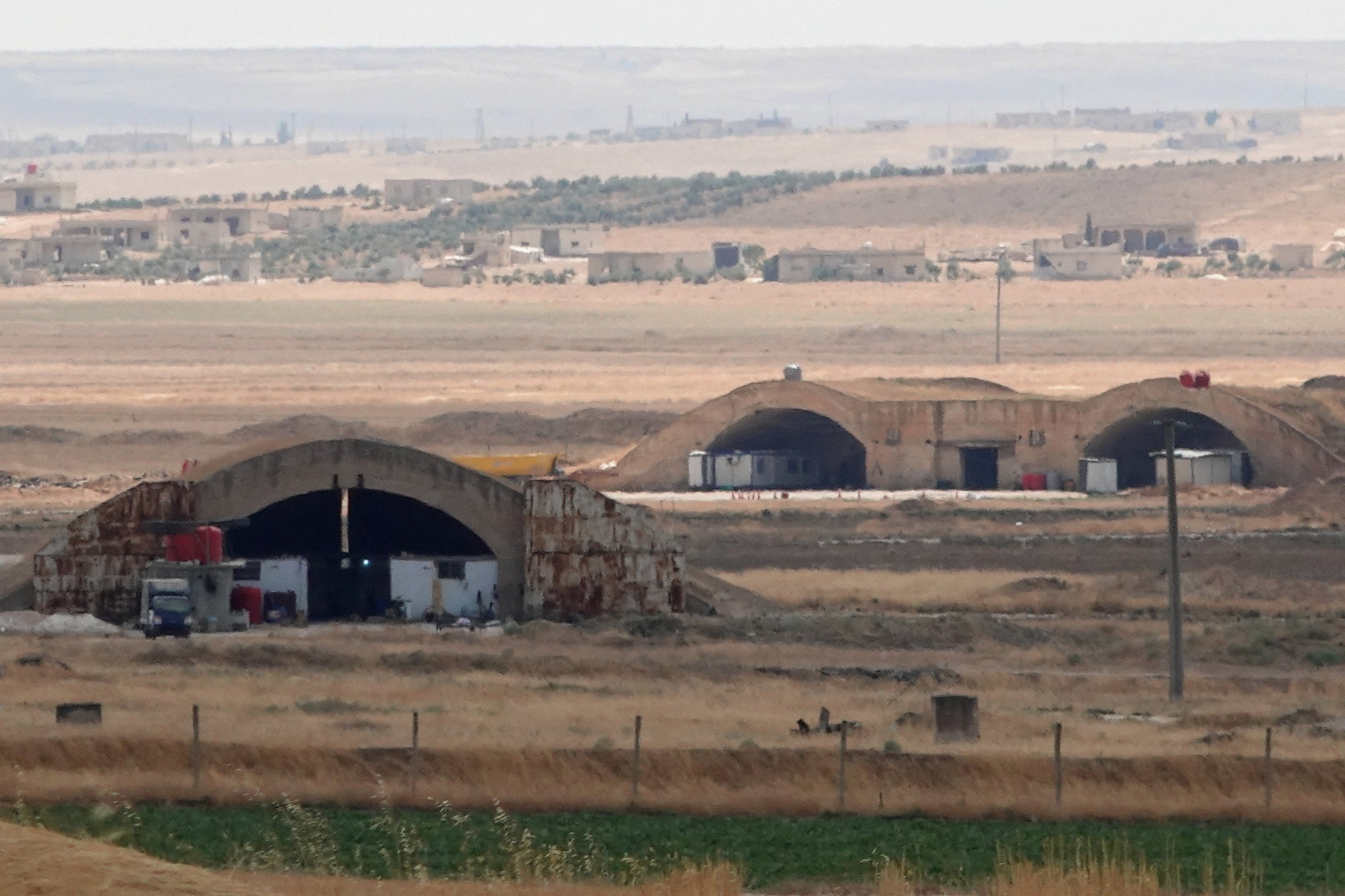
When I first assessed Israel’s Aug. 18 attack on the Abu al-Duhur Military Air Base east of Idlib, carried out with four F-15 fighter jets, I asked the following question: Why did Israel strike the empty runways at an airport that hasn’t been used for years and has no aircraft?
The statement made by Israeli Prime Minister Benjamin Netanyahu after the attack provided a clear answer to this question. The goal was to send a political message to Türkiye through the targeted runways.
Netanyahu stated that they would not tolerate Türkiye’s military buildup advancing southward in Syria. He argued that they had previously sent a “don’t do it” message to Ankara, that the message had not been understood, and that they had therefore “made sure they understood it better.” He later reiterated this approach, saying they had been forced to deliver the message “through kinetic means.”
So what does sending a message "through kinetic means” mean?
In military terminology, a kinetic approach refers to the use of direct physical force, such as weapons, ammunition and military operations, rather than diplomatic, economic or political pressure. In other words, Netanyahu is saying, “We delivered our political message by dropping bombs.”
The Israeli government based the attack on intelligence suggesting that Turkish troops were to be deployed to Abu al-Duhur. However, Ankara denied this claim. The Syrian government also stated that there were no plans to establish a permanent Turkish base at the airport.
More importantly, Tom Barrack, the U.S. Ambassador to Ankara and Special Representative for Syria, stated that U.S. intelligence agencies had investigated the claim in question and found it to be unfounded.
Thus, Israel’s justification of an “imminent security threat” has been seriously undermined. The Netanyahu administration attempted to turn the bombing into a vehicle for a political message by presenting an unconfirmed possibility as if it were a fact.
We cannot assess the Abu al-Duhur attack independently of recent developments in Syria. The YPG announced that they had ended their existence as an independent armed force and joined the Syrian army. This marked a significant step toward eliminating an armed structure in northeastern Syria that served as an alternative to the central government.
From the perspectives of Türkiye and Syria, this development is a strategic gain that strengthens the country’s territorial integrity. However, the same cannot be said from Israel’s perspective. This is because Israel wants Syria to remain fragmented along its ethnic and sectarian fault lines, in other words, it desires Syria to become like Lebanon.
The dissolution of the YPG structure means that Israel is deprived of a significant tool of terror and coercion that it could have used against the central government in Syria. The integration of these armed groups into the Syrian army strengthens the Damascus government’s control over the country while narrowing Israel’s room to maneuver through internal separatist elements.
Israel’s real fear is not today’s weak Syria. It is a Syria of tomorrow that has established a regular army, repaired its air bases, controls its borders, and develops military cooperation with Türkiye.
Such a Syria would restrict the unlimited air operations zone Israel has relied on for years and put an end to its initiative in the north. This is precisely why Tel Aviv seeks to prevent Damascus from getting back on its feet before it even begins. This approach is not a quest for security but a policy aimed at limiting the sovereignty of a neighboring state.
The Netanyahu administration’s threatening rhetoric toward Türkiye does not align with the actual balance of power on the ground. When comparing relative military strength, Türkiye is a far greater military power than Israel in terms of population, active-duty troop numbers, ground forces, navy, defense industry, strategic depth and sustained warfare capability.
Furthermore, Türkiye’s ability to detect Israel’s F-35 fighter jets from a distance of approximately 600 kilometers (372.82 miles) and strike them from approximately 400 kilometers nullifies all military options Israel could employ against Türkiye. Moreover, in a potential war, Türkiye’s potential to launch air, land and sea attacks on multiple fronts – if necessary – despite opposition from the U.S. and Europe leaves Israel helpless against Türkiye.
Netanyahu’s goal is not, in fact, to engage in a real war with Türkiye. Although the Abu al-Duhur attack was carried out by military means, its primary objective is political, not military. By bombing empty runways, Israel is attempting to open a new front in the political crisis with Türkiye.
In short, what is being done is the creation of a political crisis through the use of military means.
We cannot assess Netanyahu’s statements targeting Türkiye independently of the elections to be held in Israel on Oct. 27. By threatening a powerful regional country like Türkiye, Netanyahu is trying to keep his base united and gain political capital through security policies.
Striking the runways of an empty airport actually exposes Israel’s military weakness. The attack did not result in destroyed fighter jets, neutralized air defense systems, or eliminated military units. The only targets hit were runways that can be repaired in a short time.
Nevertheless, the Netanyahu administration wants to market the attack to the Israeli public as having "halted Türkiye’s advance in Syria.” By presenting this militarily limited attack as a strategic victory, it is attempting to tell voters a new success story.
Netanyahu’s second objective is to create a new crisis front with Türkiye in the eyes of the international community. By portraying Türkiye’s legitimate activities in Syria as a growing security threat to Israel, he seeks to secure the support of the U.S. and Western countries in particular.
Faced with increasingly serious problems in Gaza, Lebanon, Iran and Syria, Netanyahu is now seeking to create a new perception of an enemy and a threat through Türkiye. However, the bombs dropped on Abu al-Duhur are particularly noteworthy not as a major military success for Israel, but as an indication of Netanyahu’s political predicament ahead of the election. The bomb landed on the runway, but the target was creating a political crisis with Türkiye.
Yet, the Turkish state acts based on political realities, not empty threats. It is now very difficult for the Israeli prime minister to reverse his ongoing political decline in the remaining one and a half months. Netanyahu is on the verge of being consigned to the dustbin of history.