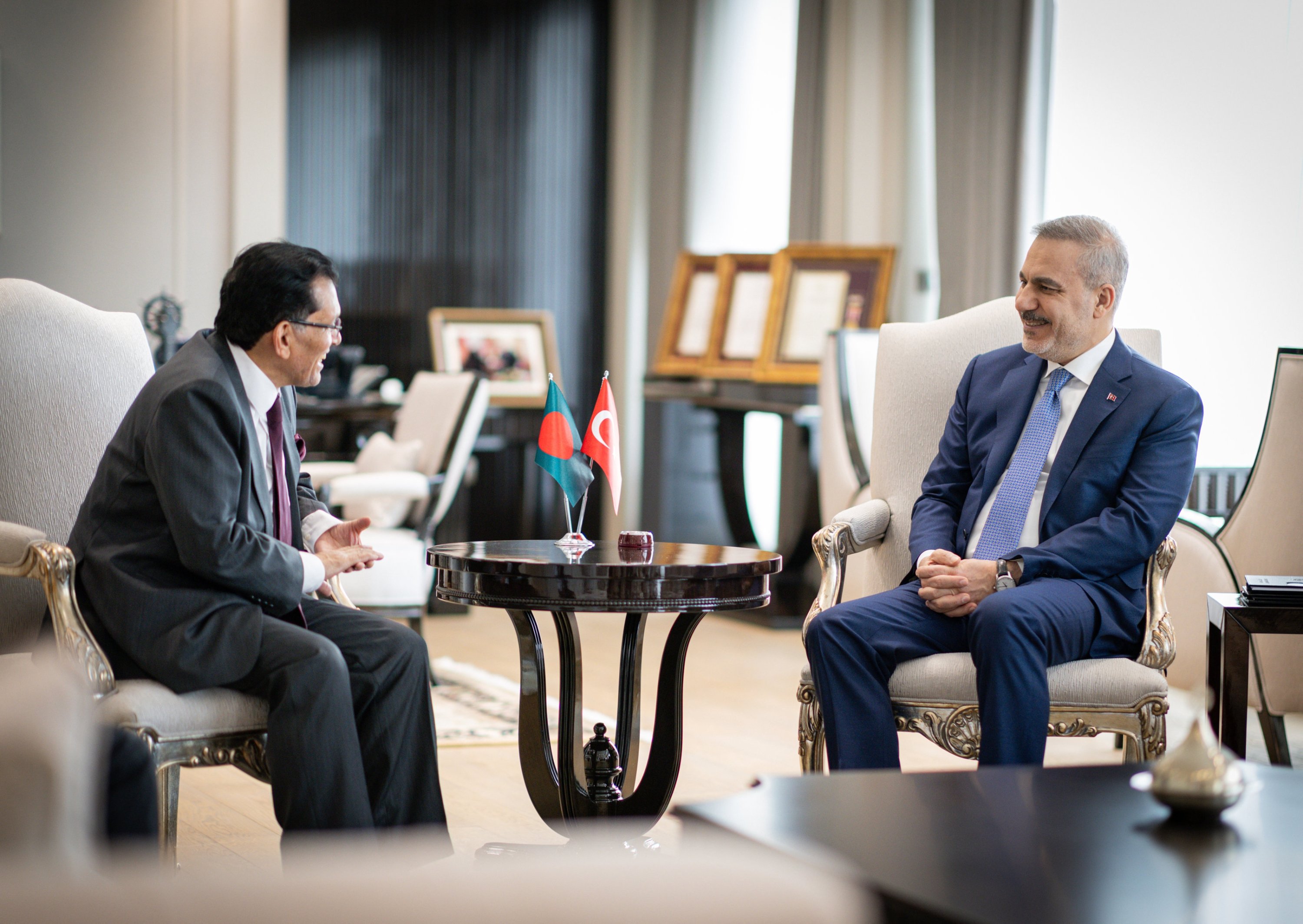
The first formal visit of Bangladeshi Foreign Minister Khalilur Rahman to Ankara on March 14 was more than a routine diplomatic meeting. It indicated a significant moment in the evolution of Türkiye-Bangladesh bilateral relations, highlighting the expanding scope of Ankara’s foreign policy under President Recep Tayyip Erdoğan. At a time when the global order is characterized by fragmenting alliances and wars with global impacts, Türkiye’s ability to build strategic partnerships across Asia through its Asia Anew Initiative maintains its role as a central diplomatic actor.
From a foreign policy perspective, the fact that Foreign Minister Rahman chose Türkiye for his first official visit abroad carries significant diplomatic meaning. The first bilateral visits conventionally signal political importance, and Dhaka’s decision to start its new diplomatic era with Ankara reflects the significance Bangladesh attaches to strengthening relations with Türkiye. The visit marks that Türkiye’s multidimensional diplomacy is gaining acceptance among rising powers of the Global South.
The visit came shortly after Bangladesh’s February 2026 elections and the formation of a new government, making its timing diplomatically significant. Ankara’s open support for stability and democratic legitimacy in Bangladesh demonstrates Türkiye’s comprehensive approach toward friendly nations, encouraging political continuity while fostering institutional cooperation.
Foreign Minister Hakan Fidan’s remarks during the joint press conference highlighted that relations between the two countries are built on historical solidarity but are now entering a more strategic phase. Fidan's references to the support of the Bengali people during the Balkan wars and Türkiye’s War of Independence served as reminders that the bilateral relationship is rooted in a unique historical foundation.
The discussion produced concrete outcomes that show the expanding institutional depth of bilateral ties. Türkiye reaffirmed its strong support for Bangladesh’s candidacy for the presidency of the next session of the United Nations General Assembly (UNGA). Additionally, a memorandum of understanding (MoU) was signed for the Diplomacy Academy of Türkiye and the Bangladesh Foreign Service Academy, establishing the door to further collaboration in capacity building and diplomatic training. These steps show that relationships are progressing from rhetoric to long-term institutional engagement.
Economic cooperation is a key pillar of the Asia Anew Initiative. Both countries agreed that the current trade volume of approximately $1.3 billion does not reflect the true potential of the bilateral relations and should be increased through deeper economic cooperation. Bangladesh’s strategic location in South Asia, with its growing economy and playing an active role in various international organizations, is seen in Ankara as an important partner in this vision. Bangladesh should be viewed as a vital player in Asia. Cooperation is possible in textiles, infrastructure, energy and manufacturing, given Bangladesh’s large, youthful, and skilled population, which makes it both a production hub and a rapidly growing consumer market.
Defense cooperation, in particular, carries strategic significance. In recent years, Türkiye has developed an independent, technologically advanced defense industry, especially in unmanned aerial vehicles (UAVs) and naval platforms, providing opportunities to cooperate with partners for mutual benefit. Bangladesh’s interest in developing collaboration in this sector reflects the growing appeal of Türkiye’s defense capabilities among developing countries seeking alternatives to conventional suppliers. Such relations also contribute to Ankara’s long-term goal of building sustainable partnerships based on mutual benefit rather than dependency.
The importance of this cooperation is further enhanced by Türkiye’s expanding role as a humanitarian and diplomatic actor. Its involvement in crises from Syria to the Gulf demonstrates that it is becoming increasingly adept at multilateral coordination and mediation. One of Bangladesh’s most urgent humanitarian challenges is the Rohingya issue, as the country continues to host more than one million Rohingya refugees. In this context, Türkiye has provided humanitarian assistance, estimated at approximately $80 million, through institutions such as the Turkish Cooperation and Coordination Agency (TIKA), the Disaster and Emergency Management Authority (AFAD), the Turkish Red Crescent, and the Türkiye Diyanet Foundation. The relationship between the two countries reflects a shared understanding that regional crises require collective responsibility.
In the future, Türkiye could play a role in resolving the crisis. Unlike many other actors, Türkiye maintains cooperative ties with both Western countries and major global powers such as China and Russia, which have influence over Myanmar. With its experience in international mediation, Türkiye is well-positioned to facilitate multilateral discussions. Ankara’s balanced diplomatic strategy could help revive international attention and coordination on this crisis, even though a full resolution remains challenging.
The discussions in Ankara were also influenced by the broader regional context. The importance of diplomatic cooperation among middle actors has grown due to escalating tensions in the Gulf region and the Middle East. Both sides expressed shared concerns, noting that instability in the Gulf directly affects energy markets, maritime routes and global economic security.
Furthermore, the two countries reiterated their support for a two-state solution based on the 1967 borders, with East Jerusalem serving as Palestine’s capital and an immediate cease-fire in Gaza. This coordinated stance underscores how nations like Bangladesh and Türkiye are increasingly shaping diplomatic discourse in the Muslim world and the Global South.
Taken together, the Ankara visit demonstrated how Türkiye’s foreign policy under President Erdoğan has evolved into a multidimensional strategy that combines diplomacy, economic cooperation, defense partnerships and humanitarian engagement. Through the Asia Anew Initiative, Ankara is strengthening its relationships with South Asia while reinforcing its role as a bridge between regions.
Bangladesh’s choice of Ankara as the destination for its foreign minister’s first visit signals trust in Türkiye’s rising diplomatic influence. For Türkiye, the meeting confirms that its proactive and independent foreign policy continues to attract partners seeking stability, cooperation and a more balanced international order.
In an era defined by uncertainty and shifting alliances, the Türkiye-Bangladesh partnership stands as a clear example of how middle powers can shape the emerging geopolitical landscape through strategic vision, diplomatic consistency and mutual respect. If supported by long-term political will and concrete agreements, this partnership has the potential to become one of the most dynamic ties connecting South Asia with the Middle East and the broader Global South.