The Antalya Diplomacy Forum (ADF) 2026 should not be understood merely as a diplomatic gathering that brings together a large number of leaders, ministers and international representatives. Rather, it represents a multilayered platform through which Türkiye’s increasingly visible approach of stability diplomacy is projected onto the international stage. The forum’s central theme, “Mapping Tomorrow, Managing Uncertainties,” effectively encapsulated the core message Türkiye seeks to convey: the contemporary international system no longer requires actors that simply describe crises, but those capable of managing uncertainty and navigating transitional periods.
Within this context, Türkiye positions itself as a balancing, dialogic and mediating middle power that is able to engage with multiple actors simultaneously and contribute to the construction of order amid systemic flux. This positioning is not merely rhetorical; it reflects an evolving diplomatic practice that combines crisis management with proactive engagement and norm-shaping capacity.
In essence, the Antalya Diplomacy Forum has moved far beyond being a conventional venue for diplomatic contacts and has evolved into a structural messaging platform for Turkish foreign policy. In many ways, it reflects both the “heart” and the “spirit” of the system in transition.
At a time when crises and conflicts are intensifying across the global system, the search for and need for stability has become increasingly critical. This is largely because the system itself is presenting uncertainty as the “new normal,” leading to a gradual erosion of international legal norms and established diplomatic practices. Within this context, President Recep Tayyip Erdoğan explicitly defined the forum as a “platform of wisdom,” emphasizing that diplomacy should not be confined to a technical process of negotiating disputes. Rather, it should serve as a broader space where the fundamental principles shaping the common future of humanity are debated and redefined. A brief look at the figures further illustrates the scale and significance of the Forum.
The 2026 edition had an exceptionally dense agenda, reflecting the fragile and transitional nature of the international system. According to official data, ADF 2026 brought together approximately 6,400 participants from around 150 countries, including 23 heads of state and government, 13 deputy heads of state/government and parliamentary speakers, 50 ministers, and senior representatives from 87 international organizations in Antalya.
The main themes highlighted at the forum included the Gaza genocide, the Russia-Ukraine war, the U.S.-Israel-Iran tensions, the Strait of Hormuz, energy security, regional peace, free trade, artificial intelligence, Islamophobia, food security, drought and climate change. These topics collectively reflect both conjunctural crises and deeper structural transformations within the international system. Their prominence was far from coincidental. Rather, the forum was designed as a platform to better understand the roles of key actors and to generate solutions in a period marked by growing uncertainty and the urgent need for stability.
From an analytical perspective, the thematic structure does not passively accept systemic decline. Instead, it foregrounds actors capable of managing uncertainty and contributing to stabilization processes. Beyond the panel discussions, the messages delivered by political leaders were equally significant. The statements of President Erdoğan and Foreign Minister Hakan Fidan emphasized diplomacy grounded in morality, conscience and justice, while also highlighting the importance of a rules-based order and multilateralism. In this sense, the panels provided a theoretical backdrop that reinforced this broader political vision.
The common discourse emerging from participants and panels suggested a critical reassessment of the current international system, moving beyond the limits of short-term, conjunctural developments. Finally, one of the most important dimensions of the forum was the role of backchannel diplomacy in addressing ongoing conflicts. Perhaps the most visible example of this was the revival of diplomatic engagement surrounding the U.S.-Iran negotiation process, which found a discreet yet meaningful space within the ADF.
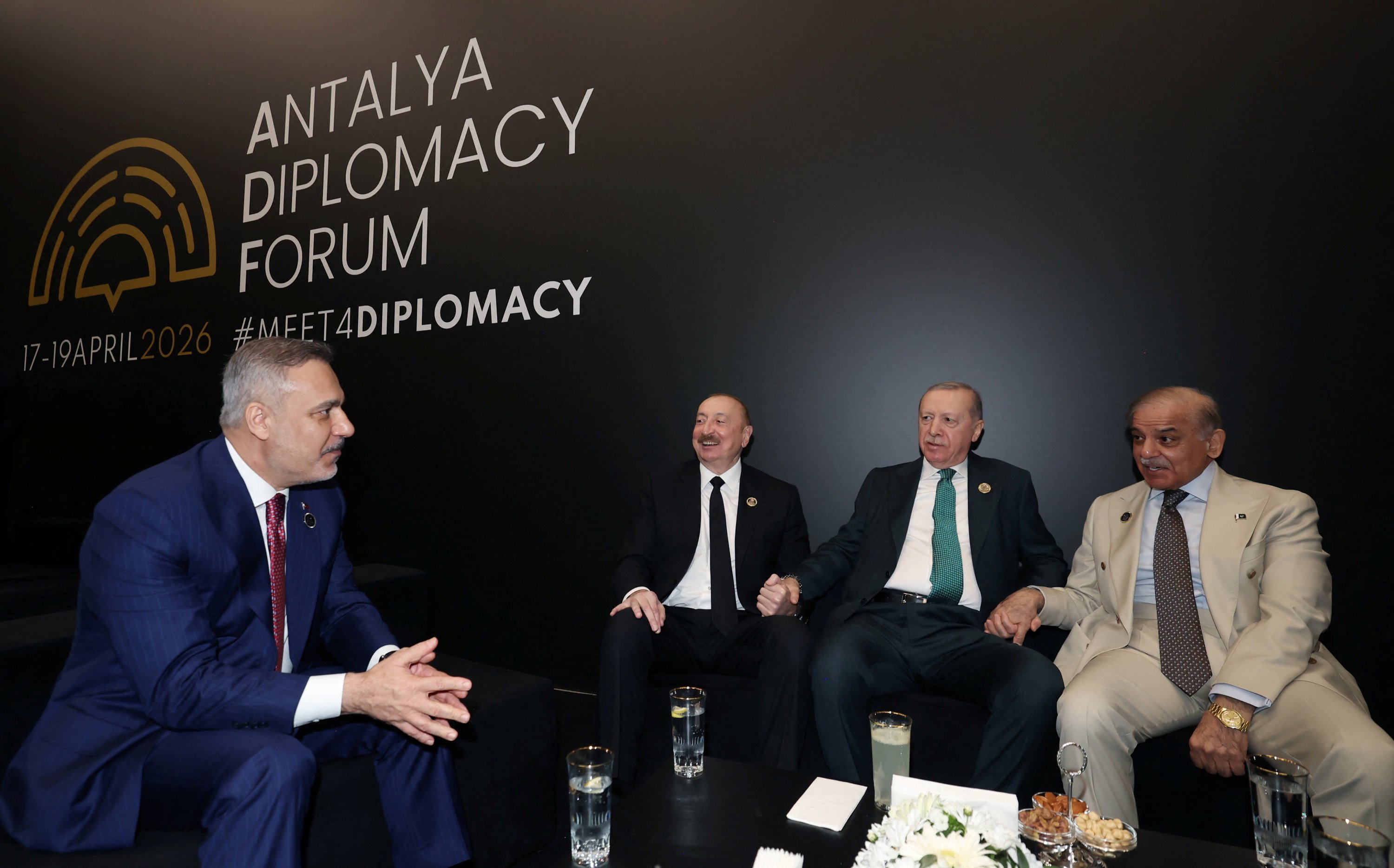
One of the forum’s most critical dimensions was the intensity of backchannel diplomacy. A key reflection of this was the imagery of Erdoğan alongside Pakistani Prime Minister Shahbaz Sharif and Azerbaijani President Ilham Aliyev, underscoring the forum’s role not only as a venue for open dialogue but as a multilayered negotiation platform. The Pakistan dimension stood out in particular. Meetings on the margins of the ADF, involving the foreign ministers of Türkiye, Pakistan, Egypt and Saudi Arabia, focused on major regional crises, especially the U.S.-Israel-Iran war, while also revealing shifts in the evolving security and dialogue architecture.
Within the framework of the fifth ADF, clear and assertive messages were delivered regarding the need to end ongoing wars and conflicts across the global system. From its earliest sessions, the forum has served as a platform where mediation efforts, particularly in the context of the Russia-Ukraine war, have been actively promoted. Over time, it has evolved into a space that not only facilitates dialogue at the table but also contributes to practical problem-solving on the ground.
It should also be noted that, particularly with the second presidential term of U.S. President Donald Trump, the notion of equality in the international system has increasingly eroded, giving way to a more hierarchical structural order. In contrast, Türkiye’s foreign policy approach deliberately moves away from rigid dichotomies such as the North-South divide. In this context, Türkiye’s expanding relations with Africa and Latin America reflect its effort to extend stability diplomacy geographically and to establish a more sustainable, equitable and multilayered framework of engagement with the Global South.
In this sense, these initiatives demonstrate that the forum goes beyond producing discourse and actively contributes to strengthening diplomatic capacity through institutional mechanisms. At the same time, an equally important dimension that should not be overlooked is the less visible impact of wars and conflicts. These processes extend beyond geopolitical and military arenas, generating multilayered crises that directly affect individuals through psychological and environmental consequences.
In this regard, one of the most notable aspects of ADF 2026 is that Türkiye has expanded its concept of stability diplomacy beyond conventional war and ceasefire narratives to include emerging security domains such as energy security, migration, digital security, strategic communication and climate diplomacy.
The forum also dedicated specific spaces to COP31-related discussions, while the risks and implications of the digital and cyber domain were addressed in depth. In short, the forum provided a multilayered analytical framework extending from the individual to the systemic level, and once again questioned the international order through a human-centered, macro-level perspective.