They say that not the strongest nor the fastest but the most resilient, who can adapt to changing conditions, always have a better chance of survival.
Due to its unique location, Türkiye has always had a fragile economic balance. Throughout history, there have always been wars, coups and terrorist movements in these lands, a history of struggle and turmoil. At any moment, such as now, we have been suffering from the ongoing Russian-Ukranian war, which has affected our leading sectors: agriculture, tourism and construction. Similarly, not so far from our southern borders, the war between Israel and Palestine has deteriorating effects on our tourism, defense industry and agriculture.
However, in this article, I will not tell you the disadvantages of living in a country surrounded by troubles. On the contrary, the muscles developed thanks to those troubles via the example of our neighbor from another continent, Argentina.
Just like ours, Argentina had a complicated 20th century. According to the year 1900 data, Argentina was the 12th richest country in the world with $2,756 per capita, richer than countries such as Sweden, Norway, Portugal or even its former colonialist, Spain.
Then, the country suffered from a military coup in 1930, which was partially an outcome of the great depression that started in the U.S. and led the country into a decade of political and economic instability. Although the 1930 coup had drastic effects on the country’s economy, the real change came with the 1943 coup that led to the establishment of the Peronism ideology, which profoundly shaped Argentina's politics and economy even today. The economic climate created by the ideas affected by Peronism had changed Argentina for good and transformed its policies into a more populistic line.
The Peronism idea has few economic aspects. Just like the newly founded Republic of Türkiye achieved right after its birth, Argentina followed a more nation-oriented economy by nationalizing some strategic sectors and companies such as transportation, energy to reduce the independence and increase the country’s autonomy since it was deeply wounded by the distant effects of the great depression.
To support domestic production and reduce the country’s dependency, Peron applied tariffs, quotas, protective measures and incentives that would make imported goods less available and advantageous. He also started reforms in social welfare, which may be interpreted as the beginning of populist policies. Yet, during his time, Peron's regime established extensive social programs that provided workers with benefits such as health care, pensions, housing and education. The government built a strong alliance between the state and the working class by empowering unions and setting minimum wages and working conditions for the workers.
One of the main focuses of Peronist ideas is to gain the support of the public and redistribute the wealth of the country in a relatively fair manner to the low-class people, with social aid, access to free health care and education being key. Although these policies help the governments maintain the support of the public, they may lead to fiscal deficits.
Protectionist ideology aims to protect the domestic producers and foreign trade balance in favor of internal products, so applying high tariffs and trade barriers to imported products is a significant element. Protectionist policies had a significant role in developing local industries while reducing the dependency on foreign products.
Although all those policies may seem in favor of the country’s economy, in some cases, the lack of imported alternatives or the inability to provide a safe haven for foreign investments may eventually lead to hyperinflation.
Argentina’s government followed similar principles during the last four years right before 2024 to reduce the hyperinflation that the country has been struggling with. Argentina’s former president, Alberto Fernandez, tried to straighten up the turmoil in the economy by regulating certain sectors and serving the quality of life of middle- and low-class people with state aid. These policies gave the economy of Argentina a 25% growth in gross domestic product (GDP) and a big ascend in income per capita in the year 2021, right after the lowest point of recent years. A similar recovery happened with a 29% growth in 2022 as well.
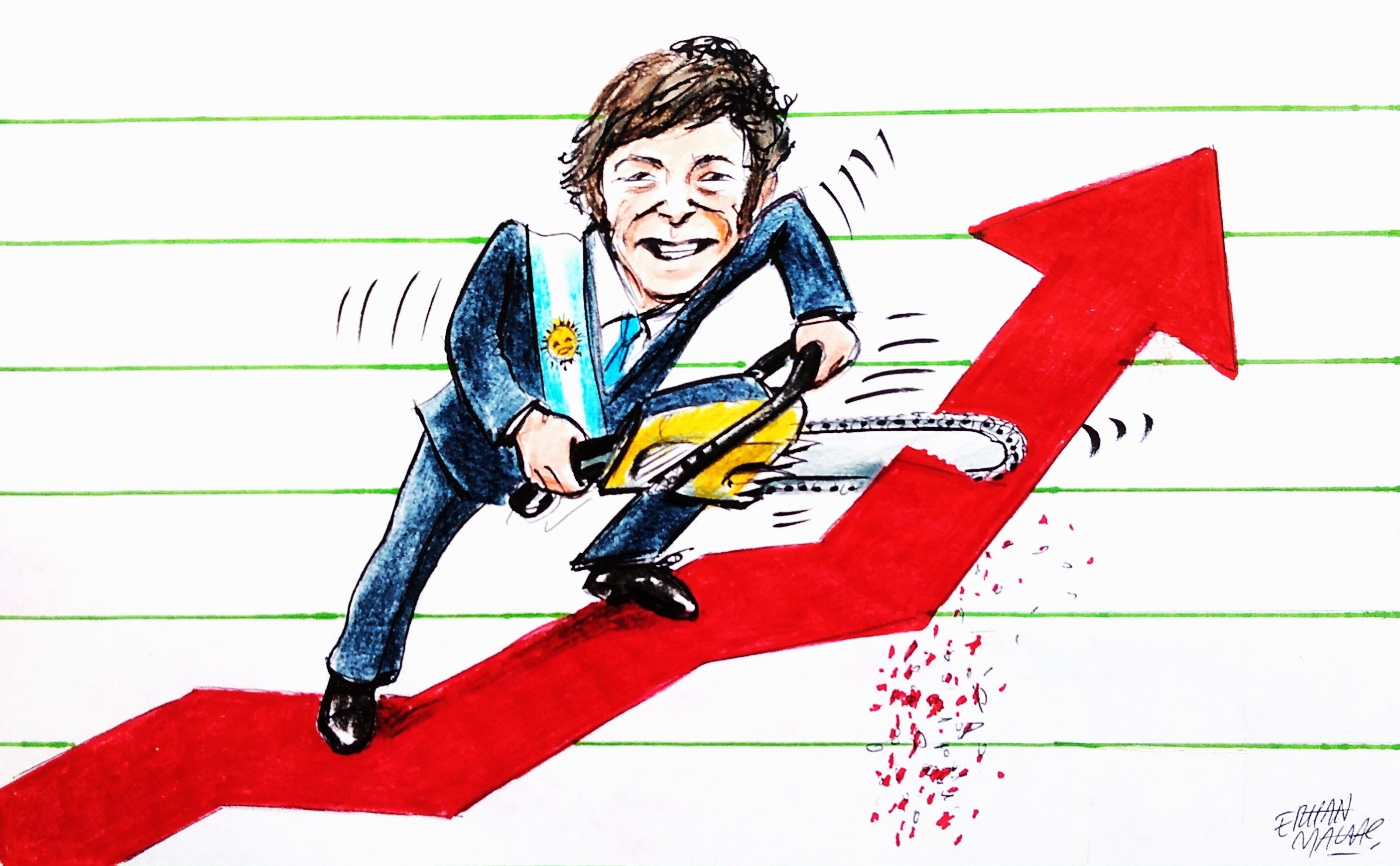
The 2023 elections were a significant checkpoint for Argentina, which changed the 80-year-old wind in a different direction. The newly elected president, Javier Milei, has been following more drastic and, in many ways, opposite policies by minimizing the intervention of the state, dollarizing the economy, thus removing the central bank's control and canceling most of the state aid to reduce inflation. Milei has been removing most of the strict regulations over the private sector to position Argentina as a safe haven open for foreign investments. Unlike Peronist ideas, which tend to nationalize certain sectors and companies, Milei has launched a movement to privatize state assets to fuel the Treasury.
Milei has seen that the fastest way to heal the economy is to let it run at its own pace. For it to flow, his management has begun to clear all obstacles in its path by removing the restrictive regulations and letting the free market control inflation. Milei also tries to support free trade to increase Argentina's integration into the rest of the world.
Unlike Peronist ideas accepted by his predecessor, Milei cut back most of the public welfare and governmental budgets and achieved a fiscal surplus. Milei sees that constantly feeding the poor people is not a sustainable solution. The goals that need to be achieved are to manage the country’s budget more efficiently and to let the free market regulate inflation by creating a fair environment for both foreign and local products and investors. Although his ministration’s efforts may cause short-term pain, such as job losses or a 50% devaluation of the Peso, in the long term, there is a more optimistic picture that lies before Argentina. The inflation statistics and projections made by authorities show us that the worst is almost behind and the inflation rates will fall under 30%, especially after 2027.
The interesting thing is that in most of the Western or Central European countries or the U.S., economic policies usually pursue a certain line that is predetermined and doesn’t change over a short period. In Argentina’s case, one president follows 80-year-old policies and the next one is quite the opposite of the very same policies, yet both give similar results.
The reason is simple: the country needed one then and now needs another, and most importantly, the people are resilient enough to apply what needs to be done at any moment.