The ultimate desire of evil is not to convert everyone to its cause, but to become normal. Its true victory lies in being shared by all, a dystopia where everyone is complicit. In this way, evil endures not by hiding in the shadows, but by tasting the daylight.
Hannah Arendt captured this chilling reality in her analysis of Adolf Eichmann. She noted that the very man who organized the logistics of mass murder also enjoyed weekend picnics with his family. This famously became known as "the banality of evil," the terrifying idea that monstrosity can coexist with the mundane, the bureaucratic and the polite. Evil does not always march in with a skull emblem; sometimes it arrives in the disguise of a spectacle to artwash the crimes of a state.
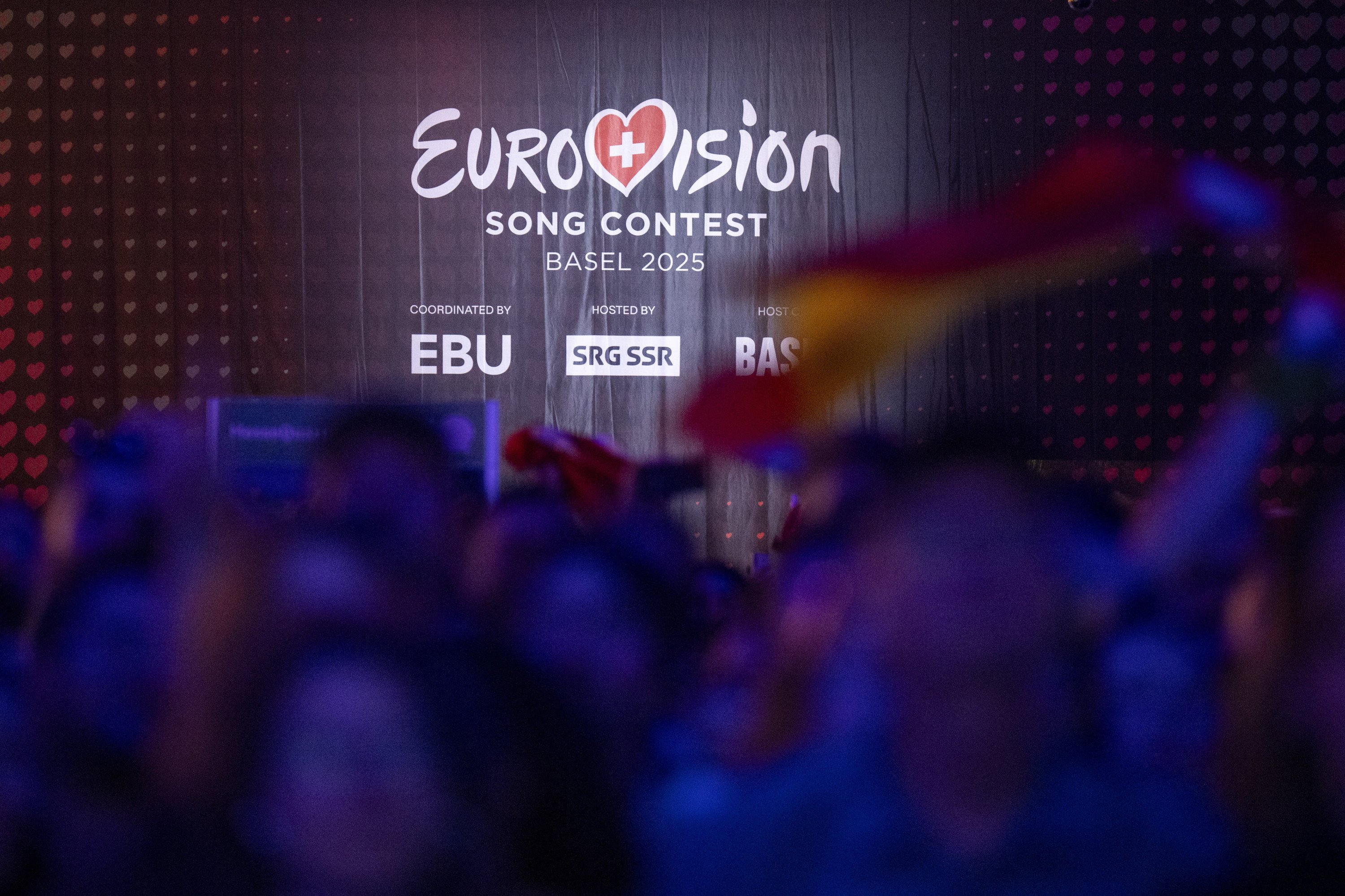
Following the European Broadcasting Union’s (EBU) decision confirming Israel's participation in the 2026 contest, five European broadcasters from the Netherlands, Spain, Ireland, Slovenia and Iceland formally withdrew in protest. They framed this exclusion not as a "political sanction," but as a moral imperative, arguing that participation would legitimize, and therefore normalize, Israel’s conduct.
Eurovision was born in 1956 as a postwar peace project, a deliberately "light" cultural glue meant to stitch a fractured continent back together. Yet, the contest has never truly been apolitical; it has always served as a mirror for Europe’s changing alliances and moral boundaries. The "non-political" Eurovision has always been, at best, a carefully maintained myth.
Reports confirmed that the EBU deployed "anti-booing technology" during the protests against Israel in recent broadcasts. While attendees inside the arena booed and chanted, television audiences at home heard only a sanitized mix of cheering and applause. The purpose is to ensure that dissent does not register, to render the moral disturbance inaudible and thereby socially tolerable. The "non-political" ideal did not survive as a principle; it reappeared as a technique.
Israel understands that Eurovision is not just a performance; it is a platform of belonging. To appear there is to be affirmed as a member, to be granted the privilege of normality. Participation becomes a vehicle of legitimacy: a chance to "artwash" its image with song and spectacle while Gaza remains in catastrophe.
For the 2025 contest, the Israeli broadcaster KAN selected Yuval Raphael, a young singer who survived the Oct. 7 Hamas attack, and gave her a song titled “New Day Will Rise.” By placing a young, sympathetic performer on a global stage surrounded by glitter, inclusivity and the brand language of unity, the state projects normalcy and Western liberal values. Israel presents itself, again, as the victim of terror, casting its artists as messengers of resilience.
Yet, behind the stage lights, the machinery of influence turns. It was revealed that the Israeli Ministry of Foreign Affairs ran aggressive social-media advertising campaigns across Europe, explicitly urging users to vote for Israel. If a state actor can purchase high placement through paid advertising and mobilized lobbies, Eurovision ceases to measure musical popularity and becomes a gauge of a state’s propaganda budget.
Faced with this legitimacy crisis, EBU leadership maneuvered to avoid a direct vote on expulsion, pivoting instead to a technocratic solution involving rule changes. By bundling the "safety" of the contest with the status quo, they forced members into a binary choice: accept the new rules and Israel, or risk the contest’s collapse. This is not principled neutrality. It is institutional discipline, using the fear of organizational breakdown to secure compliance.
The EBU acted decisively to expel Russia for invading Ukraine in 2022, yet engaged in procedural contortions to keep Israel despite similarly devastating actions in Gaza. The question is whose violence disqualifies, and whose is managed.
The facade, however, is cracking. Public outcry reached the scale of mass petitioning, with 600,000 signatures calling for exclusion. Symbolic acts punctured the institutional insulation: Swiss winner Nemo returned the 2024 trophy, and Irish legend Charlie McGettigan moved to return his 1994 trophy, declaring that slogans of "unity and dignity" are hollow when a state accused of war crimes is embraced.
Yet, Israel remains onstage, supported by allies like Germany and EBU statutes, but its presence has triggered the largest boycott in the contest’s history. The debate has become a contest of institutional allegiances: who counts as "Europe," and who is allowed to remain within its cultural family regardless of their actions.
When a celebratory spectacle is asked to coexist with mass murder, the choice is no longer between art and politics. The choice is between art as truth or art as anesthetic. By insisting on "business as usual," institutions like the EBU do not protect culture from politics; they draft culture into the service of erasure.
In the language of Arendt, the issue is not simply what happens on the battlefield, but what happens in the salon, what happens when the world’s stages, brands and rituals are asked to provide continuity, comfort and consensus while mass murder continues. As Arendt warned, evil thrives when it is invited to the picnic.