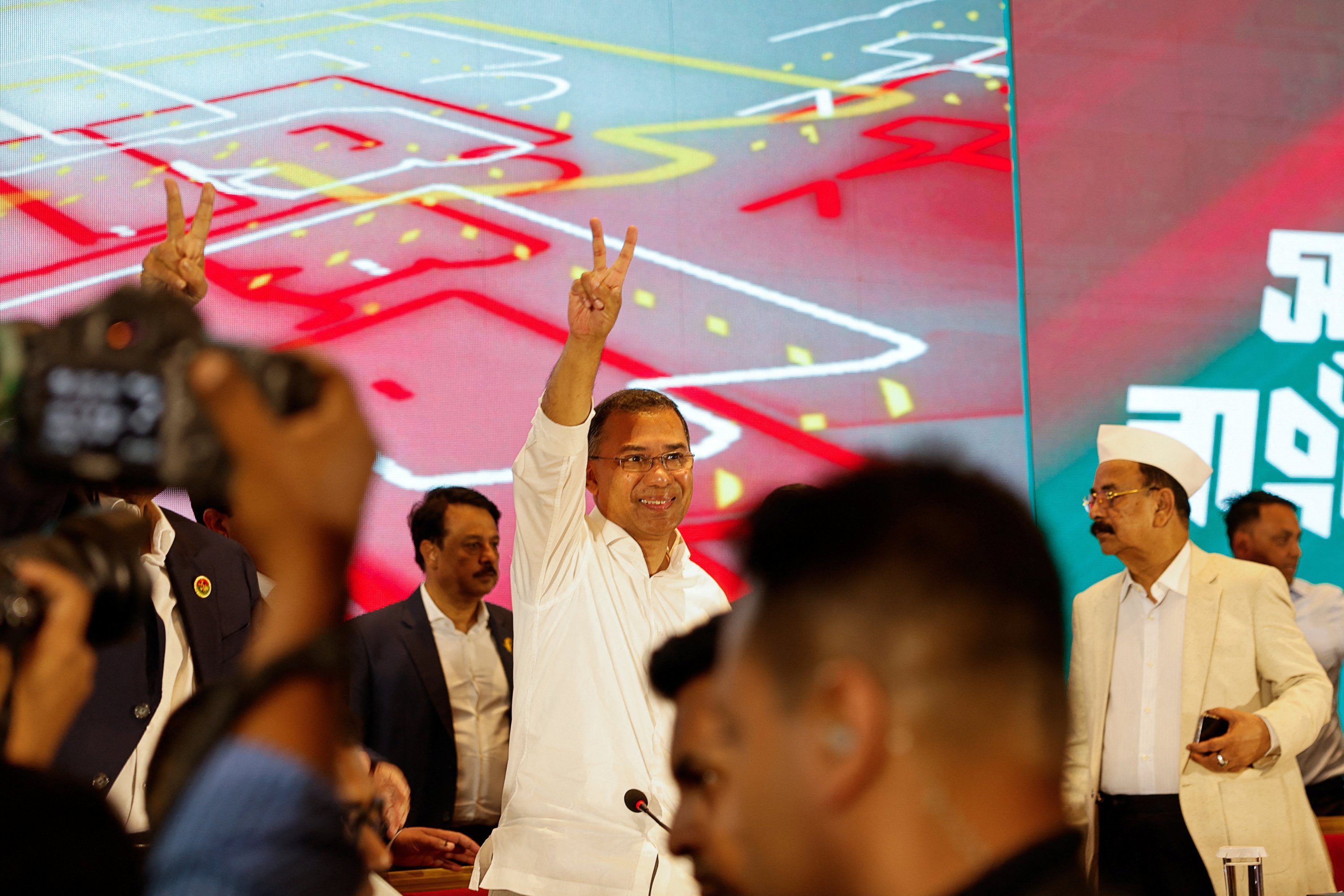
On Feb. 12, 2026, Bangladesh held its 13th national parliamentary election, delivering a significant political outcome. With 59% voter turnout and largely peaceful voting ever, the contest carried a degree of public legitimacy that recent national elections had struggled to achieve.
The Bangladesh Nationalist Party (BNP) and its allies secured 212 seats in the 300-member parliament, giving it a commanding two-thirds majority. At the same time, Bangladesh Jamaat-e-Islami (JI) and its alliance partners claimed around 77 seats. It is the strongest parliamentary showing in JI’s history. It won 18 seats in 1991 and 17 in 2001 as a junior coalition partner.
In Bangladesh’s first-past-the-post electoral system, changes in vote concentration can produce decisive seat outcomes. The result is not simply a landslide for one party, but the emergence of a new political balance.
This is more than a change of government. It is a structural political realignment.
For over a decade, Bangladesh’s political system operated under heavy centralization. This election marks the return of open parliamentary competition, even if the institutional environment remains fragile. BNP’s victory reflects both organizational strength and the consolidation of anti-incumbent sentiment after the collapse of the previous order (following the 2024 mass uprising and the fall of the Hasina government).
In many constituencies, voters who were once aligned with the Awami League appear to have shifted tactically toward BNP candidates. Yet, the most striking development is Jamaat’s resurgence. Its gains were geographically diverse, from northern districts to southern constituencies and selected urban seats. This pattern suggests disciplined mobilization rather than isolated protest voting. Bangladesh’s Parliament now contains both a dominant governing bloc and a sizable ideological opposition. That alone marks a break from recent political cycles.
Jamaat’s electoral campaign differed noticeably from its past rhetoric. Instead of emphasizing religious slogans, it focused on governance, anti-corruption themes and social welfare. Its campaign materials were simple and broadly accessible. The party engaged foreign diplomats and presented itself as a normal parliamentary actor.
This change appears intentional. After years of repression, Jamaat seems to have concluded that electoral legitimacy requires moderation in tone and openness in presentation. Its student wing’s recent victories in university union elections, widely discussed earlier this year, offered an early indication of this approach. Those campus contests revealed that organization and discipline can translate into trust when voters believe their choices matter.
But parliamentary politics is not campus politics. Winning seats is one thing. Governing a complex state is another.
A notable feature of this election was the participation of younger voters and segments of the emerging middle class. Many among them appear less attached to inherited party loyalties and more concerned with accountability, fairness and political credibility.
For some, support for Jamaat reflected dissatisfaction with established elites rather than a clear ideological turn; for others, the newly formed National Citizen Party (NCP), a democratic youth platform born from the July uprising, offered an alternative to traditional party structures.
Meanwhile, many young voters turned to the BNP, viewing it as representing experience and stability during a period of uncertainty. The result cannot be reduced to "conservatism versus secularism." It reflects a broader search for credible leadership in a society emerging from prolonged political strain.
The deeper challenge now lies beyond electoral arithmetic. Bangladesh’s state institutions remain shaped by years of centralized control and politicization. Courts, bureaucracies, law enforcement agencies and regulatory bodies do not transform automatically when governments change.
A national referendum on reform proposals reportedly received roughly two-thirds approval. If implemented seriously, these reforms could rebalance executive authority and strengthen institutional oversight. But constitutional amendments on paper do not guarantee institutional transformation in practice.
Other countries offer cautionary lessons. In Tunisia, right-wing coalitions embraced moderation after the 2011 uprising but struggled to govern through entrenched bureaucratic structures. Electoral victory did not translate into effective control over state institutions.
Bangladesh now faces a similar question: can electoral competition be followed by institutional reconstruction?
The regional response to the election has been pragmatic. India quickly congratulated the BNP leadership, signaling continuity in bilateral engagement. Türkiye has maintained open channels with a range of Bangladeshi political actors, including Jamaat figures, reflecting Ankara’s broader interest in South Asian political developments.
Yet foreign reactions matter less than domestic governance capacity. Bangladesh’s economic challenges, social polarization and institutional fragility will test any government, regardless of ideological label.
This election has restored visible competition to Bangladeshi politics. That is significant. It clarifies political fault lines and reduces the appearance of managed outcomes. But realignment is not resolution. The country now has a strong government and a strengthened opposition. Whether this leads to reform or renewed polarization will depend on how both sides govern, negotiate and restrain themselves in the years ahead.
Bangladesh has experienced ideological conflict before. What it has lacked is durable institutional trust. Elections can reopen political space. Only institutional reform and responsible leadership can stabilize it. The ballots have been cast. The reconstruction of the state has yet to begin.