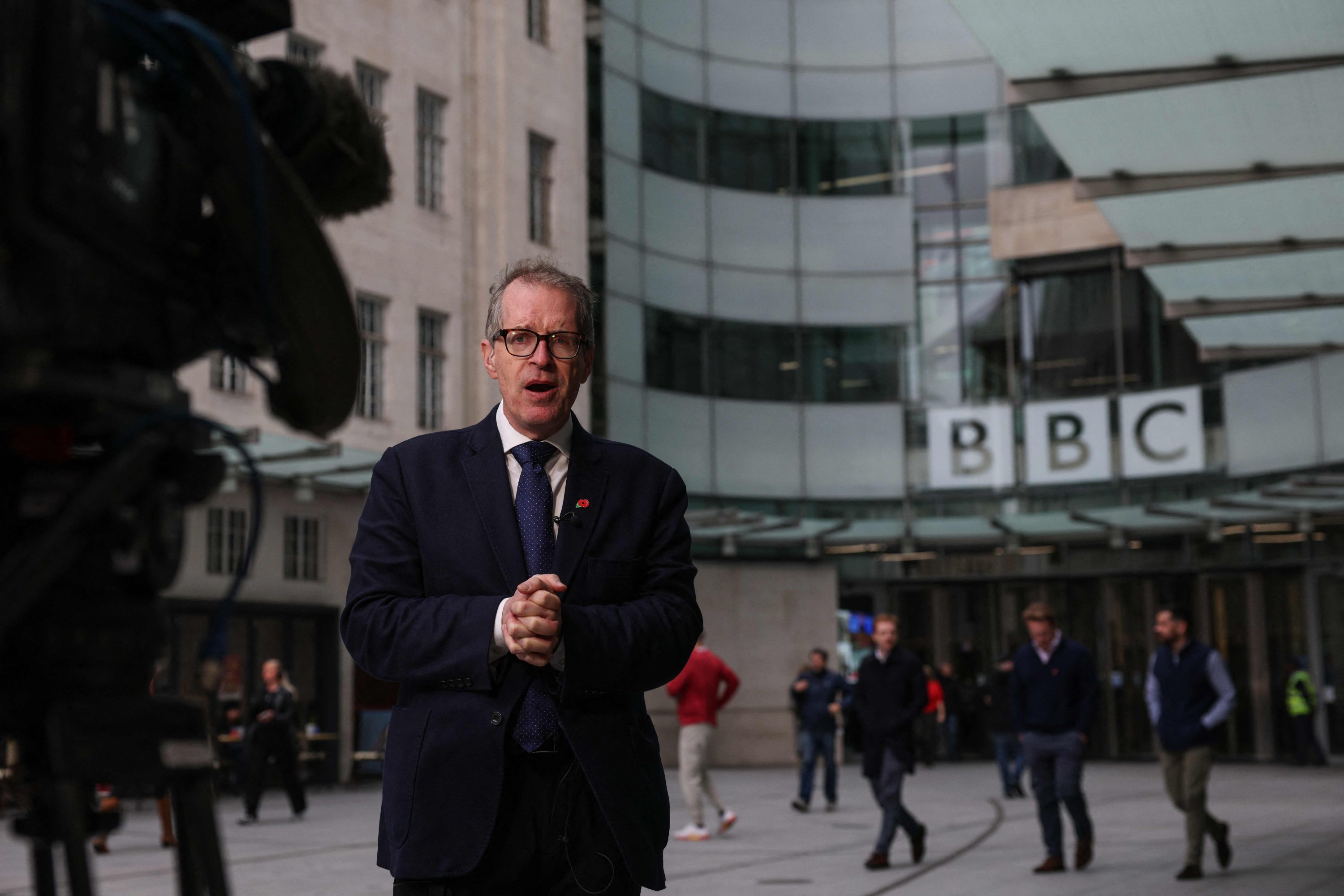
An internal report leaked to the Telegraph last week revealed that the BBC had misled viewers in a 2024 "Panorama" program by doctoring a speech of U.S. President Donald Trump, broadcast shortly after his election loss in 2020. According to the report, the editing made Trump “say things he never actually said.” Naturally, the BBC was accused of having a political agenda, particularly a very cynical one against Trump, which in turn made him target the public institution with renewed hostility.
On top of that, the report also mentioned concerns over an alleged bias in the BBC Arabic’s coverage of Gaza, suggesting, contrary to the facts, that it was generally slanted toward the Palestinian (and, indeed, global) position. The concerns were rather incredible, of course, since the BBC’s “editorial standards” have consistently been favorable to the fanatical Israeli position. This has been clearly demonstrated by numerous statistics and, perhaps more decisively, by Al-Jazeera’s excellent "The Labour Files" documentary series earlier, which exposed institutional rot within British media in general.
Why, then, did it take the revelations about a doctored Trump speech for top BBC executives like Tim Davie to resign? And why exactly was that the tipping point for, especially, the “right-wing” politicians in Britain to launch such a vehement attack on the broadcaster? Finally, why were self-proclaimed “patriots” cheering Trump, who threatened to sue the BBC for a billion dollars in damages, even though most of the British people really despise him, according to the polls?
It is well understood that the “right-wing” political class in Britain considers its alliance with the U.S. absolutely sacred. Not sacred, however, in the sense that the peoples of the two nations share a moral kinship, but in the sense that Britain “depends” on the U.S., both militarily and economically, to sustain its dwindling global relevance. James Schneider, communications director for Progressive International, commented similarly on this dependence during a recent GB News panel, describing Britain as a “vassal” to the U.S. rather than an “independent state” capable of exercising an autonomous foreign policy. And without autonomy, how can there be equality?
On that same panel, Schneider also critiqued the “incredible levels of corporate purchase of politics” of which Trump is merely a representative. Corporatism, particularly of the global kind, is certainly the prime engine of U.S. politics, whether it is a Biden or a Trump in the driver’s seat. In fact, Trump’s brand of corporatism may be even more sinister, for it cloaks itself in populist rhetoric diametrically opposed to its actual policies, as when it pretends to fight massive corporations, for example, of the “big pharma” and the “Big Tech.” And this corporatism is equally embraced, despite his claims to the contrary, by Trump’s closest ally in Britain, namely, Reform U.K. leader – and, arguably, Britain’s most probable next prime minister – Nigel Farage.
Indeed, Farage’s “populism” mirrors Trump’s almost perfectly in this respect, in that both can be defined by a conflict between rhetoric and actual policy. For instance, in his pledge to champion “small businesses,” Farage defended the spirit of entrepreneurship, insisting that we do not really live in capitalism, but in “an age of global corporatism.” He claimed, furthermore, that “the big businesses virtually control and own the political arena” in Britain. Yet it was exactly that entrenched corporate power that facilitated his political ascent and continues to shape his policies to a remarkable degree.
It is more or less the same story with the BBC. The “right-wing” political class is content with the rule of corporatism, but only really takes issue with what may be called public institutionalism. How can a truly anti-corporate stance be compatible with a complete subservience to the empire of corporations? The BBC would never be accused of having corporate interests in mind in its editorial decisions, even as it is so clearly guilty of that tendency.