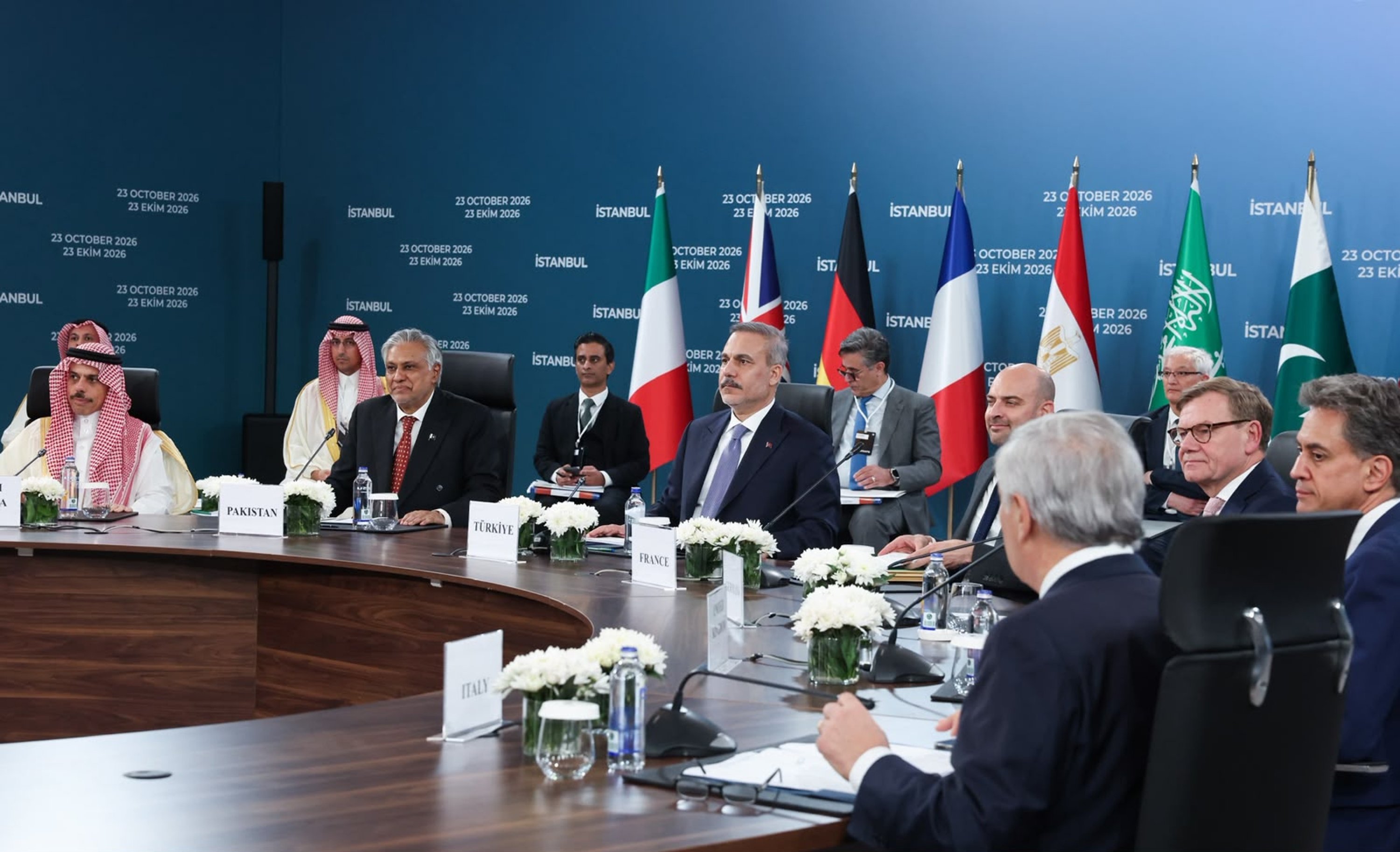
On Oct. 23, the foreign ministers of the R4, Türkiye, Saudi Arabia, Pakistan and Egypt, met in Istanbul, followed by talks with their E3 counterparts from Britain, France and Germany and also Italy.
Later, on Oct. 26, senior officials from the three Mecca accord countries, Türkiye’s intelligence chief Ibrahim Kalın, Saudi Defense Minister Prince Khalid bin Salman, and Pakistan’s army chief Field Marshal Asim Munir, visited Tehran for regional security talks. A joint statement said the four countries had agreed to continue high-level consultations to strengthen regional cooperation and promote peace and stability.
Together, these initiatives represent two essential dimensions of dialogue within the Muslim world and between the Muslim world and the West. Both are directed towards the same larger purpose of peace within the region and beyond it. Muslim nations' gathering has laid the foundation for both possibilities, affirming a principle too often neglected: Regional problems require regional solutions.
In its meeting ahead of the talks with the E3, the R4 rejected renewed hostilities, stressing that war would only deepen the problems it purported to resolve. The subsequent R4 E3 talks addressed pressing concerns regarding the conflict involving Iran, Palestinian statehood through a negotiated two-state solution, Houthi attacks on Saudi Arabia and Yemen’s government, freedom of navigation, and tensions in the Strait of Hormuz, Bab el-Mandeb and the Black Sea. The significance of these meetings, however, extends beyond their immediate agenda. The strongest grounds for hope lie in the R4 E3 participants’ agreement to continue the dialogue, opening the way to broader participation and an expanded agenda for peace.
The diplomatic initiatives in Istanbul and Tehran address two distinct dangers: the immediate threat of renewed American-Israeli hostilities against Iran and the looming prospect of a wider regional war driven by Israel’s hegemonic ambitions. The first demands urgent action to prevent a return to war, while the second requires sustained diplomatic and political intervention to halt the expansion of Israeli hostilities before a far more destructive confrontation becomes inevitable.
Against the backdrop of the Russia-Ukraine war and Europe’s prolonged confrontation with Moscow, these regional dangers carry global implications. The possibility of interconnected conflicts widening into a global conflagration cannot be dismissed.
If ever there was an urgent need for sustained dialogue both within the Muslim world and between the Muslim world and the West, it is now. The Istanbul R4 E4 engagement, with the eventual inclusion of the United States, could lay the foundation for an enduring dialogue between civilizations, capable of countering the forces seeking to make a clash between them inevitable.
Such a clash has its advocates in the West, while Israel has much to gain from a political climate that treats relations with the Muslim world as an enduring confrontation. For the past quarter-century, the language of counterterrorism has repeatedly served to obscure the Palestinian right to self-determination, discredit resistance to occupation and weaken the universal application of human rights. The claim that terrorism has “no cause” has too often become a refusal to examine the conditions in which violence emerges. Condemning attacks on civilians does not require denying the realities of dispossession and occupation, nor does it justify treating an occupied people’s struggle for freedom as inherently terrorist. Any credible pursuit of peace must recover these distinctions.
Israel’s barbaric war in Gaza is an assault on humanity itself. That genocide could unfold before the eyes of a world claiming to uphold civilization, justified in the language of counterterrorism, exposes a profound moral failure. American military and financial support have sustained Israel’s campaign, while Europe’s response has fallen far short of the action required to restrain it. The unqualified defense of Israel places Israeli conduct beyond any process of accountability.
Israel’s security doctrine is fundamentally rooted in the pursuit of regional hegemony, sustained through the occupation of Palestinian and neighboring Arab territories and the weakening of states capable of challenging its dominance. This approach makes recurring war a permanent feature of the region. Relentless settler violence and territorial fragmentation in the West Bank steadily undermine the possibility of a contiguous, sovereign Palestinian state. Beyond Palestine, Israel’s occupation of territory in Lebanon and Syria, its military operations across the region and its confrontation with Iran reflect a conception of security that subordinates the sovereignty and security of neighboring societies to the preservation of its own military supremacy.
A credible peace process requires the West to appreciate that lasting security depends on ending Palestinian dispossession and establishing a sovereign Palestinian state. Israel’s expansionist doctrine of security must also be brought to an end, and the onus lies on the Western nations that have helped sustain this doctrine.
The Mecca accord, though still in its early stages, offers a foundation for coordinated engagement in pursuit of regional and world peace. Türkiye’s leadership and the commitment to continue the Istanbul dialogue have opened a path towards sustained engagement. A dialogue of civilizations, however, will acquire meaning only through the political will to end occupation, uphold equal rights and confront the sources of conflict. Without that resolve, the region risks descending into a devastating war, with the promise of peace buried beneath Israeli hubris.