Social media restrictions for young people are becoming a worldwide phenomenon. Australia and the United Kingdom have already introduced bans on social media accounts for children under 16, while Türkiye introduced its own restrictions for youth under 15 in April 2026. Several countries such as New Zealand, France, Spain and Slovakia are also moving in the same direction.
The lawsuit filed by 29 U.S. states against Meta, alleging that its platforms were designed to foster addiction among children, and concerns regarding their potential impact on children’s mental health, highlight the serious consequences of designing digital platforms to keep young people engaged for extended periods.
These developments show growing concerns about the impact of social media on children and teenagers, but also raise an important question: whether the restrictions are enough to protect young people. Moreover, before taking a position on social media restrictions, it is important to understand the developmental needs of adolescence and the impact of social media on young people.
From a social and cognitive perspective, adolescence is characterized by a stronger attachment to peers than family, increased attention to appearance and the outside world, a desire to assert one’s own opinions and gain peer approval, resistance to rules and authority, and, at times, a need for solitude. It is one of the most intense periods of social identity exploration.
Neurologically, brain systems involved in seeking attention, feedback and peer approval become particularly sensitive during adolescence, while the brain regions responsible for self-regulation are not yet fully mature.
The need to prioritize peer relationships is therefore inherent to adolescence. Today, a significant part of these relationships takes place through social media.
In practice, social media can serve as a functional tool for connection, self-development and mental health support.
In the digital world, distance is becoming increasingly irrelevant. As an effective means of maintaining relationships across geographical boundaries, social media offers teenagers various benefits, including staying connected with family members, maintaining relationships with school friends, collaborating on projects, and communicating with friends quickly and easily.
In addition, social media can provide meaningful social connection for young people who may struggle socially or experience loneliness. When they cannot find peers who share their interests in their neighborhood or school, social media can connect them with people elsewhere in the world who can offer social support, acceptance, and a sense of belonging. The accessibility of these connections is one of its defining advantages.
Social media and other digital platforms also increase cultural awareness by enabling young people to engage with different nations around the world. Through these platforms, teenagers can explore not only their own social environment but also different cultures. Exposure to these differences can foster curiosity and interest, promote greater acceptance and understanding of others, and help young people develop more diverse cultural perspectives.
While social media use offers important benefits, its potential harms become inevitable when it is not used in a balanced, age-appropriate and healthy manner.
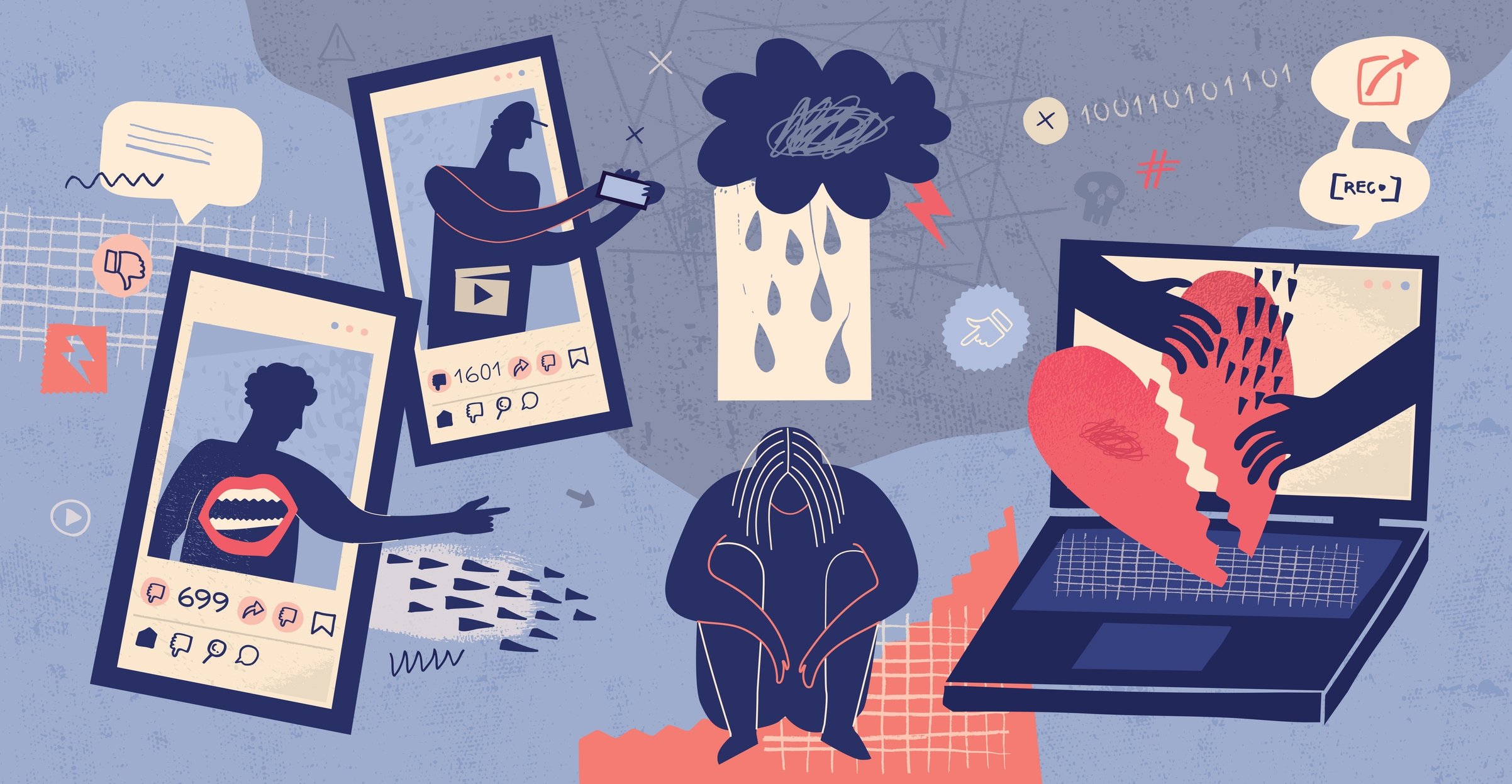
Adolescence is a critical period for developing a stable sense of body image and identity. However, social media platforms have become spaces where people often present the “most perfect” versions of their lives. Repeated exposure to filtered, retouched and highly idealized images can distort young people’s perceptions of themselves, fostering feelings of inadequacy, anxiety and low self-worth as they navigate the process of forming their own identities.
The risk may be greater among young people who are introverted, have low self-esteem or have limited social connections. The images they see in the digital world may make it difficult to disengage, leading them to withdraw from face-to-face relationships and become increasingly immersed in virtual ones. This can lead to increased feelings of loneliness and isolation, and weaken social skills.
Furthermore, exposure to content that normalizes self-harm, extreme thinness, eating disorders, bullying, marginalization and unrealistic lifestyles and relationships can influence how young people perceive and evaluate these behaviors.
Algorithms can identify their interests, screen time and vulnerabilities, repeatedly exposing them to harmful content and drawing them deeper into an increasingly extreme digital environment. This can also make young people more vulnerable to digital predators.
Beyond its negative psychological effects, social media addiction may also have significant adverse effects on young people’s physical health.
During adolescence in particular, young people may lose track of time, and spending more time with technology than is appropriate for their age can contribute to problematic use and addiction.
The lawsuit filed by 29 U.S. states against Meta, alleging that its platforms were designed to foster addiction among children, and concerns regarding their potential impact on children’s mental health, highlight the serious consequences of designing digital platforms to keep young people engaged for extended periods.
Social media, with its constant stream of short and rapidly changing content, can shorten attention spans and make it increasingly difficult to sustain focus on longer or more demanding forms of reading.
Excessive exposure to blue light can also interfere with the secretion of melatonin, the hormone that plays a central role in regulating healthy sleep. For young people whose brains are still developing, adequate sleep is essential. Without reasonable limits on social media use, prolonged screen exposure can contribute to sleep disturbances and other health problems.
Based on both my clinical experience and the recommendations of the American Psychological Association, I would like to offer several suggestions.
First, young people should receive digital media literacy education. They need to understand that the content they encounter is not random. Algorithms are designed to identify their interests and maximize engagement and time spent on social media. Developing the ability to question whether content is accurate, realistic or fictional is therefore essential.
Second, parents have an important role to play. While many may believe that banning social media is the simplest solution, parental control is most effective when it is guiding rather than purely prohibitive. Appropriate monitoring can be helpful; parents can be aware of the content their children encounter, discuss it with them, and set limits when necessary.
At the same time, as children grow, their need for privacy and autonomy naturally increases. Effective parental guidance therefore requires finding a balance between protection and respect for this growing need for independence.
Modeling healthy behavior is key. Simply telling young people to put down their phones and go outside is generally ineffective. Parents can have a much greater influence by putting their own phones away while eating, talking, or spending time together, and by maintaining a life beyond social media through work, friendships or hobbies. Regardless of age, children learn more from what they see than from what they are told.
Unfortunately, content that encourages self-harm or harm to others, promotes eating disorders, violence or hate speech exists and can be repeatedly recommended by algorithms. Such content should be monitored, reported and removed. More importantly, the use, content, functionality and safeguards of social media platforms should be adapted to the developmental needs of adolescents. Platforms designed primarily for adults may not be appropriate for teenagers.