The transformation witnessed in the global security architecture in recent years clearly demonstrates that NATO has evolved beyond being merely a military alliance into an increasingly influential geopolitical and geo-economic actor. One of the clearest indicators of this transformation is the changing trajectory and composition of defense expenditures.
The target introduced at the 2014 Wales summit, which established defense spending at 2% of GDP as a benchmark for member states, has effectively become a minimum threshold today. Across NATO, defense expenditure accounted for approximately 2.6% of GDP in 2014, rising to 2.8% by 2024 according to the organization’s annual report. Although this increase may appear numerically limited, particularly given the accelerated budget expansions observed among European countries in recent years, it reflects a broad and sustained horizontal expansion across the alliance.
Escalating geopolitical tensions constitute the primary driver of this trend. Both the Russia-Ukraine war and the broader conflict stemming from the U.S./Israel-Iran war have become central issues on NATO’s strategic agenda, further accelerating defense spending and defense industrial mobilization.
Contemporary governance debates, discussions surrounding Europe’s strategic role, and assessments regarding Türkiye’s potential position within the SAFE program all indicate that the alliance is entering a new phase of structural and strategic transformation. The recent debate within NATO regarding increasing defense expenditures to 5% of gross domestic product (GDP) is also a significant turning point for the alliance.
The latest World Economic Outlook published by the International Monetary Fund also indicates that this upward trajectory in defense expenditure is becoming increasingly visible not only within NATO but across the global economy, too.
This horizontal trajectory points to a different dynamic in Türkiye. During the same period, Türkiye increased defense expenditures from 1.4% to 2.3% of GDP, surpassing NATO’s two percentage point threshold and not only converging with the alliance average but also displaying a differentiated performance in several areas. This nearly one-percentage-point increase reflects not only an expansion in budget size but also a structural transformation in the defense economy itself.
In Türkiye’s case, the defining feature has been both the scale of spending and the significant shift in the composition of expenditures. Whereas personnel expenditure accounted for approximately 60% of total defense spending in 2014, this ratio declined to 40% by 2025. In this context, a clear divergence emerges between NATO’s broadly horizontal spending trend and Türkiye’s research and development (R&D) oriented transformation. While some NATO countries continue to prioritize expenditures to sustain existing military capabilities, Türkiye is increasingly moving toward a defense industry model centered on technological innovation, high-value-added production and indigenous capability development. As a result, defense spending is gradually evolving from being a conventional security expenditure into a component of economic growth.
At this point, high-technology exports emerge as a critical threshold. Sustainable competitiveness in global trade is determined not merely by export volume but by technological intensity and value-added per unit of exports. According to data from the Ankara Chamber of Industry, the export value per kilogram in Türkiye’s defense and aerospace sector has approached $65, representing one of the clearest indicators of this transformation. Considering that export value per kilogram in traditional industries often remains within the range of $1-$3, the value-added generated by the defense industry is particularly striking. In this regard, the defense sector has become one of the leverage industries transforming Türkiye’s overall export structure toward a more technology-intensive composition.
From a broader perspective, the increase in high-technology exports directly affects current account balances, productivity growth, qualified employment and long-term economic growth dynamics. As R&D expenditures rise, the commercialization of newly developed technologies enables firms to move up global value chains and facilitates a transition from a price-competition-based growth model to one driven by quality and innovation.
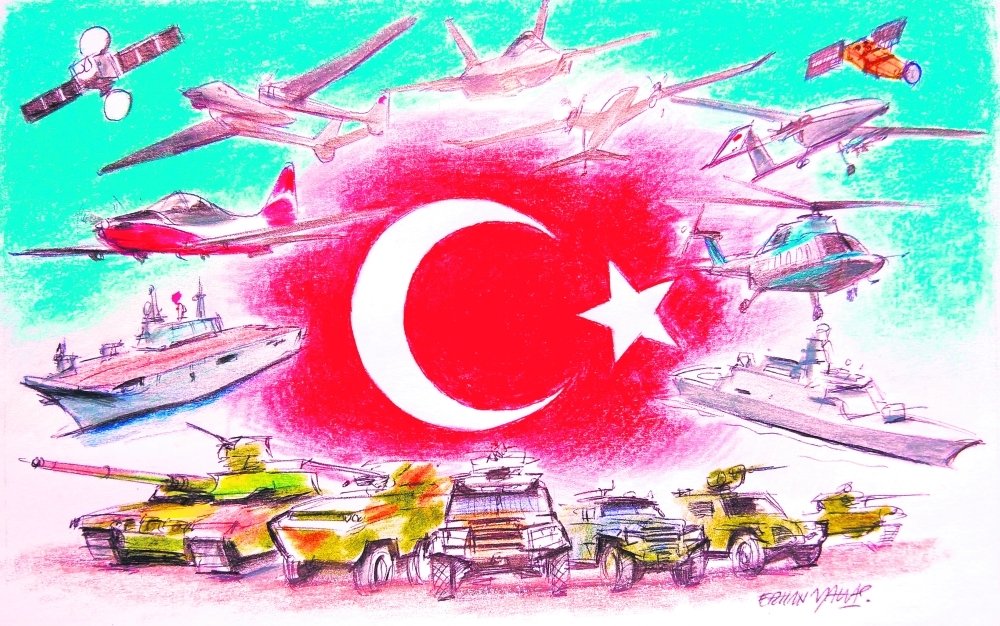
In recent years, Türkiye has evolved beyond being merely a country that develops new weapons systems; it has become a strategic actor capable of accurately interpreting the changing nature of warfare and building a production and technology model accordingly. This transformation represents one of the most concrete reflections of the structural change taking place in the composition of Türkiye’s defense expenditures.
To illustrate, the SAHA 2026 exhibition demonstrates that Türkiye is no longer simply a defense importer or supplier, but increasingly a country that develops technology, builds industrial production capacity and shapes next-generation warfare concepts. The current warfare environment has demonstrated that modern conflicts are shaped not only by expensive high-tech systems, but also by rapidly producible, electronically resilient, low-cost precision-guided munitions. Recognizing this transformation early, Türkiye invested in hypersonic missile technologies and AI-supported defense, significantly expanding its mass production capacity to build a sustainable defense industrial ecosystem.
In particular, the long-range resilient systems developed by Roketsan and the “Steel Dome” concept, along with the capacity expansion in 155 mm ammunition production by MKE, stand out as some of the clearest examples of industrial transformation in the defense sector. The usage of artificial intelligence, quantum technologies, autonomous systems, and rapid production techniques in the defense ecosystem is further strengthening Türkiye’s position not only within the regional security architecture but also within NATO’s evolving geo-economic framework as a strategic actor capable of producing technology, generating high added value, and shaping the global defense landscape.
In conclusion, as NATO’s Ankara summit approaches, Türkiye is consolidating its position both within the regional security architecture and within the evolving global geo-economic order as a strategic actor that produces technology, creates high added value, and increasingly shapes the international defense landscape. The rise in high-technology exports constitutes both an outcome of this transformation and one of its key pillars of sustainability.
In this respect, Türkiye is emerging not only as a provider of security on the global stage, but also as a technology-producing and economically influential power with growing strategic reach. This transformation also carries significant potential to strengthen Türkiye’s contribution to global peace, stability, and sustainable security.