Rarely since assuming office in 2014 has Prime Minister Narendra Modi appeared as politically vulnerable as he does today.
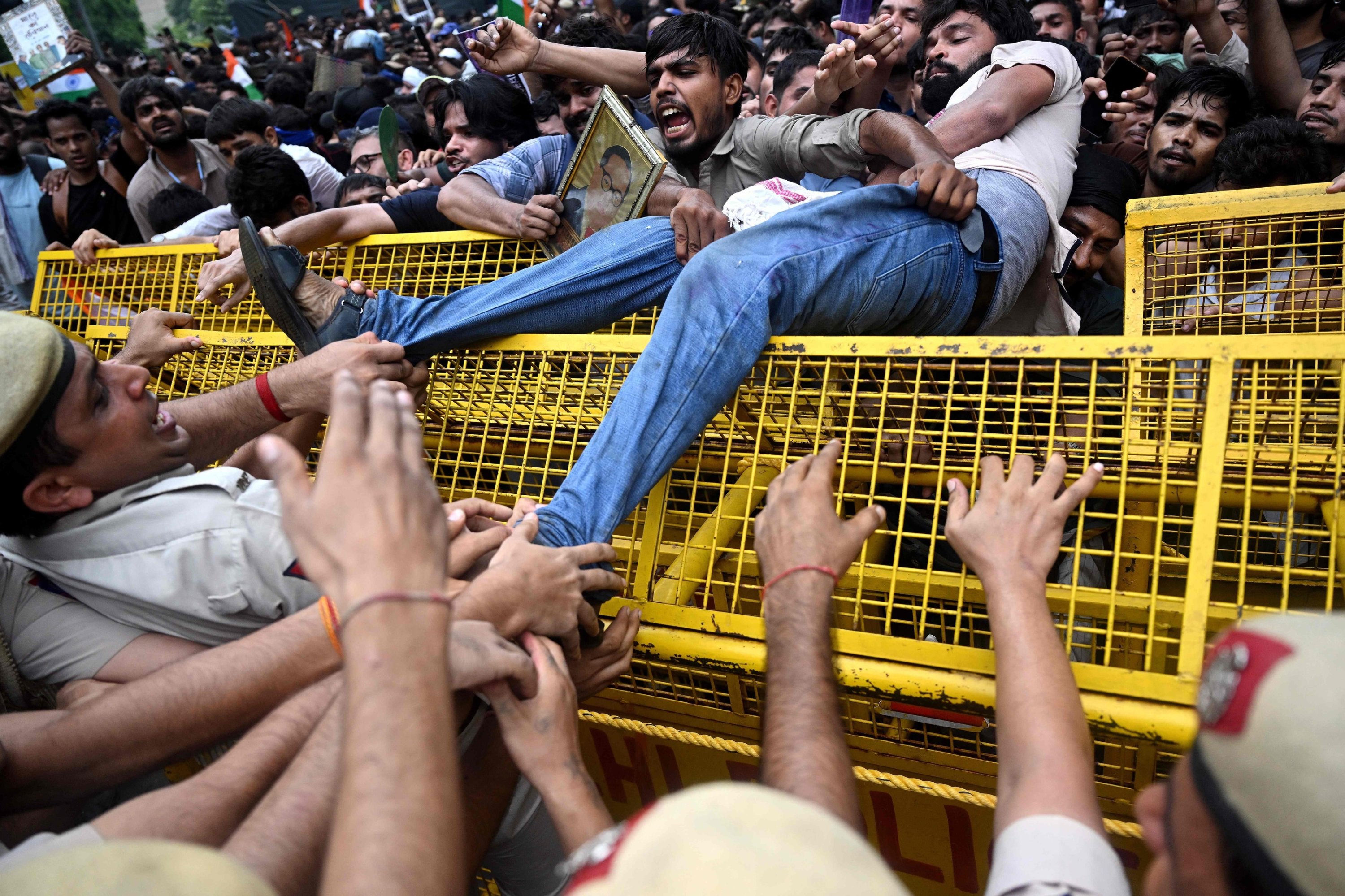
The ruling Bharatiya Janata Party (BJP) suffered two important assembly by-election defeats in states it governed, including the loss of a constituency vacated by its own national president that it had retained for nearly three decades. Whether the recent Gen Z-led protests will significantly reshape India's electoral politics is still uncertain. Electoral outcomes alone, however, do not capture the protests' broader significance. What appears increasingly clear is that they have punctured one of the most carefully cultivated political narratives of the past decade, the image of Modi as an electorally invincible leader whose authority remained largely immune to popular challenge.
The uniqueness of these protests lies in their social composition. India has witnessed larger and longer agitations. The yearlong farmers' movement ultimately compelled the government to repeal three contentious farm laws after more than six hundred protesting farmers died by suicide, harsh weather and other causes. The protests against the Citizenship (Amendment) Act were met with widespread communal violence, and many of their prominent organizers remain imprisoned years later without trial.
Yet those movements could be portrayed as sectional, ideological or minority-driven. The present mobilization is fundamentally different. It has been led largely by India's own urban, educated youth, the very demographic that formed one of the BJP's most enthusiastic political constituencies and served as the social vanguard of the Hindutva project. This, in many respects, is a revolt from within the political family itself, making it far more difficult to dismiss or suppress through familiar political narratives.
Understanding the significance of this shift requires appreciating the political model the BJP has built over the past decade. Winning three consecutive parliamentary elections and dominating most state contests in a country as vast and diverse as India is an extraordinary political achievement. Backed by the organizational depth of the Hindu nationalist volunteer organization, Rashtriya Swayamsevak Sangh (RSS), and its wider network, the BJP transformed electioneering into a permanent campaign, combining sophisticated electoral management with a powerful narrative centered on Hindu nationalism, national security and the projection of Modi as an incorruptible and decisive leader.
The durability of this political dominance rested on two mutually reinforcing pillars: the fulfilment of long-standing Hindu nationalist aspirations and the promise of unprecedented economic transformation. The first has largely been delivered. The abrogation of Article 370 in Kashmir, the construction of the Ram Temple in Ayodhya and the consolidation of a majoritarian political narrative fulfilled many of the movement's long-standing ideological objectives. The second pillar, however, the promise of "Good days are coming," broad-based prosperity, employment and economic transformation, has proved considerably more contested.
Symbolic victories can sustain political enthusiasm for a time, but they cannot indefinitely substitute for secure employment, rising incomes and expanding opportunities. As the generation that enthusiastically embraced the politics of identity entered the labour market, it increasingly began judging the government less by ideological fulfilment than by its own economic prospects. The question, therefore, is why a generation that formed the social backbone of the Hindutva project is now emerging as one of its most visible sources of political unease.
If the past decade truly represented the transformational economic breakthrough often claimed by its supporters, India's youth should have been its greatest beneficiaries. A genuinely transformative economy would be expected to accelerate per capita income, expand manufacturing, shift labor out of low-productivity agriculture, enlarge and secure the middle class, reduce informality, lower educated unemployment and distribute the gains of growth more broadly.
India's economy has undoubtedly expanded, from roughly $2 trillion in 2014 to nearly $4 trillion today, but this largely reflects the continuation of a long-term growth trajectory rather than a dramatic acceleration, with average growth broadly comparable to the preceding decade under former Prime Minister Manmohan Singh. More revealing than aggregate gross domestic product (GDP) is the quality of growth. Per capita GDP remains below $3,000, while the top 1% owns about 40% of national wealth and receives over 22% of national income, the top 10% accounts for nearly 60% of national income, and the number of Indian billionaires has risen from fewer than 10 in 2000 to well over 250 today. India today has an estimated 430-450 million middle-class citizens, yet this achievement coexists with an equally striking reality: well over 450 million Indians continue to work in the informal economy, illustrating how rapid wealth creation has not been matched by equally broad-based economic security.
The structural picture is even more revealing. Around 45% of India's workforce still depends on agriculture. However, the sector contributes only about 17% of GDP, while manufacturing, the traditional engine of structural transformation, has remained broadly stagnant at 13-17% of GDP and employs only 11-12% of the workforce. Although India has built globally competitive industries in information technology, pharmaceuticals, automobiles, telecommunications, electronics and space technology, these sectors have not generated employment on the scale required for a labor force exceeding 600 million people. Consequently, 80-90% of workers remain in informal employment, while educated youth constitute nearly two-thirds of the unemployed.
The comparison with China is particularly instructive. Beginning from broadly comparable levels of per capita income around 1980, China fundamentally transformed its economy through large-scale industrialization, lifted around 800 million people out of extreme poverty, and created the world's largest middle class.
The gap between the promise of transformation and the lived economic experience of millions, particularly a digitally connected and increasingly educated generation, best explains the growing frustration among India's youth. Gen Z has grown up in an age of instant communication, global comparison and immediate expectations. It is a generation far less inclined to wait patiently for promised prosperity to materialize. For them, political legitimacy is increasingly measured by tangible economic outcomes. It is this impatience, more than the protests themselves, that may prove to be the defining political challenge of the next decade.