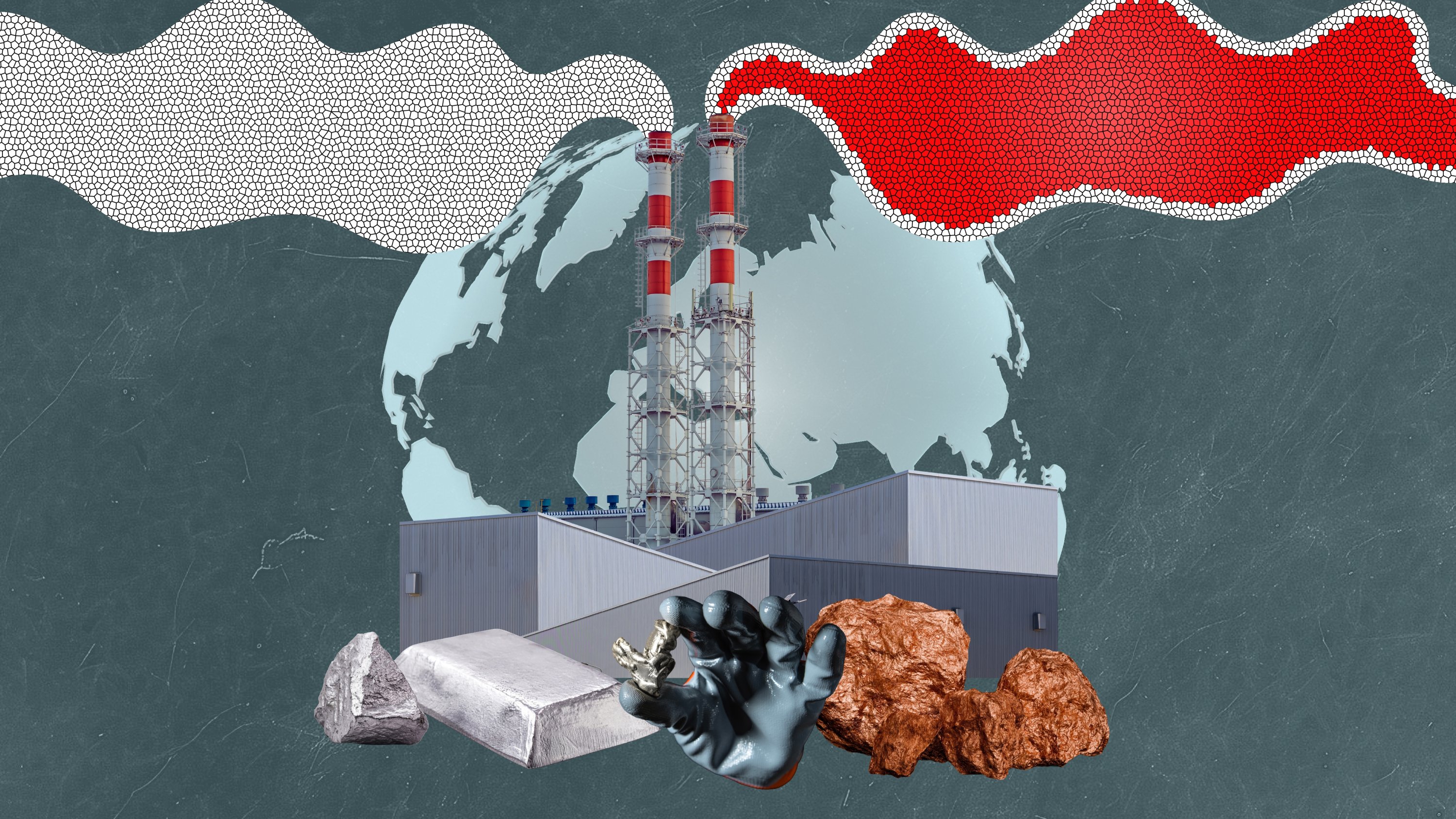
Türkiye is one of the world's largest economies, with a gross domestic product (GDP) of approximately $1.5 trillion. According to the Turkish Statistical Institute (TurkStat), manufacturing and construction account for more than 40% of the country's economic output. Reports published by institutions such as the Türkiye Exporters Assembly (TIM), the Union of Chambers of Turkish Engineers and Architects (TMMOB) and the Istanbul Chamber of Industry (ISO) show that Türkiye ranks among the world's leading producers of steel, white goods and automobiles. Turkish manufacturers have steadily expanded their presence across international markets, becoming increasingly competitive on a global scale.
Yet every great strength carries its own vulnerability. Behind Türkiye's impressive industrial capacity lies a structural weakness that receives far less attention than it deserves: our dependence on imported raw materials.
Despite the size of Türkiye’s metal-processing industry, the country still imports nearly $9 billion worth of steel, more than $6 billion worth of aluminium, and more than $3 billion worth of copper each year, according to SteelOrbis and the ISO. The stronger our manufacturing sector becomes, the more dependent it also becomes on a stable supply of raw materials.
The developments of the last decade have made this reality impossible to ignore. Wars across our region, the COVID-19 pandemic, geopolitical tensions, logistical disruptions and shifting global alliances have fundamentally changed the way supply chains operate. During the same period, copper and gold prices have nearly tripled, while steel prices have more than doubled.
The 21st century has demonstrated that controlling end-product markets is no longer sufficient. In an era shaped by geopolitical uncertainty, regional conflicts and fragile logistics networks, industrial competitiveness depends not only on manufacturing excellence but also on securing the entire supply chain.
For a metal producer, this challenge is particularly significant. Metal processing requires enormous amounts of energy, continuous production lines, large smelting furnaces and sophisticated downstream operations. Even a brief interruption in raw material supply can halt production and generate losses worth millions of dollars.
Securing raw materials is therefore about much more than guaranteeing supply. In today's volatile global economy, managing raw material costs often determines whether a company preserves its competitiveness or gradually loses it.
An overview of global production explains why.
Global copper mine production stands at roughly 23 million metric tons annually. More than half originates from only three countries, Chile, the Democratic Republic of the Congo and Peru, while over 80% is supplied by a relatively small group of producing nations, of which Türkiye is not one.
Iron ore presents a similar picture. Australia, Brazil, China, India and Russia account for the overwhelming majority of global production.
The aluminium market is even more concentrated, with China alone producing more than half of the world's supply, while around 10 countries control nearly 80% of global production.
The imbalance is evident.
Türkiye ranks among the world's leading manufacturing nations in several metal-intensive industries, yet it has limited control over the raw materials that sustain them. This industrial strength is genuine, but it also creates a strategic vulnerability. Every geopolitical crisis, supply disruption or sharp increase in commodity prices directly affects Turkish industry and, consequently, the broader Turkish economy.
Türkiye is fortunate to possess abundant natural resources. However, its geological endowment does not include sufficiently large reserves of the metals most critical to its industrial base, particularly iron ore, copper, and aluminium. According to TurkStat reports, Türkiye imported more than 5 million tonnes of iron ore in the first six months of 2026. A similar situation applies to copper: data from the Istanbul Chamber of Industry shows that Türkiye imported 76% of the copper required by its industry in 2025. According to a report by the Türkiye Aluminium Industrialists Organization (TALSAD), this ratio was even higher for aluminium, at 92%.
For this reason, Turkish companies should begin viewing investments in overseas mining projects not as diversification into an unrelated industry, but as a natural extension of their supply chain strategy.
Admittedly, mining is one of the world's most demanding industries. Transforming a mineral deposit into a reliable source of industrial raw material requires years of exploration, internationally accepted resource certification, substantial financing, complex operational management and an integrated logistics network. It is not a journey that most manufacturers can undertake alone.
This is precisely why many successful mining projects around the world are built through collaboration among international investors, operating companies and host governments. Such partnerships combine technical expertise, financial strength and local knowledge to create long-term, secure sources of supply. A few top metal producers from Türkiye recently started their mining investments in Africa and South America.
For Turkish industry, the real question is therefore not whether mining is difficult. It certainly is. The real question is whether manufacturers can invest their resources in founding a supply chain that extends from the soil of an overseas country until its doorstep.
For decades, industrial investment meant building larger factories, installing better machinery and expanding production capacity. That model served Türkiye well. However, today's global economy demands a broader perspective. Competitive advantage no longer begins at the factory gate; it begins where the raw material is extracted.
For large metal-consuming companies, investing in mining is no longer simply entering a new sector. It is a strategy for managing costs, reducing supply-chain risks and strengthening long-term competitiveness. In an increasingly uncertain world, controlling the source of production may ultimately prove just as important as controlling production itself.