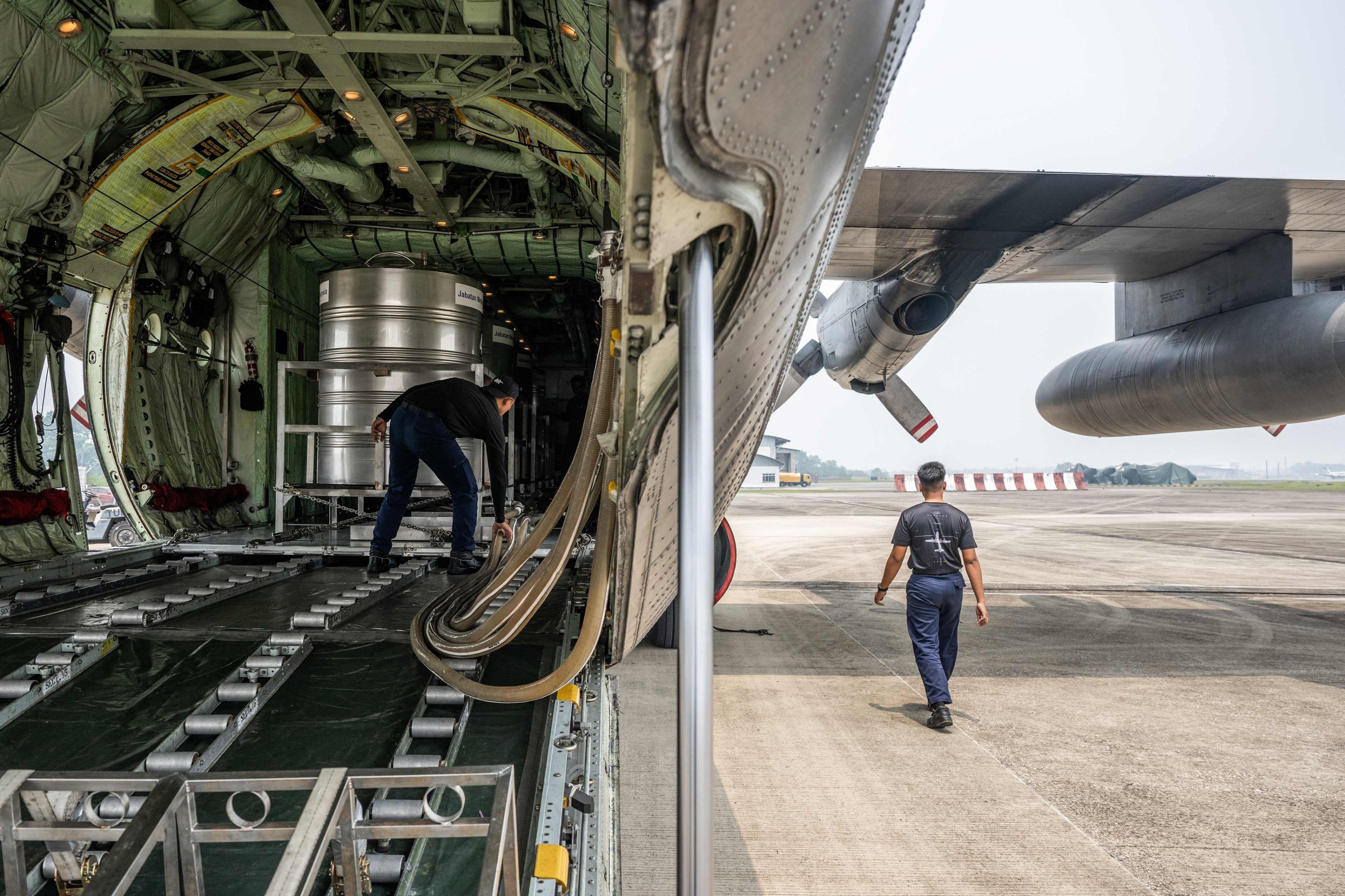
Malaysia is building a new Royal Malaysian Air Force (RMAF) “bare base” in Bintulu, and on paper, it makes sense. But as the project nears completion, there’s a bigger question worth asking: Will East Malaysia’s future security actually be best served by adding yet another fixed air base?
This isn’t just about military hardware. Malaysia is geographically split into two distinct landmasses, the Peninsula Malaysia, which borders Thailand to the north, and East Malaysia, comprising the states of Sarawak and Sabah on the island of Borneo. The two halves are separated by over 600 kilometers (370 miles) of South China Sea, making unified defense coverage across both territories a persistent strategic challenge.
The 48‑hectare RMAF bare base is near Bintulu Airport, located in a coastal city in central Sarawak that faces the South China Sea. Construction started in November 2024 and is due to finish by May 2028.
Its location is critical as Bintulu is much closer to Malaysia’s offshore interests in the South China Sea than the main bases further west. Furthermore, it sits near key features like Beting Patinggi Ali (Luconia Shoals), a group of contested reefs and shoals in the South China Sea where Chinese coast guard vessels have been repeatedly sighted near Malaysian-claimed waters, as well as important offshore energy infrastructure.
Malaysia has already acknowledged this gap. In 2026, the RMAF confirmed an air‑defense radar was being set up at Bintulu to help close surveillance holes in strategic parts of Malaysian airspace.
But Bintulu shouldn’t be seen as just another airfield. Its real value is how it plugs into a wider network of sensors, aircraft, drones, naval assets and maritime enforcement agencies. A bare base is useful precisely because it gives Malaysia a forward location to deploy existing assets when circumstances demand it, instead of locking everything into one permanent site.
East Malaysia covers around 198,000 square kilometers – about 60% larger geographically than Peninsular Malaysia, yet most air bases are still located on the peninsula.
The RMAF operates established facilities across Peninsular Malaysia – Butterworth in the northwest, which serves as the country’s main fighter base covering the Strait of Malacca and northern approaches; Kuantan on the east coast, oriented toward the South China Sea; Subang near Kuala Lumpur as a central logistics and transport hub; and Gong Kedak and Ipoh for additional air defense coverage. In contrast, East Malaysia relies primarily on just two locations: Kuching in the far southwest of Sarawak, and Labuan, a small federal territory island off the coast of Sabah that serves as the regional air hub.
Bintulu fills the wide gap between these two – covering the central South China Sea approaches that neither Kuching nor Labuan can efficiently reach. It clearly fills a geographical gap in Sarawak. But Sabah is not so linear.
To refute the imbalance, however, in eastern Sabah, the security challenge isn’t just conventional air defense. During the 2013 Lahad Datu incursion, in which 200 armed followers of a self-proclaimed Sultan of Sulu from the southern Philippines landed on Sabah’s east coast, a weeks-long military standoff was triggered. Since then, Malaysia has built the Eastern Sabah Security Command (ESSCOM) as a multi-agency setup focused mainly on maritime surveillance.
ESSCOM was established to secure eastern Sabah’s coastline against cross-border threats from the Sulu-Sulawesi maritime zone, including piracy, kidnap-for-ransom activities, illegal immigration, and arms smuggling originating primarily from the southern Philippines.
This distinction matters as multiple operations showed how eastern Sabah’s security issues are interconnected on smuggling, immigration and wildlife violations, not just “military threats.” Building another air base alone can’t solve that web of problems.
Interestingly, Malaysia’s most notable recent defense move in eastern Sabah points in another direction. The Tun Sharifah Rodziah Sea Base, which had operated off Semporna since 2015, was decommissioned in June 2026. Instead of simply replacing it with another fixed platform, the government is procuring a Turkish‑built multi‑purpose command platform.
This new platform is designed to provide a more mobile forward operating capability, equipped with long‑range surveillance radar and unmanned systems, including unmanned aerial and surface vehicles.
In effect, Malaysia is moving from protecting territory through fixed points to protecting a wider security domain through mobility. For eastern Sabah, that makes a lot of sense. The RMAF already has Labuan – a federal territory island off Sabah’s west coast – as a regional air hub, while Tawau, situated near Malaysia’s border with Indonesia and the Philippines in southeastern Sabah, provides air support for the eastern Sabah area. Naval and maritime assets, ESSCOM and other enforcement agencies, add another layer.
The new Turkish‑built command platform will extend the ability to monitor and respond across the waters of the Eastern Sabah Security Zone.
So, does eastern Sabah need another air base?
This doesn’t mean another air base should never be built. It means the question should be asked differently.
A permanent air base in eastern Sabah would have to justify its cost against what it adds to an already expanding network. Would it substantially reduce response times? Would it host permanently stationed aircraft? Would it provide capabilities that Labuan and Tawau cannot? Would it improve surveillance, rather than merely add another runway? And, most importantly, would it strengthen the maritime‑security architecture or duplicate it?
These are the questions Malaysia should answer before deciding where to put another base.
And Semporna – a coastal town in eastern Sabah close to the Sulu Sea and historically vulnerable to cross-border incursions from the Southern Philippines – is an obvious location to consider because of its proximity to the maritime frontier and its importance as a tourism and economic center. But strategic geography alone isn’t enough. The area already benefits from military, maritime and enforcement assets. The new command platform will also provide a mobile presence at sea rather than tying every capability to land.
This is where Bintulu offers a useful lesson. The purpose of the new bare base isn’t simply to put more aircraft on the map. It’s to create strategic depth. Malaysia can disperse and reposition assets while reducing its dependence on a small number of established bases.
That principle could be more valuable than constructing another conventional air base in eastern Sabah.
Malaysia should instead consider a layered model: Fixed bases where they are genuinely necessary; bare bases and periodic operating locations where flexibility matters more; mobile maritime command platforms where the threat is predominantly offshore; and unmanned surveillance systems where persistent monitoring matters more than permanent aircraft presence.
The RMAF’s Anka unmanned aerial systems add another dimension to this architecture. These systems can provide persistent intelligence, surveillance and reconnaissance without requiring the same infrastructure and operating patterns as conventional combat aircraft.
The future East Malaysian security network should focus less on counting bases and more on measuring coverage.
Can Malaysia detect an intrusion early enough? Can it identify what is approaching? Can information move quickly between the RMAF, Royal Malaysian Navy, Malaysian Maritime Enforcement Agency and ESSCOM? Can an aircraft, ship or unmanned system be deployed before a security incident becomes a crisis?
These are the indicators that should determine whether another base is necessary.
Bintulu is a good start because it recognizes that East Malaysia requires greater strategic depth. But it should not automatically become the argument for another dozen fixed installations. By 2030, Malaysia should have a clearer picture of what Bintulu contributes to the national defense network. If there remains a genuine coverage gap in eastern Sabah, then a new air facility should be considered. If there isn’t, Malaysia should resist the temptation to build simply because geography appears to demand another dot on the map.
The more modern answer may be found offshore, in the air and increasingly in unmanned systems. For Malaysia, the strategic objective should not be to have more bases. It should be to have fewer blind spots.