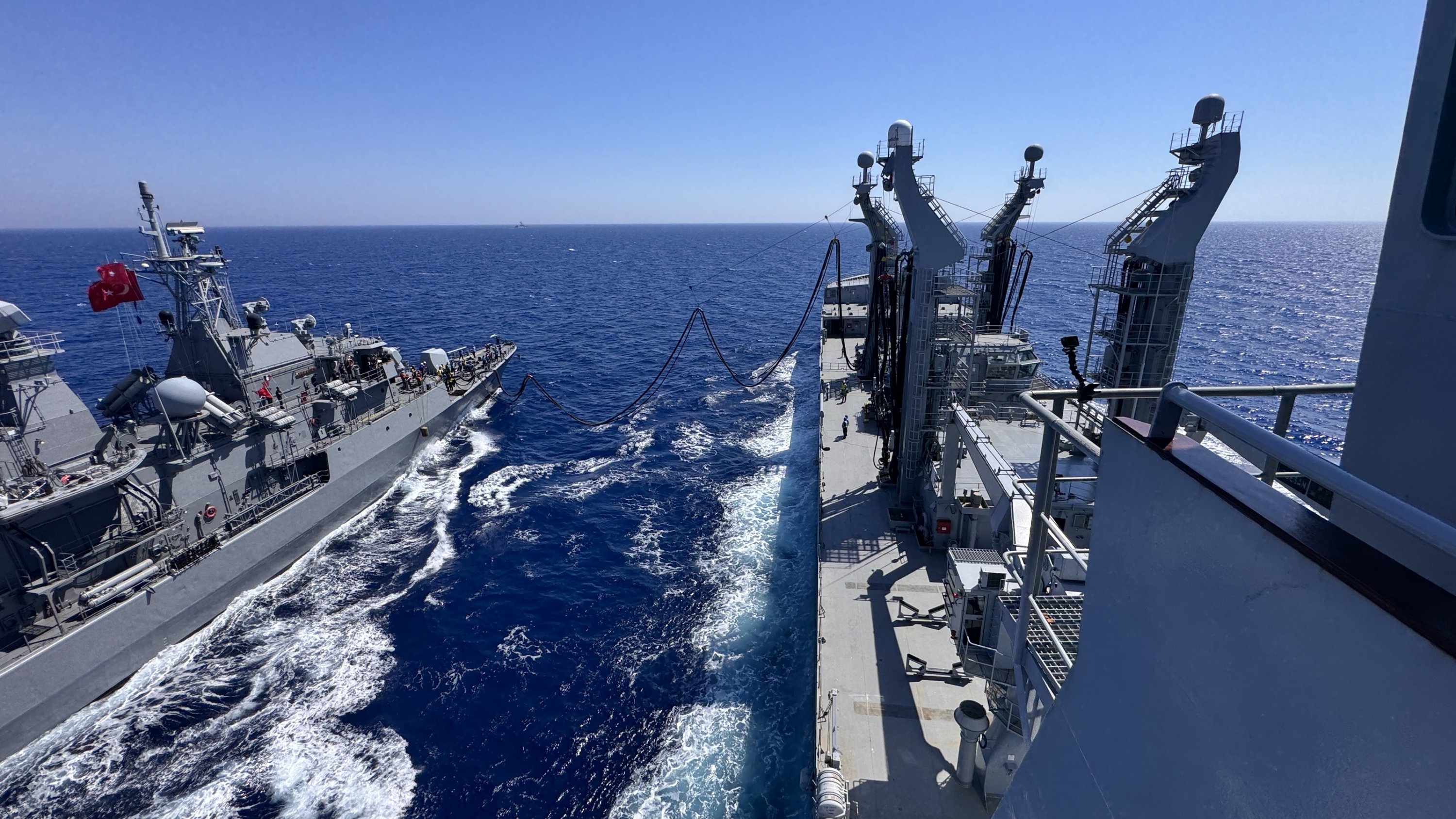
The source of the most recent tension in Turkish-Greek relations is the "Blue Homeland" draft bill – a piece of domestic legislation in Türkiye that has not yet even been tabled in the Turkish Parliament. Although it is still merely a draft, the tension it has generated once again highlights a cyclical impasse in Turkish-Greek relations that has emerged over the last 30 years, with the EU at its center.
This impasse arose when Kostas Simitis, who came to power in Greece in 1996, abandoned the policy of keeping Türkiye out of the EU and effectively recast the bilateral issues as a Türkiye-EU problem. The shift aimed to offset the power asymmetry with Türkiye, while many assumed the EU's soft power would help resolve the disputes peacefully. This assumption appeared to hold for a short while, but the EU's influence has instead come to entrench the status quo and perpetuate the problems.
The "Blue Homeland" doctrine, which took shape over the 2010s, covers Türkiye's maritime zones – continental shelf, territorial waters and exclusive economic zone (EEZ) – across the Black Sea, Aegean and Mediterranean. It gained prominence after the 2020 EEZ delimitation agreement with Libya and is a major source of tension with Greece, with which Türkiye has unresolved maritime boundary issues.
Despite this doctrine, Türkiye has enacted only the 1982 Territorial Waters Act as the fundamental framework for its maritime zones under domestic law. Presented by Ankara University's National Centre for the Sea and Maritime Law (DEHUKAM), the draft bill appears – though not yet enacted – to establish the domestic legal basis for arguments Türkiye has advanced for years.
Indeed, according to Yücel Acer, a member of the Presidential Council on Legal Policies, the traditional Turkish approach – that territorial waters in the Aegean should be six nautical miles – is maintained.
Even so, this DEHUKAM presentation, short on public detail, drew significant reactions from both the government and opposition in Greece, amplified by the Greek press and looming elections. Members of the government have characterized the move as a unilateral and revisionist act contrary to the United Nations Convention on the Law of the Sea (UNCLOS).
Opposition parties have gone even further: Their proposals have ranged from a 12-nautical-mile extension of Greek territorial waters in the Aegean – which Türkiye deemed a "casus belli" in 1995 – to the suspension of all EU programs relating to Türkiye.
The main basis for the Greek side's objections is the provision granting the Turkish president the authority to designate "maritime areas with special status" in zones where an EEZ has not yet been declared. This authority, it is argued, opens the door to unilateral expansion in disputed areas. However, this criticism overlooks the structural nature of the problem: In a sea where no delimitation treaty binds the parties, both states are filling the legal vacuum using means of their own choosing.
While Türkiye does so through domestic codification, Greece, in the same period, has floated unilateral options such as a marine park in the Eastern Aegean. The issue, then, is not that one side is "revisionist" while the other is "status quo"; rather, in the absence of a treaty-based framework, both seek to consolidate their positions through unilateral moves. More tellingly, the draft bill even surfaced in the European Parliament's 2025 report on Türkiye, adopted on June 17, 2026, which called on Türkiye to respect the sovereignty of all EU member states over their territorial waters.
At the root of the disputes lie either differing interpretations of an existing treaty or matters that require the parties to reach a bilateral agreement. The demilitarization of the Aegean islands, for instance, turns on conflicting readings of the 1923 Lausanne and 1947 Paris treaties; EEZ delimitation, in contrast, requires a bilateral agreement that does not yet exist.
Resolving such issues requires mutual concessions, not maximalism. Yet the EU's almost unconditional support for the Greek position is one of the greatest obstacles to Greece abandoning its maximalist stance toward Türkiye, a candidate country.
Greece resisted announcing its maritime spatial plan in the Aegean – which conflicts with Türkiye's claims – for years, until the Court of Justice's 2025 ruling compelled it to do so, triggering a new crisis. Moreover, Greece's strategy of internationalizing the dispute rests on a legal foundation more fragile than it appears.
Almost all of Athens' arguments against Türkiye invoke UNCLOS and the compulsory dispute-settlement mechanisms it provides. But Türkiye is not a party to this convention, so neither its provisions on island rights nor its dispute-settlement procedures bind Ankara.
The position Greece defends as "international law" therefore amounts to imposing on Türkiye a text it has never signed. In fact, both UNCLOS and customary international law point first and foremost to a negotiated bilateral agreement as the method of delimitation – precisely the approach Türkiye has advocated for years.
Consequently, the EU's general stance is one of the most significant external factors perpetuating these disputes, and the EP's criticism of the bill is the most recent instance of this. Mirroring the populist rhetoric of Greece's election season, the criticism shows once again how asymmetric the EU's role in Turkish-Greek relations has become. Just as the EU's pre-referendum assurance in 2004 – that it would admit the Greek Cypriot administration to full membership as the whole island's representative, regardless of the result – was a key reason for the Greek Cypriot "no" vote, such one-sided support today is one of the key factors keeping Greece from the negotiating table with Türkiye.