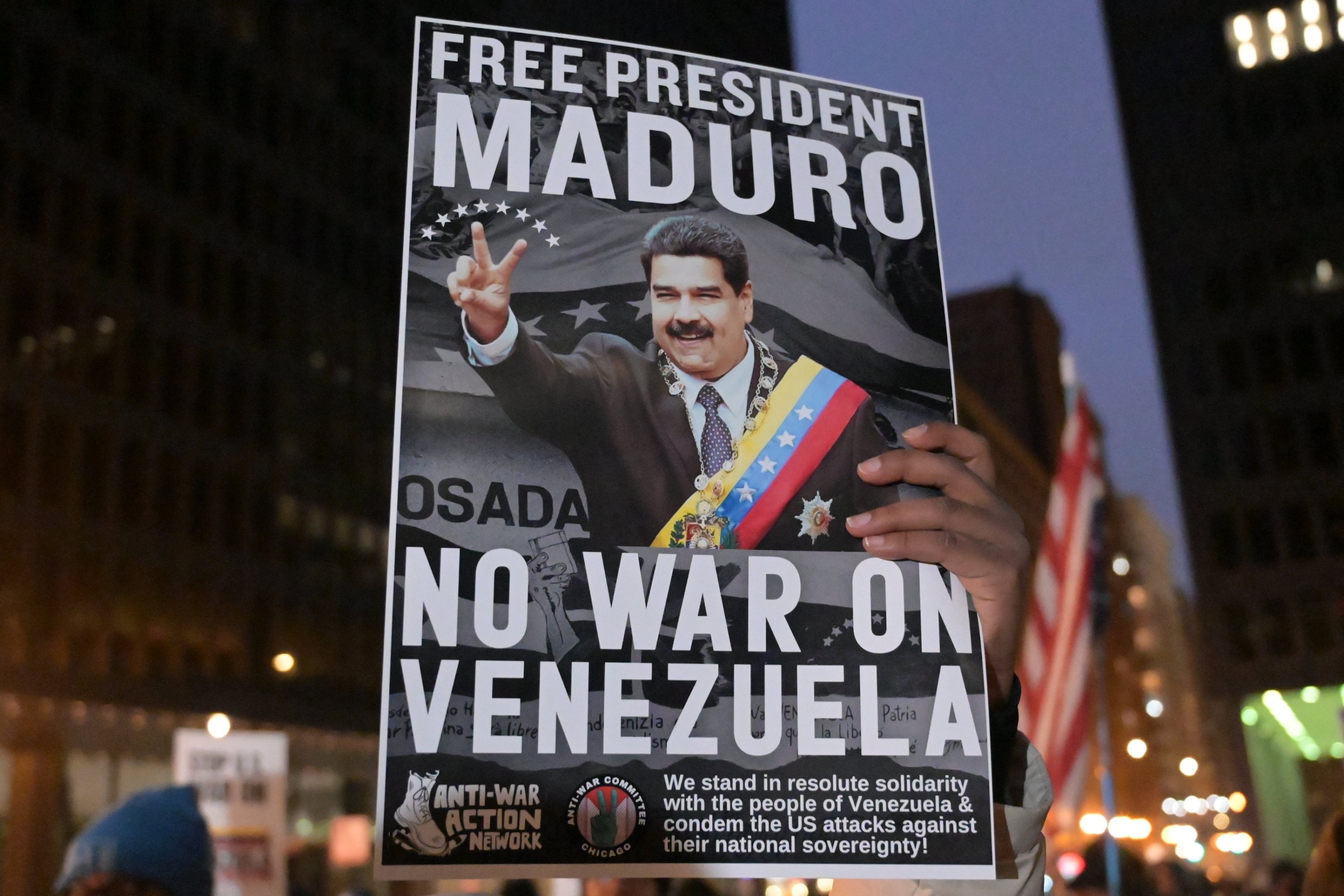
The night of Jan. 3 marked a watershed moment in the post-Cold War international order. In an unprecedented move, the United States effectively seized the sitting president of another sovereign state, Venezuela’s Nicolas Maduro. This came after Washington's carrying out a military operation in northern Nigeria, invoking the familiar yet elastic justification of the “war on terror.”
Taken separately, each incident might be framed as an exceptional response to extraordinary circumstances. Taken together, however, they raise a far more consequential question: What do these consecutive aggressive actions signal about the trajectory of U.S. foreign policy and the broader international system?
In the cold calculus of 21st-century realpolitik, Daesh has become the ultimate "useful tool" for waning Western hegemony. For an American administration looking to bypass the frustrating barriers of African sovereignty and the rising tide of anti-Western sentiment, the "Daesh brand" provides the perfect moral and legal pretext for intervention. Under the guise of a "Christmas present" to protect religious minorities, Washington has successfully re-militarized its African policy without the burden of long-term nation-building or economic investment.
By elevating a fragmented group of militants in the Bauni forest into an existential global threat, the U.S. creates the very "AUMF-able" monster it needs to justify its presence near the continent’s vital resource corridors. In this theater of "kinetic diplomacy," the terrorist is not an enemy to be fully defeated, but a convenient justification to be managed. This justification is a shadow that allows the U.S. to challenge Chinese checkbooks and Russian mercenaries with the only language it still speaks fluently: the language of the drone.
The dawn of 2026 has arrived not with the promised "Trumpian Peace" of the early 2025 rhetoric, but with the smoke of explosions in Caracas and the high-stakes drama of a captured president. As the news of the overnight operation to seize Nicolas Maduro reverberates across the globe, the carefully curated image of U.S. President Donald Trump as the "Nobel-seeking peace-bringer" in Ukraine and Gaza has finally been stripped away. In its place stands a 21st-century iteration of James Monroe, wielding a "Trump Corollary" that treats the Western Hemisphere not as a community of nations, but as a private frontier: a "Wild West" where Washington makes the rules and the law is whatever the "sheriff" says it is.
Throughout the first half of 2025, the world watched a strategic performance. The White House spoke of "ending wars" and positioned itself as the grand mediator in Eurasia. Yet, while the cameras were focused on the Dnieper and the Mediterranean, the real "America First" agenda was being quietly sharpened in the Caribbean.
The strategy, codified in the National Security Strategy (NSS) of December 2025, revealed the true intent: the Western Hemisphere is no longer just a "shared neighbourhood." It is a Fortress. The Trump administration has effectively resuscitated the 1823 Monroe Doctrine, but with a predatory, transactional twist. This "Trump Corollary" declares that U.S. preeminence is the primary condition for American prosperity, granting Washington the self-appointed right to "assert itself with confidence" wherever and whenever it deems its economic or security interests threatened.
In his latest press conference, delivered with the swagger of a man who believes he has just "settled" the history of the Western Hemisphere, Trump stood before the world and declared that the U.S. would do "whatever it takes" to "stabilize" Venezuela. To the uninitiated, his words sounded like a promise of order. To those who understand the cold gears of geopolitics, it was a funeral oration for the "rules-based international order."
Trump’s public overtures about "collaborating with local governments" and "protecting American companies" are the velvet gloves on an old and heavy iron fist. Behind the talk of stability lies a brutal recalibration of Great Power politics, which is one that is effectively turning the globe into a collection of isolated, soundproof glass bulbs.
Imagine the world not as a global village, but as a series of separate glass bulbs. Inside each bulb, there is one rooster. During the Cold War, we had two such bulbs: one in Washington and one in Moscow. Within their respective glass walls, these roosters could scream as loud as they wanted, and no one from the outside could or would intervene.
Today, Trump is rebuilding the American bulb with a "guns-a-blazing" zeal. By capturing Nicolas Maduro and effectively announcing a corporate takeover of Venezuelan oil reserves, Trump is signalling to Beijing that the "Western Hemisphere" bulb is now airtight. He is telling the world: "In this sphere, I am the only one who screams." This is the essence of the "Trump Corollary" to the Monroe Doctrine. It is no longer about shielding the Americas from foreign colonization; it is about the absolute exclusion of any rival voice.
Trump’s "Peace Prize" posturing in Ukraine and Gaza was merely a strategic distraction, which is a way to clear the deck so he could return to the "Wild West" of his own backyard and reclaim the resources he believes are rightfully American.
Moving forward, the global community must prepare for the "Great Partitioning." The soundproof glass bulbs Trump is constructing are not anomalies; they are the new blueprints for 21st-century survival in a post-rules world. Expect a rapid hardening of regional boundaries where the hollow shell of sovereignty is sacrificed on the altar of raw "security transactions."
As Washington retreats into its hemispheric fortress to extract Venezuelan crude and Nigerian minerals, Beijing will inevitably cement its own airtight spheres. In this landscape of lawless frontiers, the true challenge lies with middle powers. The question is no longer how to preserve the old order, but whether these actors can leverage their strategic autonomy to navigate the cracks between these bulbs or if they will be the first casualties when the glass eventually shatters.