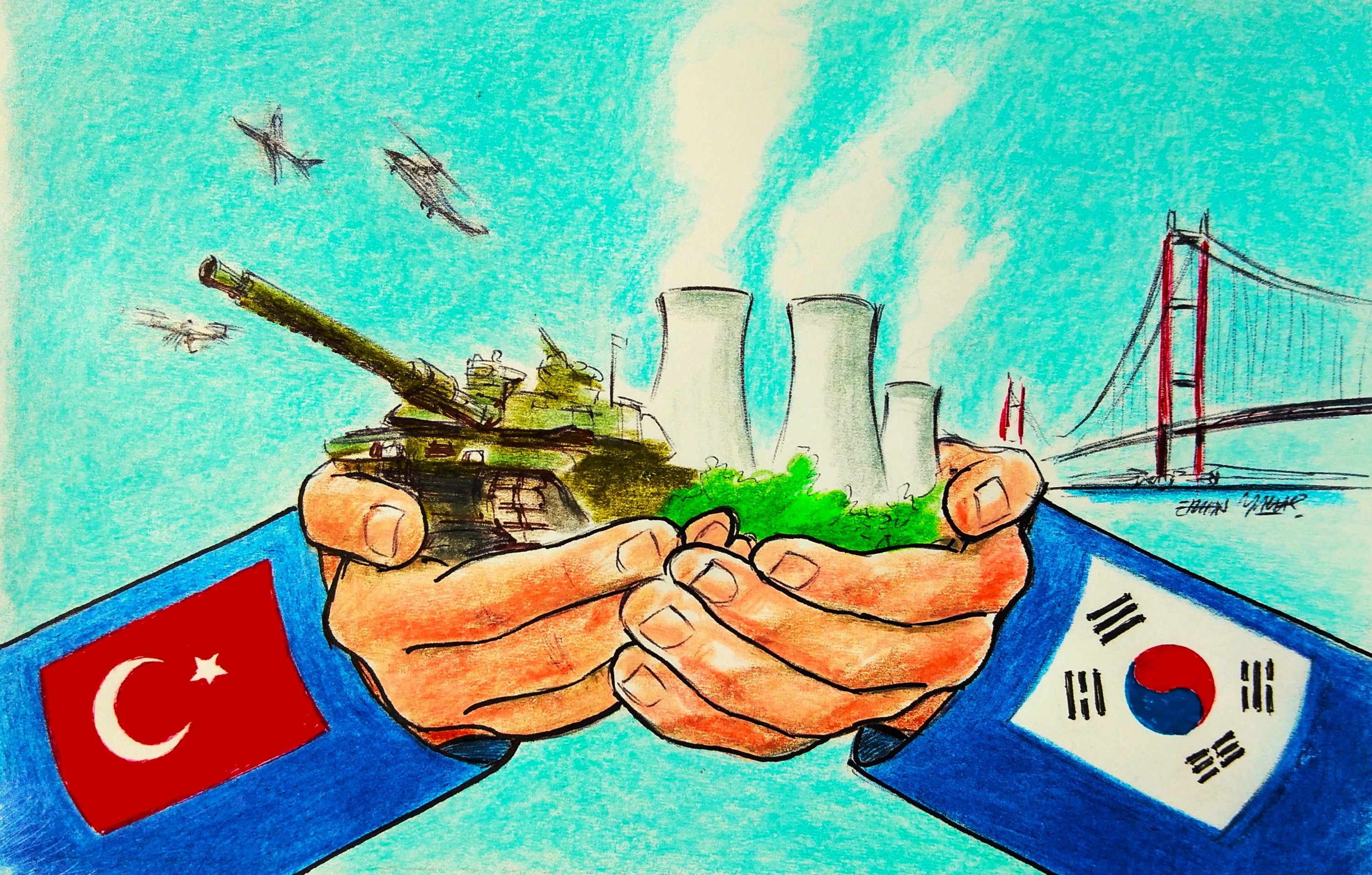
For decades, South Korea and Türkiye have described each other as “blood brothers,” a phrase rooted in shared sacrifice during the Korean War. The emotional resonance of that bond has endured across generations, shaping public perception and diplomatic warmth between the two nations. Yet history, however meaningful, does not automatically translate into strategic relevance. In today’s rapidly changing international order, the more pressing question is whether that trust can evolve into a structured, future-oriented partnership, particularly in the field of defense and strategic industries.
The global security environment has entered a period of profound transformation. Great-power competition has intensified across Europe, the Indo-Pacific and the Middle East. Supply chains are increasingly politicized. Access to advanced technologies is restricted by export controls. Defense industrial resilience has become not merely a military concern but a pillar of national strategy. In such an environment, middle powers cannot rely exclusively on traditional alliances. They must diversify partnerships, build trusted industrial networks and strengthen their own strategic autonomy.
This is precisely where South Korea-Türkiye defense cooperation becomes both timely and consequential.
Over the past two decades, South Korea has emerged as one of the world’s most dynamic defense producers. Once heavily dependent on foreign suppliers, Seoul has transformed itself into a technologically advanced exporter of armored vehicles, self-propelled artillery, naval platforms, fighter aircraft, missile systems and integrated combat technologies. Korean firms have demonstrated an ability not only to manufacture high-quality systems, but also to deliver them efficiently and at scale.
Seoul’s recent proposal of the MASGA (Make America Shipbuilding Great Again) initiative to the United States illustrates this transformation. MASGA was not merely a commercial offer, it signaled Korea’s readiness to contribute to revitalizing allied shipbuilding capacity and to participate actively in shaping future maritime security architectures. In essence, it conveyed a broader strategic message: South Korea sees itself as a reliable, high-capacity defense partner capable of operating within global production networks and contributing to long-term security stability.
This industrial confidence matters greatly for Türkiye at a pivotal moment in its own defense evolution.
Ankara has made remarkable progress in strengthening its indigenous defense capabilities. From unmanned aerial systems to missile development and the TF-X next-generation fighter program, Türkiye has pursued a determined path toward strategic autonomy. Its achievements in drone warfare and precision systems have already reshaped regional military calculations.
At the same time, Türkiye is undergoing an ambitious naval modernization drive. The commissioning of the TCG Anadolu represents a strategic milestone, reflecting Ankara’s expanding maritime vision. Designed as a multipurpose amphibious assault ship with an evolving unmanned aviation concept, Anadolu signals Türkiye’s intention to enhance expeditionary capability and maritime presence.
Yet naval modernization is not defined by a single flagship platform. For Anadolu to operate effectively as the centerpiece of a maritime task force, it requires a balanced and resilient fleet structure. Modern air-defense destroyers capable of long-range interception, advanced frigates with integrated combat systems and stealthy submarines providing undersea deterrence are all essential components of layered maritime defense. Naval strength today is not about prestige, it is about survivability, deterrence and the ability to secure sea lanes, offshore energy assets and regional stability across the Black Sea, Aegean and Eastern Mediterranean.
Here, South Korea’s experience becomes particularly relevant.
Korean shipyards have developed Aegis-equipped destroyers, advanced conventional submarines with air-independent propulsion systems and sophisticated amphibious platforms. More importantly, Korea’s defense industry excels in systems integration, combining radar networks, missile architectures, electronic warfare capabilities and command-and-control frameworks into coherent operational structures.
As Türkiye strengthens its fleet, cooperation in propulsion technologies, combat system integration, sensor fusion and weapons deployment could significantly accelerate capability development while reinforcing Türkiye’s domestic industrial base.
It is important to emphasize that strategic autonomy does not mean isolation. Sustainable autonomy often depends on carefully selected partnerships that enhance domestic capability without creating structural dependency. Korea’s defense cooperation model is particularly aligned with this philosophy. Rather than relying on simple export transactions, Korean firms frequently engage in co-production, technology collaboration and long-term industrial integration.
Previous cooperation between Korean and Turkish industries, particularly in armored and artillery systems, demonstrated that both sides could benefit while reinforcing Türkiye’s domestic production capacity. Such experiences show that defense collaboration between Seoul and Ankara need not undermine local industry; it can, in fact, strengthen it.
Beyond the defense sector, the broader industrial foundation between the two countries is already substantial. Major Korean corporations such as Hyundai Motor Group, POSCO, Samsung and LG have operated in Türkiye for years. They have invested in manufacturing facilities, infrastructure projects and advanced industrial ecosystems. These civilian partnerships have created institutional familiarity, supply-chain integration and deep business trust.
This accumulated experience is strategically valuable. Defense cooperation requires not only technological compatibility but also long-term industrial coordination and political reliability. When companies, engineers and policymakers have already collaborated successfully in civilian industries, expanding cooperation into strategic sectors becomes significantly more feasible.
At a broader geopolitical level, South Korea and Türkiye occupy comparable positions within the global hierarchy. Neither is a superpower, yet both are influential regional actors with advanced industrial capabilities, diversified diplomatic networks and strategic geography. Both have demonstrated an ability to act independently while maintaining alliances. Both seek resilience rather than confrontation.
In an era dominated by major power rivalry, cooperation between capable middle powers can provide diversification and balance. By deepening defense collaboration, Seoul and Ankara can reduce overdependence on any single supplier or bloc. They can strengthen supply-chain resilience and enhance strategic flexibility.
Moreover, such cooperation sends a broader message about the evolving architecture of global security. The future international order will not be shaped solely by the largest powers. Middle powers with technological capacity and strategic vision will play an increasingly important role in stabilizing regional environments and contributing to collective security frameworks.
The evolution from “blood brothers” to strategic partners is therefore a structural necessity.
The emotional bond forged during the Korean War provides a rare foundation of trust in an industry where political alignment and reliability are as important as hardware performance. In the defense sector, contracts often span decades. Industrial ecosystems are deeply intertwined with national security. Trust cannot be improvised; it must be built over time. Korea and Türkiye already possess that trust.
The next step is to institutionalize it through structured cooperation, long-term planning and strategic dialogue.
If properly managed, deeper defense collaboration between South Korea and Türkiye could become one of the most tangible pillars of their bilateral relationship. It can expand industrial capacity, stimulate innovation, create export synergies and strengthen regional deterrence. It can reinforce Türkiye’s pursuit of strategic autonomy while positioning South Korea as a trusted global defense partner.
In a world where alliances are tested, supply chains are weaponized and maritime competition intensifies, partnerships grounded in both emotional solidarity and practical complementarity stand out.
Korea and Türkiye have the rare advantage of possessing both.
History created the bond. Strategy must now define its future.