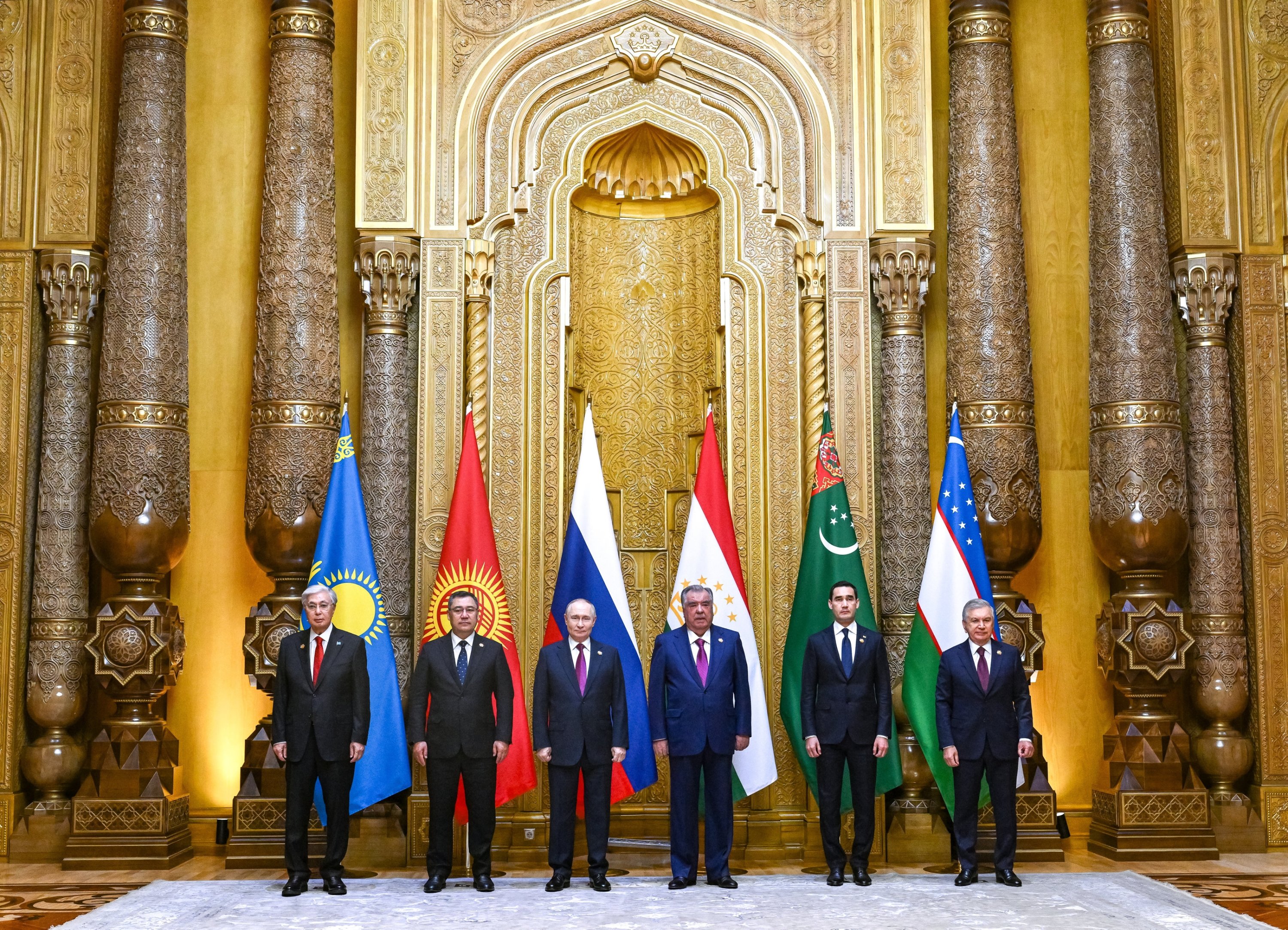
The Second Central Asia-Russia Summit, held in Dushanbe, the capital of Tajikistan, on Oct. 9, 2025, stood out as a concrete reflection of Moscow's efforts to reestablish its geopolitical influence in the Eurasian region.
The summit, attended by the leaders of Kazakhstan, Kyrgyzstan, Uzbekistan, Turkmenistan and Tajikistan, had a multidimensional agenda covering economic integration, strengthening transport networks, energy cooperation, security coordination and cultural rapprochement.
The final communique issued at the end of the summit revealed that there was a desire to institutionalize a multilateral cooperation framework between Russia and Central Asian countries in the economic, security and humanitarian spheres. However, the text's language makes clear that the communique goes beyond cooperation commitments and serves as a roadmap for Moscow's strategy to reestablish itself as the center of the Eurasian order.
The final communique of the Second Central Asia-Russia Summit has highlighted the concept of “multipolarity,” which has long been central to Russia's foreign policy discourse. The emphasis in the document on the “emerging multipolar world order” reflects Moscow's goal not only of counterbalancing the Western-centric international system, but also of establishing a new normative order centered on Eurasia under its leadership. In this context, the concepts of “diversity of development models” and “indivisibility of security” highlighted in the declaration form the ideological basis of Russia's search for legitimacy in the post-unipolar era.
With this rhetoric, Moscow is promoting the idea of a “civilization-based order” that respects the diverse political and economic systems of states in Eurasia and is independent of Western values. This approach is a regional extension of the concept of “sovereign democracy” developed by Russia since the 2000s. According to the Kremlin, stability in Eurasia can only be achieved by building a multicentered security architecture free from Western interference.
Moscow's vision is supported by efforts to harmonize the region's institutional multiplicity within a strategic framework. The call to "harmonize" the potential of organizations in Eurasia reveals Russia's aim to create a multilayered Eurasian order encompassing economic, security and cultural dimensions by turning structures such as the Commonwealth of Independent States (CIS), the Eurasian Economic Union (EEU) and the Collective Security Treaty Organization (CSTO) into complementary mechanisms. Thus, Moscow aims to consolidate its leadership in the region not only through military or economic means, but also through institutional integration.
Cultural diplomacy occupies a prominent place in Russia's regional strategy, as much as its economic orientation. The emphasis in the declaration on establishing the “International Russian Language Organization” demonstrates the Kremlin's intention to bring soft power back to the fore. Russia views language and culture not merely as tools for interaction, but as symbolic carriers of a shared Eurasian identity. This perspective is part of Moscow's efforts to produce a “Eurasian counternarrative” against the cultural and ideological influence of the West.
Similarly, references in the statement to “preserving our shared historical heritage” and “the 80th anniversary of the Great Patriotic War” reveal the Kremlin’s tendency to use the shared past with Central Asian societies as an ideological bond and a basis for legitimacy. With this rhetoric, Russia aims to revive the weakened historical bonds of solidarity in the post-Soviet era and transform post-Soviet identity consciousness into a culture of collective solidarity.
Moscow's Eurasian vision brings all these elements together, positioning the region as the center of an alternative international order. However, this strategic design does not fully correspond to the dynamics on the ground. Central Asian countries interpret multipolarity differently, in line with their growing independence and national-interest-based policies, complicating the formation of the uniform Eurasian unity envisaged by Moscow.
The Dushanbe Summit has highlighted Moscow's efforts to reestablish its influence in the region, as well as the determination of Central Asian countries to preserve their independence and maintain their diversified foreign policy lines. Although the leaders made commitments in a joint statement to strengthen regional cooperation, the summit's diplomatic language reflects the countries' desire to conduct relations with Russia on an equal footing.
In recent years, Central Asian capitals have shifted their foreign policies away from dependence on a single center, building instead on a multivector strategic balance policy. This has enabled the region to gain a more autonomous position, both geopolitically and economically. Kazakhstan's principle of a “multivector foreign policy,” Uzbekistan's approach of “open regional cooperation” and Turkmenistan's “neutrality diplomacy” are concrete examples of this trend. While maintaining relations with Russia, all three countries have chosen to benefit simultaneously from China's economic investments, the European Union's green transition projects and Türkiye's partnerships in infrastructure, defense and logistics.
This approach poses a certain challenge for Moscow. Although the Kremlin seeks to consolidate its influence in the Eurasian region through economic ties and security cooperation, Central Asian countries now view this relationship not as a complementary element but as a decisive axis. The concepts of “inclusive development” and “national interest-based cooperation” emphasized by regional leaders point to a search for a regional order based on mutual dependence rather than one centered on Russia.
In the economic sphere, Central Asian states are seeking to deepen their integration with the international financial system while maintaining their trade ties with Russia. China's Belt and Road Initiative (BRI), Europe's Middle Corridor projects and the transport networks within the framework of the Organization of Turkic States (OTS) offer new alternatives to the countries in the region. In this context, the Dushanbe Summit highlighted the delicate balance between Russia's efforts to maintain its economic pull and the Central Asian countries' independent development priorities.
In the field of security, cooperation is based on pragmatic grounds. Issues such as instability in Afghanistan, the threat of cross-border terrorism and illegal migration are leading Central Asian countries to coordinate with Moscow to a certain extent. However, this does not mean that strategic dependence on Russia is being reproduced. On the contrary, the countries in the region are seeking to strengthen their own defense capabilities by diversifying their collective security mechanisms. In particular, the multilateral contacts maintained by Kazakhstan and Uzbekistan with NATO, Türkiye and China are concrete reflections of this search for balance.
For the countries of the region, independence signifies more than just a foreign policy choice; it represents a redefinition of economic and cultural identity. Consequently, Central Asian leaders are developing a diplomatic discourse that emphasizes their national languages, local cultures and their own development models, while preserving their historical ties with Russia. This concretely demonstrates Central Asia's transformation from a “geopolitical object” to a “geopolitical subject” for the first time in the post-Soviet era.
The region is no longer under Russian control, but has become an active regional system in which multicentered powers intersect, developing partnerships with each actor at different levels. This transformation clearly demonstrates that, in the future of Eurasia, Central Asia has risen from a passive buffer zone to a balancing actor.