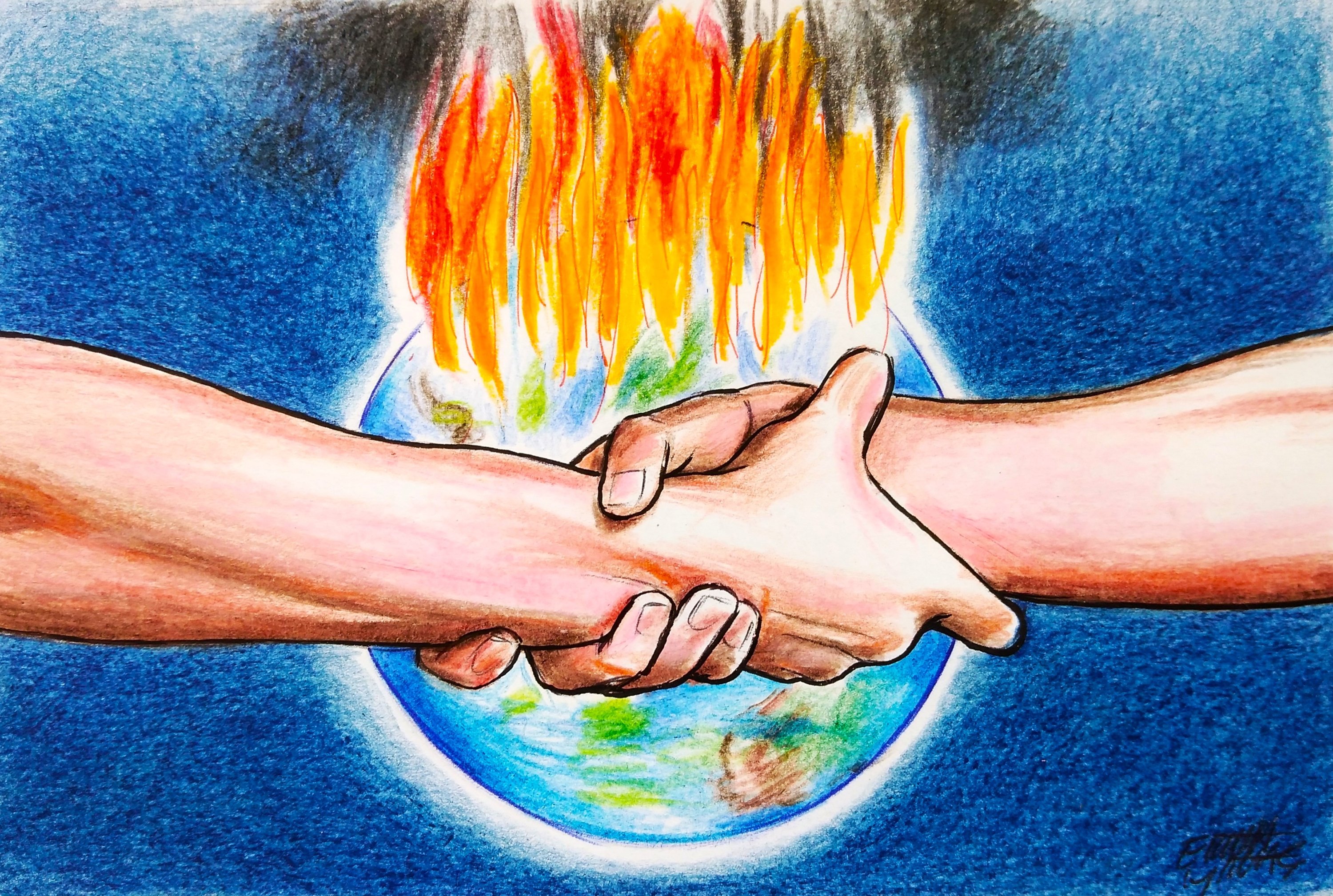
In the last decade, the summer season has become more of a nightmare than a holiday, due to forest fires, droughts and even unexpected icy weather. Of course, these events are not new, but their effects on our daily lives are quite new to everyone. Over the years, individuals, societies and states have become more prepared, but there is still a lack of strong, preventive and adaptive responses to the consequences of climate change during the summer.
Climate diplomacy evolved in reaction to the rising understanding of climate change as a worldwide concern that necessitates international collaboration. Its evolution may be traced back to important historical, scientific and political developments. In this respect, the question, how climate diplomacy can work for international cooperation to respond more effectively must be answered.
Climate change has transformed summer into a season of extremes, leading to intense heat waves, droughts and wildfires that form a catastrophic trinity. Rising global temperatures fuel longer, more intense heat waves, causing environmental, physical and psychological damage.
First of all, extreme heat waves have been one of the main long-term results of climate change in the long term. According to Climate Central’s Climate Change and the Escalation of Global Extreme Heat Report, around 4 billion people, almost half of the world's population, have experienced a minimum of 30 days of extreme heat. In more than 195 countries, the number of extreme heat days has doubled.
The numbers and research clearly prove that extreme heat waves are no longer an exception. They affect almost all continents in different ways, leading to drought and wildfires.
Secondly, extreme heat waves and a lack of rainfall create droughts. Numerous attribution studies demonstrating how climate change affects extreme events show that climate change contributes to the frequency or intensity of droughts. In addition to this, research shows an increase in the severity and likelihood of droughts in the Mediterranean, South Africa, Central and East Asia, southern Australia, and western North America due to global warming, with a high degree of confidence by the World Weather Attribution group.
Finally, climate change directly affects the season and intensity of wildfires. Globally, hotter and drier weather brought on by climate change is making fires more frequent, larger and more severe. Longer fire seasons and more intense fire behavior are caused by rising temperatures and shifting precipitation patterns. Each region has its own season for typical wildfires; however, one of the biggest changes is the changing seasonal norms. For example, the last wildfires in Los Angeles occurred in winter rather than the usual spring season.
The interplay between these three threats, exacerbated by climate change, creates a vicious cycle. In other words, heat waves accelerate evaporation, worsening droughts, while dry vegetation becomes tinder for wildfires. Once fires rage, they release massive amounts of carbon dioxide, further heating the planet and intensifying future climate extremes. Especially, regions like the Mediterranean, the western U.S. and Australia are already experiencing this deadly combination.
The consequences extend beyond the environment, disrupting economies, displacing communities and straining health care systems. To break this cycle, urgent action is needed; otherwise, without decisive intervention, summers will continue to grow hotter, drier and more dangerous, reshaping life in a warming world.
The world has been under threat economically and socially by harsh weather, droughts, flooding and changing climatic zones. There is no doubt that addressing climate change requires not only individual action by states but also strong regional and global cooperation. In this respect, the notion of "climate diplomacy" can help us understand at what level countries are cooperating.
An effective response to the consequences of climate change is complex and requires multiple actors. Accordingly, the phrase "climate diplomacy" began after countries accepted the United Nations Framework Convention on Climate Change (UNFCCC) in 1992.
Since 1992, the nature and tools of climate diplomacy have changed and diversified. The 2015 Kyoto Protocol can be considered a milestone in creating a flexible structure for actors. Climate diplomacy has become more complex as the global climate regime prioritizes implementation and risk management. As climate change became a more prominent issue in foreign policy and diplomacy due to rapid changes, it has led to the necessity of increased collaboration among state and independent players, as well as innovative techniques to build a worldwide debate on its effects and remedies.
Data show that regardless of governments’ capacity, the increasing number and intensity of wildfires make them unable to respond collectively. Under climate diplomacy, there are major international organization schemes like the U.N. collaborative initiative on Reducing Emissions from Deforestation and Forest Degradation (REDD+) and the U.N. Office for Disaster Risk Reduction (UNISDR) Global Wildland Fire Network. These programs create platforms for governments and local authorities to develop prevention and risk reduction strategies, respond to threats more effectively, and identify issues earlier by collaborating and combining local fire management strategies. Furthermore, the EU Civil Protection Mechanism facilitates the fast deployment of firefighting aircraft and personnel across member states during emergencies. Meanwhile, organizations like the G20 and Conference of the Parties (COP) summits provide platforms for nations to negotiate climate funds, assisting vulnerable regions to invest in fire protection, early warning systems, and sustainable land management.
In addition to this, climate diplomacy has added a new dimension to cross-border cooperation in bilateral relations between countries. Especially, neighboring countries have developed common policies and measures in wildfire management. This helps prevent larger-scale disasters that could impact ecosystems, communities, and economies locally, regionally, or even globally.
Climate diplomacy at the bilateral level facilitates advanced firefighting technologies; for example, Canada and the U.S. share resources and expertise with nations struggling to combat increasingly uncontrollable blazes. Moreover, cooperation between neighboring countries for wildfires facilitates positive outcomes both for mutual relations and for preserving forests. For example, Türkiye has helped Greece tackle wildfires in recent years, which shows the intersection of climate diplomacy and disaster diplomacy. The country also recently introduced its first climate law, which is expected to provide a more efficient framework for cooperation.
Obviously, geopolitical challenges and economic burdens make it harder to employ effective tools of climate diplomacy. However, the reality is that upcoming summers and seasons will be hotter than today, intensifying the consequences of climate change, including wildfires. There are some suggestions that states and non-state actors can consider for climate diplomacy.
At the global level, the Green Climate Fund can be used more efficiently to support fragile developing countries in the case of wildfires. As expected, regional cooperation has more potential to provide a fast response. Especially, recent research shows an anomaly in the number of extreme heat days and forest fires in the Mediterranean, North Africa and Middle East region; that’s why countries in those regions can establish official but long-term structured cooperation to have international firefighting teams, satellite monitoring, and warning systems.
Along with this, AI can be employed to expand cooperation. Also, it should be remembered that climate diplomacy has a multi-actor structure, which includes individuals as stakeholders; hence, not only state-to-state level but also civil society plays a key role in increasing awareness, knowledge exchange, and capacity building between societies. Consequently, climate diplomacy has become more important than ever while the consequences of climate change increasingly transcend borders, through smoke drift, displaced communities and economic disruptions.