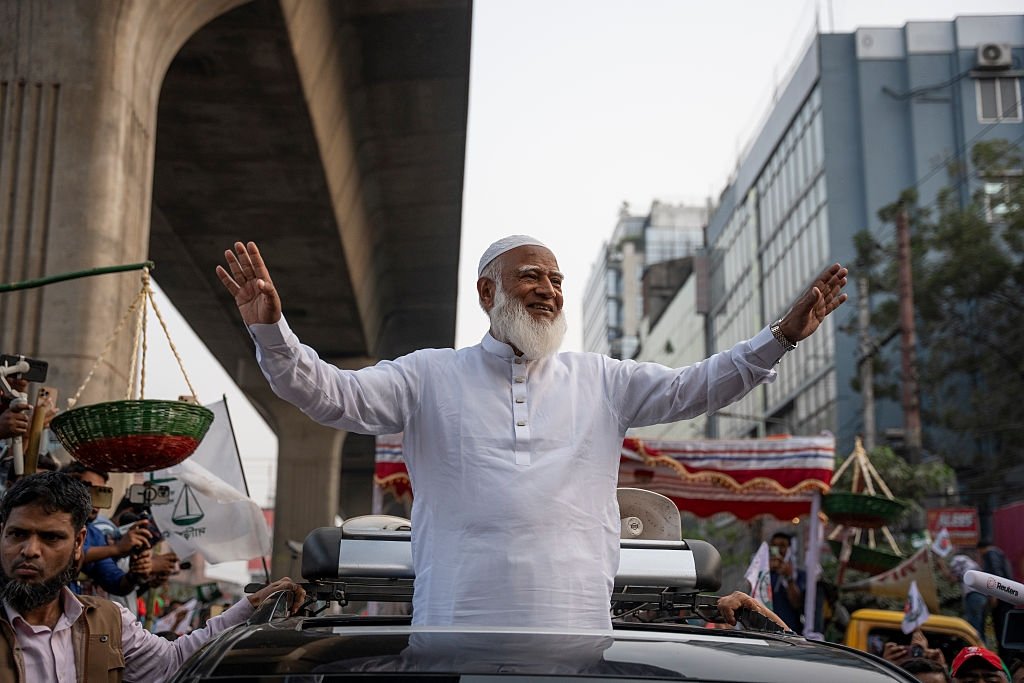
The recent national election in Bangladesh has produced a headline that many foreign observers find fascinating. Jamaat-e-Islami, the country’s oldest and most established conservative party, has emerged as the single most powerful opposition force in Parliament. Some international outlets have framed Jamaat’s gains as evidence of a conservative resurgence in Bangladesh. Drawing such a conclusion is too quick, and it confuses parliamentary arithmetic with ideological transformation.
The numbers are indeed compelling and deserve attention. Domestic reporting shows that Jamaat won 68 seats on its own, while the Jamaat-led alliance secured 77 seats in total, making it the main opposition bloc. This is the party’s strongest result in its history. Its previous best single-party performance was 18 seats in 1991. But precisely because these numbers are impressive, they must be interpreted carefully. Large electoral outcomes can result from structural conditions that have little to do with a deep shift in public belief.
Bangladesh is not experiencing a sudden, nationwide shift toward conservatism. What we are witnessing is a familiar pattern after long periods of dominant-party rule: a reopened political field, fragmented competition and an early advantage for disciplined organizations that can mobilize quickly in a transitional moment.
For roughly 15 years, Bangladesh’s political landscape was shaped by a dominant-party system with limited space for dissent. In such an environment, politics becomes less about open competition and more about managing opponents through legal pressure, policing and strong political narratives. Jamaat’s political identity was not only debated, but it was frequently stigmatized and pushed to the margins of public life.
Its “controversial role” in opposing Bangladesh’s independence in 1971 has remained a lasting source of political tension. Over time, this history has been repeatedly invoked, especially by the Awami League, within electoral politics. The issue was further reinforced during the “war crimes” trials since 2010, which led to the conviction and execution of most of its senior Jamaat leaders. The Shahbagh movement in 2013 also intensified political polarization, leaving a long-term impact on Bangladesh’s socio-political environment.
When such a political order weakens, the first elections that follow rarely reflect stable ideological realities. Instead, they reflect organizational readiness. Parties with strong grassroots networks, disciplined cadres and clear internal structure often perform better than rivals who may be popular but less organized.
This helps explain Jamaat’s gains. Compared to larger parties like the Bangladesh Nationalist Party (BNP), which struggled to mobilize its wide support base in a coordinated way after the fall of the Hasina government, Jamaat operates with a smaller but more disciplined and structured organization. Its support base, though more limited, is often more ideologically committed and easier to mobilize.
At the same time, many voters found themselves uncertain about existing political options. Allegations of recent human rights violations linked to BNP supporters during the post-Hasina period, combined with fears of a possible return of Awami League dominance, created hesitation among ordinary voters. In this context, some voters appear to have chosen Jamaat not necessarily out of ideological alignment, but as a comparatively stable alternative.
A second factor is more mechanical than ideological: vote-splitting. In Bangladesh’s first-past-the-post system, a party can gain a large number of seats if its opponents are divided. Domestic reports indicate that BNP rebel candidates were present in many constituencies, splitting votes and helping Jamaat secure victories that might otherwise have been more contested.
In other words, a sharp increase in seats may reflect changes in the structure of competition rather than changes in the structure of belief. Seat gains can rise significantly even when underlying support shifts only modestly.
For example, when Jamaat’s performance is analyzed across elections from 1991 to 2026, a fluctuating pattern becomes clear. For example, the party received 12.13% of the casted vote in 1991, 8.16% in 1996, 4.28% in 2001 (an alliance with the BNP), 4.70% in 2008 (an alliance with the BNP), and 31.76% in 2026 when it led the opposition alliance.
The pattern suggests that if voter percentage is taken as a rough indicator of supporter base, Jamaat should have gained more support in the elections following 1991, especially as its organizational capacity expanded over time. However, this was not the case. Even in 1996, often considered one of the fairest elections under the caretaker government, Jamaat secured only three seats with 8.16% of the vote, a decline from its 1991 performance. In the subsequent election, when it entered government in alliance with the BNP and held two ministerial positions, its vote share dropped further to 4.28%, despite winning 15 seats through the alliance. The 2008 election showed a similar pattern, with Jamaat receiving 4.70% of the vote and winning only two seats.
Another important factor is the Awami League's absence from the electoral contest following a court ban. Domestic reporting suggests that while many of these voters chose to boycott the election, in several constituencies Awami League supporters quietly backed Jamaat candidates over the BNP, not out of ideological alignment, but due to the latter’s fragmented organization.
Jamaat also ran a confident campaign, projecting itself as ready to govern. Its leaders and supporters repeatedly presented the election as a pathway to power. Yet the outcome tells a different story. Despite strong messaging, Jamaat did not form the government. It emerged as the main opposition.
This gap between expectation and outcome is crucial. If Bangladesh were experiencing a true conservative wave, such momentum would likely have translated into executive power. Instead, it produced visibility without control.
None of this means that concerns about rights should be ignored. Questions about women’s rights, minority protection and civil liberties remain serious and deserve attention. However, these concerns should not be used as direct evidence of a society-wide ideological shift.
Rights are shaped more by institutions than by electoral labels. Weak enforcement, politicized governance and unstable coalitions can threaten freedoms under any political force. The solution, therefore, lies in strengthening institutions: ensuring the rule of law, protecting constitutional boundaries and maintaining accountability across all parties.
Jamaat’s rise to the position of main opposition should be understood within this broader transitional context. It reflects a reopening of political space, fragmentation among established parties, and the advantages of organizational discipline in uncertain times.
The key point is simple: a conservative opposition is not the same as a conservative society. Parliamentary strength can result from structure, strategy and circumstance, not necessarily from big ideological change.
Bangladesh’s future will not be decided by a single election headline. It will depend on whether the country can rebuild institutions that support pluralism, protect rights and allow fair political competition without returning to the cycles of exclusion that shaped its recent past.