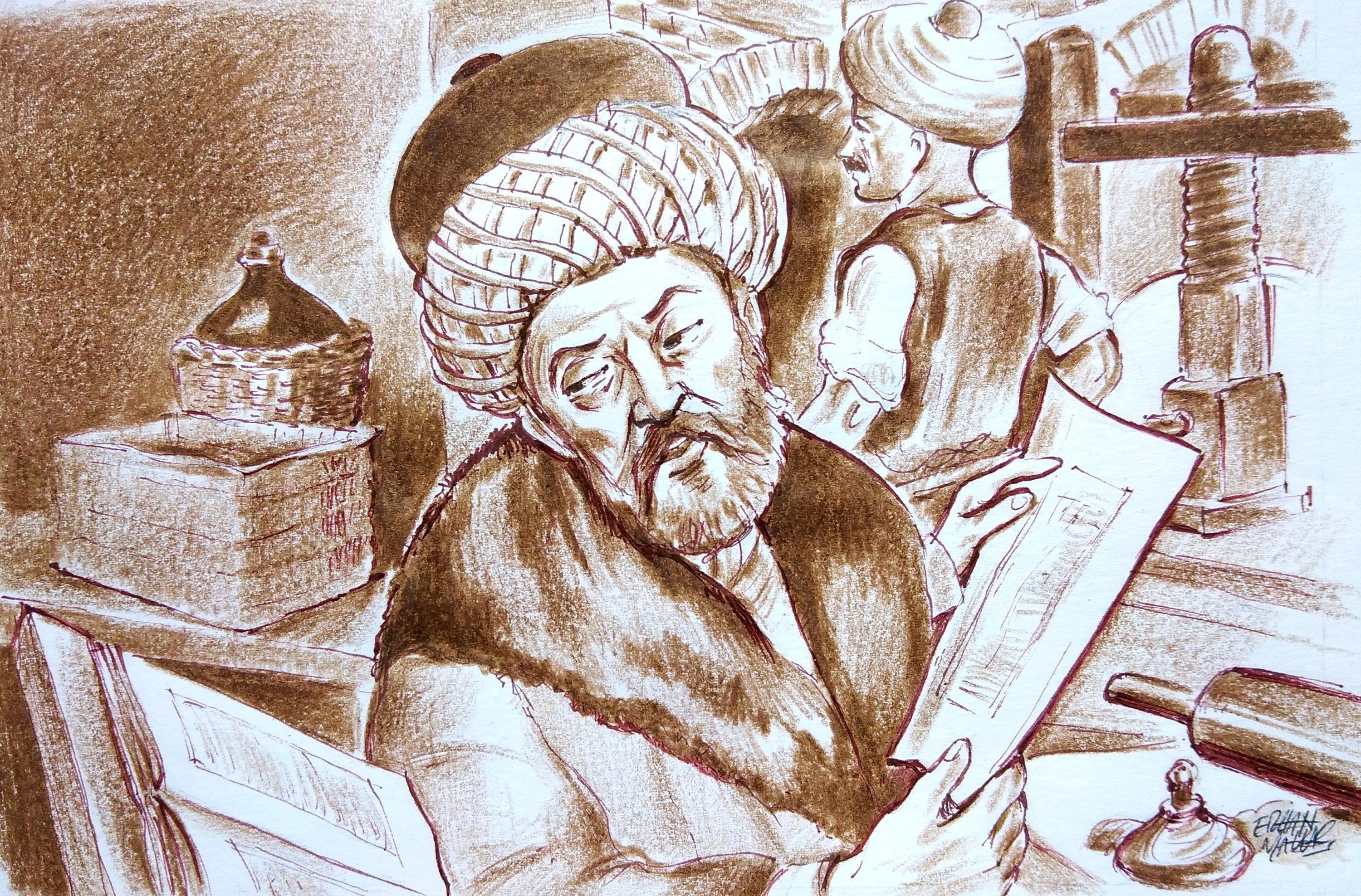
The 18th-century Ottoman Empire was rich in extraordinary converts and colorful intellectuals who left their marks on history. One such individual was Ibrahim Müteferrika, best known as the man who, albeit very late, introduced the printing press to the Islamic world. For this reason, he earned a well-deserved place in the history of modernization in Türkiye. However, a closer look at his career reveals that he was not only one of the most versatile figures of the Ottoman Empire, but also a contributor to the Age of Enlightenment in a broader sense. While France had philosophers Jean-Jacques Rousseau and Voltaire, Great Britain had John Locke and the German world had Immanuel Kant, the Ottomans had the privilege of having Müteferrika.
Thanks to school textbooks, Müteferrika is proudly remembered as the first Muslim printer. Yet this groundbreaking achievement was only one part of a far richer intellectual legacy that deserves closer attention. This is his curious and striking story.
Müteferrika was born in Cluj, in Transylvania (part of present-day Romania), around the 1670s. He and his family belonged to the Christian sect known as Unitarianism. As this denomination rejected the doctrine of the Trinity and emphasized the oneness of God, it may have facilitated Müteferrika’s later conversion to Islam and his understanding of its basic principles. Although little is known about his childhood, it can be inferred that he received a strong education, as he was proficient in Greek, Latin and Hungarian. It is also highly probable that he learned the art of printing in his hometown, possibly under the renowned printer of the period, Mihaly Kiss.
During the 1670s and 1680s, Habsburg-controlled parts of Hungary were marked by intense Catholic pressure, which provoked resistance among Protestants and other non-Catholic communities. This unrest culminated in rebellion against Vienna under the leadership of Hungarian nobleman Emeric Thököly, whose career deserves a separate discussion. Thököly secured Ottoman support, and for the remainder of his life lived under Ottoman protection. Müteferrika was among Thököly’s supporters, and as Catholic pressure intensified, many Unitarians sought asylum in Ottoman lands. Given certain theological affinities between Unitarianism and Islam, most notably the rejection of the Trinity, some of these refugees converted to Islam. Müteferrika appears to have been among them.
Müteferrika’s talents were quickly recognized by the Ottoman authorities, and he was initially placed among the sipahis of the household cavalry. Owing to his exceptional abilities, particularly his multilingualism and his skills in diplomacy and astrology, he was later transferred to palace service and appointed as a "müteferrika," a court official attached to the imperial household. In 1710, he authored a work entitled "Risale-i Islamiyye" ("A Treatise on Islam"), demonstrating not only his mastery of Ottoman Turkish but also his deep engagement with Islamic theology at a level suitable for learned debate. Recognizing his capabilities, the Sublime Porte increasingly sought to employ him in diplomatic affairs.
During the wars with Austria in 1716 and 1717, Müteferrika was employed in dealings with the Hungarian malcontents and was appointed as the Ottoman representative to their leader, Ferenc Rakoczi II. Serving as Rakoczi’s guide and translator, he earned the rebel leader’s praise, which was conveyed to the Ottoman grand vizier. Müteferrika continued to act as the Ottoman representative to Rakoczi until the latter’s death. In addition to this role, he served as a translator to a Safavid prince and took part in a diplomatic mission to Poland. During the second conflict with Austria, he again functioned as a diplomat and was among the negotiators involved in the surrender of Orşova.
Müteferrika’s service in the Ottoman Empire coincided with the Tulip Era, a period of cultural and intellectual awakening often regarded as the first phase of Westernization in Turkish history. Within this flourishing atmosphere, and in partnership with Said Efendi, who had traveled to France with his father, he established the first Muslim-run printing press in the Islamic world in 1727. The first book printed was "Vankulu Lugatı" ("Vankulu’s Dictionary"), followed by works on history, grammar and astronomy.
His printing activities were disrupted by the Patrona Halil Revolt of 1730. Nevertheless, the new sultan, Mahmud I, supported Müteferrika’s enterprise, which continued until his death in 1747. After his death, printing activities came to a halt, not, contrary to popular belief, because of opposition from Islamic scholars or calligraphers. On the contrary, the grand mufti and the ulema had endorsed the printing press through a fatwa, and there is no evidence of organized resistance from calligraphers. The true problem was economic: Sales of printed books were poor, making the continuation of the enterprise unprofitable. Large-scale printing would have to wait until the reforms of Selim III. Even so, Müteferrika’s initiative remains an undeniable milestone in the intellectual history of the Islamic world.
Müteferrika was not only a translator, diplomat, courtier and entrepreneur, but also one of the most brilliant intellectuals of his age, as evidenced by the works he authored. In his aforementioned "Risale-i Islamiyye," he offered a critique of the Bible and Christianity in general, presenting Islam as the final true religion. In the same work, he provided commentaries on Quranic verses, seeking to demonstrate the authenticity and rational coherence of Islam.
One of his most remarkable works is "Usulu’l-Hikem fi Nizamü’l-Ümem" (The Method of Wisdom and the Order of Nations). Presented to Sultan Mahmud I, this treatise reveals Müteferrika’s deep understanding of European political and military systems and includes a clear call for reform within the Ottoman Empire. He particularly emphasized the importance of disciplines such as physics, geography, and astronomy for effective governance.
In another work, "Vesiletü’t-Tıbaa" ("The Reasons for Printing"), Müteferrika set out to demonstrate the significance of the printing press. He argued that print would make books more accessible and widespread, enabling the Ottomans to establish large libraries, an endeavor he regarded as a great service to Islam itself.
Müteferrika died in Istanbul in 1747. He is remembered primarily as the founder of the first printing press in the Ottoman Empire and, more broadly, in the Islamic world. Even though this innovation rightly earned him lasting recognition, Müteferrika was far more than a printer. He was a diplomat, and more importantly, a thinker and intellectual. In many ways, he stood as the Ottoman representative of the Age of Enlightenment, whose ideas transcended his time. Between ink and reason, Müteferrika carved a space for thought in an age of Enlightenment.