As the cease-fire between the U.S. and Iran continues, it is becoming glaringly obvious that the supply chain crisis centered around the Strait of Hormuz has the potential to spiral much deeper, with the Bab al-Mandeb Strait being drawn into this vortex of conflict through the Houthis’ inclusion in the war alongside Iran.
However, at this critical juncture, we desperately need an alternative geostrategic reading that will shake established paradigms. While the vital importance of the Bab al-Mandeb and Hormuz straits in the global politico-economic context is widely debated, the analytical focus almost exclusively narrows down to energy supply security. While the international system is imprisoned by the anxiety surrounding whether hydrocarbon flows will be interrupted, an undeniable reality is persistently ignored: The depths of the Red Sea are not merely an oil transit corridor. This strategic waterway is also home to the data corridors of the 21st century, arteries that are at least as valuable as oil and far more critical for the global security architecture.
Data connects continents through the submarine fiber optic cable networks laid across the Red Sea bed, establishing the “hyperconnectivity” of the international system. Seventeen of the world’s 570 submarine cables directly traverse the Red Sea. Handling 90% of the data traffic between Asia and Europe, this route is the digital lifeblood for the Middle East, Africa and the Gulf states.
Crucially, warring actors are turning these submarine networks into asymmetric weapons by exploiting the “attribution problem,” the extreme difficulty of proving the perpetrator of a sabotage with conclusive evidence. By obscuring the source of destruction 60 meters underwater, these actors comfortably bypass international law. While it is relatively easy to trace a missile fired at an onshore energy facility, actors can attribute a severed fiber cable to the anchor of a passing commercial ship or seismic activity, establishing a vast space for “plausible deniability.”
Considering the historical and current context where Iran has restricted access to the Strait of Hormuz and the Houthis are actively engaged, the risk level for the submarine cables around the Bab al-Mandeb has reached its zenith. If the feared sabotage materializes, the global system faces a chain reaction of catastrophic proportions. We must analyze this through three escalating scenarios.
First, if only a portion of the cables is damaged, digital traffic does not stop entirely. Operators reroute the data flow via the Cape of Good Hope, the Mediterranean or other terrestrial backbones. However, this rerouting increases latency and narrows bandwidth. For algorithmic stock markets and High-Frequency Trading (HFT) platforms operating at millisecond speeds, this delay means billions of dollars in arbitrage losses. Synchronization issues in the SWIFT network, which facilitates global interbank transfers, would disrupt commercial payments, condemning the internet to a slower, highly expensive and fragile state.
Furthermore, if there were a scenario where several main cable lines in the Red Sea are destroyed simultaneously, cloud-based business processes on the Asia-Europe line would be directly paralyzed. The severance of giant data centers in the Gulf from Europe would halt e-commerce in the Middle East, crash airline reservation and logistics tracking systems and render remote health care diagnostics inoperable. This is not merely an internet outage; it is the collapse of the global digital economy’s nervous system.
Apart from the above, the most pessimistic, yet highly probable, scenario is a repair crisis morphing into a global collapse. Even during natural disasters, deploying repair ships takes days; in a warzone, this timeframe becomes entirely unpredictable. The entry of civilian repair ships into a mined strait under active fire could become practically impossible due to the need for special permits, colossal war insurance premiums and mandatory military escorts. An ensuing months-long “dark period” would completely freeze supply chains. Because the real-time data tracking of energy cargoes, container ships and international trade would be impossible, panic sales would trigger in global markets. The shock wave of this data crisis would multiply the devastation of any energy crisis, bitterly proving to the world how lethal non-kinetic warfare can be.
The vulnerabilities of this hyperconnected era have ushered in an age of technopolar geopolitics, where the centers of gravity are not just states but the technological infrastructures that sustain them. The Iranian Revolutionary Guard Corps (IRGC) has thoroughly understood this, recently expanding its asymmetric doctrine. In a chilling escalation, Iran declared that if assassinations of its leaders continue, 18 U.S. technology giants, including Google, Microsoft, Apple, Tesla, Nvidia and Amazon, will be targeted.
This was not an empty threat. Iran’s strike in Bahrain, which targeted a major corporate headquarters that hosts Amazon Web Services (AWS), serves as devastating proof of concept. By targeting these tech behemoths, Iran is aiming at the economic heart of the U.S. and Israel, but the collateral damage places the Gulf countries under an existential digital threat. Nvidia’s infrastructure powers the vast majority of data centers in the Gulf. Apple and Google maintain critical regional hubs, while Microsoft’s servers form the very backbone of the Gulf’s banking and corporate systems.
A targeted assault on these infrastructures would trigger an unprecedented systemic freeze. The stock market pressure would be immense; an attack on the physical infrastructure of these companies would trigger a massive sell-off in the global tech sector, wiping out trillions in market capitalization.
What are the consequences of striking these companies? A targeted assault on Amazon Web Services (AWS) or Microsoft data centers in the region would trigger an immediate systemic freeze. SWIFT networks would face synchronization failures, halting cross-border capital flows. The stock market pressure would be unprecedented; an attack on the physical infrastructure of companies like Nvidia or Apple would trigger a massive sell-off in the global tech sector, wiping out trillions in market capitalization overnight and spiking volatility indices to historic highs.
Naturally, this raises an urgent question: Will Türkiye be affected? The short answer is yes. Turkish corporations, banks, airlines and the thriving e-commerce sector heavily utilize cloud infrastructures provided by AWS, Google and Microsoft. A regional blackout or a targeted attack on these servers would cause severe latency, temporary loss of cloud services and disruptions in supply chain tracking for Turkish businesses. However, Türkiye’s stringent data localization laws and domestic data center investments provide a crucial layer of resilience, meaning the core functions of the Turkish state and banking sector would survive the initial shock waves better than entirely cloud-dependent neighbors. Yet, isolated domestic functionality is not enough in a hyperconnected global economy.
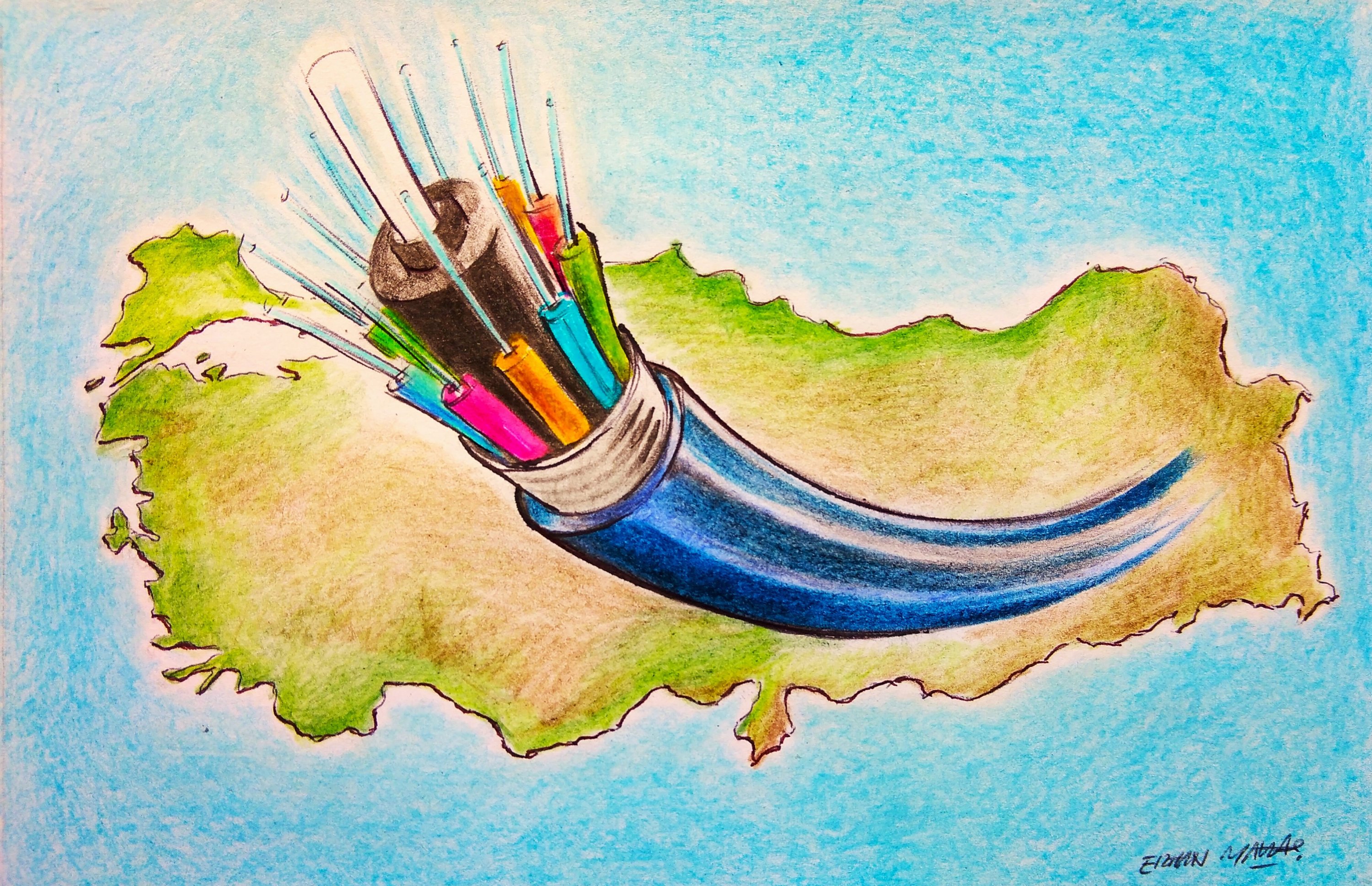
To neutralize this dystopian crisis scenario, the immediate formation of alternative, secure routes is a historical necessity. Türkiye must act proactively, taking steps to become a global Data Transit Hub. Strategic moves to transform Türkiye into a “Terrestrial Digital Corridor” rely on our country’s potential to be a reliable and stable anchor. Redundant and secure terrestrial fiber optic networks passing through Türkiye, which flank the planned Development Road Project via Iraq and the east-west Middle Corridor, have the capacity to completely bypass these maritime and regional vulnerabilities.
By assuming this “digital bridge” role, Türkiye will not only protect regional stability but will also solidify its digital autonomy. Furthermore, safeguarding the flow of information is a vital component of cognitive diplomacy. In an era where data disruptions can manipulate market panic and societal stability, providing a secure, uninterrupted data corridor elevates Türkiye’s normative power. This crisis underscores the absolute necessity of digital autonomy. A state’s ability to safeguard its cognitive and digital sovereignty is paramount in the technopolar age.
The Republic of Türkiye, as a formidable state anchoring its power in stability, peace, international law and cognitive diplomacy, possesses the unique capacity to serve as the ultimate lifeline for the global economy amid this imminent digital bottleneck. To put it starkly: even if the digital lights of the international system are entirely extinguished by asymmetric warfare, Türkiye will stand resilient as an autonomous digital fortress, serving as the unwavering beacon of hope to illuminate the grim darkness of the technopolarity and sheltering those in need.