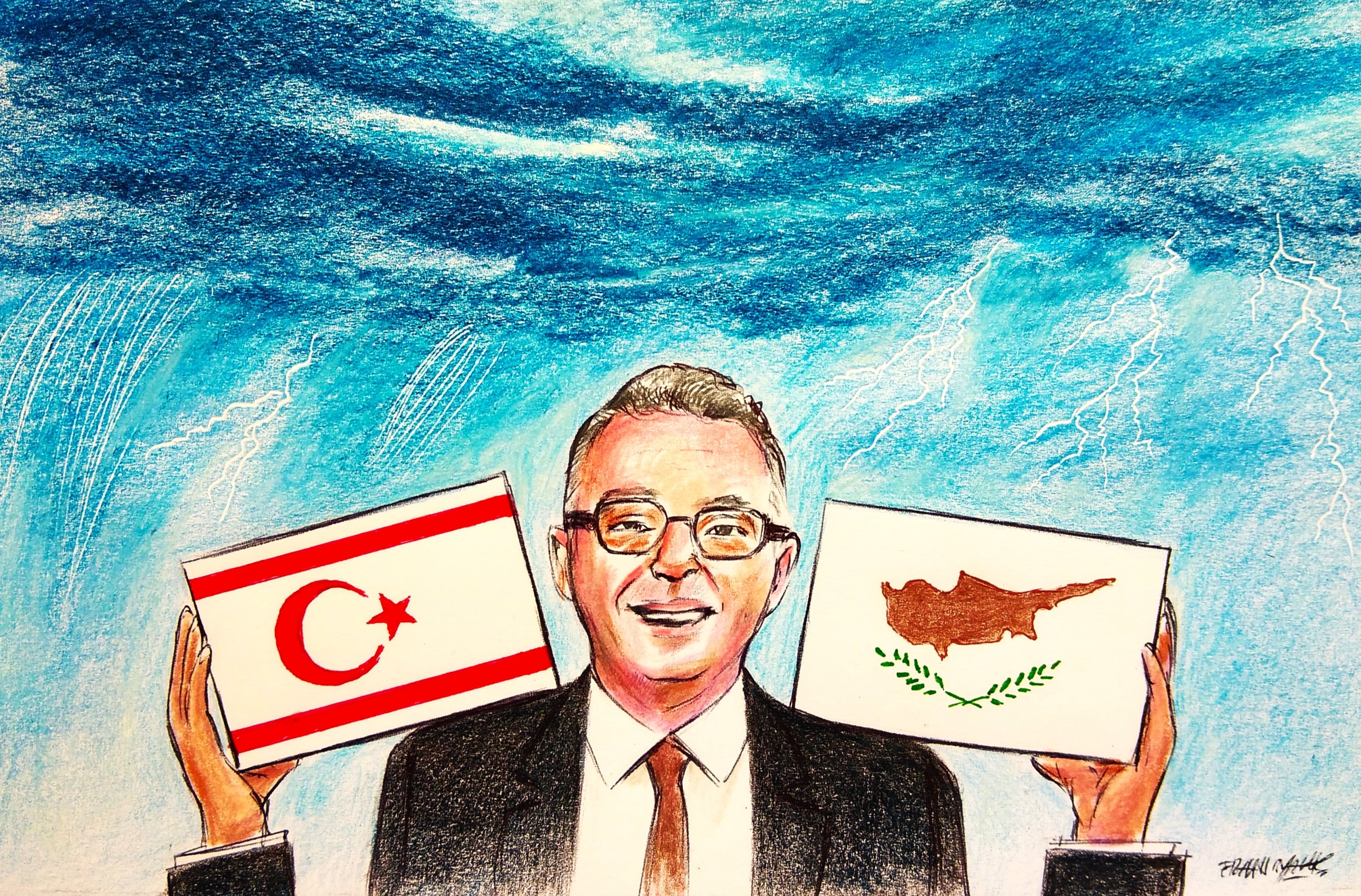
There is a phrase that sensible Turkish Cypriots have repeated for two generations, one that the late founding president Rauf Denktaş often used: “Let Cyprus not become Crete.”
Few outside the Eastern Mediterranean know the story behind it. Fewer still recognize how precisely its stages are being reenacted in the current round of Cyprus negotiations. It is worth laying out plainly, because the pattern that cost the Ottoman Empire and then Türkiye the island of Crete a century ago is not a rhetorical flourish. It is a documented diplomatic sequence, and Cyprus is now moving through its early stages.
In 1897, following a Cretan revolt against Ottoman rule, six Great Powers – Britain, France, Russia, Italy, Austria-Hungary and Germany – intervened militarily under the banner of restoring order and protecting the island's communities. An international naval squadron took control. By December 1898, the Powers had expelled Ottoman troops from Crete entirely and installed Prince George of Greece as High Commissioner of an "autonomous" Cretan State, still nominally under Ottoman suzerainty but with no Ottoman soldier left on the ground.
That nominal suzerainty proved worthless. Within a decade, Cretan deputies unilaterally declared union with Greece in 1908. Foreign garrisons withdrew. The Balkan Wars accelerated the process, and the Treaty of London in May 1913 formalized what had already happened in practice: Sultan Mehmed V relinquished all rights to the island. The Muslim Turkish population of Crete, once a substantial community, dwindled through emigration and was ultimately erased from the island by the 1923 Greek-Turkish population exchange.
The mechanism worked step by step. An international “guarantee” arrived first, framed as “protection for all communities.” The guarantor power’s own troops were withdrawn next, framed as a normalization. Sovereignty transfer followed once the demographic and military facts on the ground had already shifted irreversibly. Nobody signed a document in 1898 conceding Crete to Greece. It didn’t need to happen that way.
Cyprus today has its own treaty architecture, and it did not emerge from nothing. The 1960 Treaty of Guarantee, signed alongside Cyprus's independence, named Türkiye, Greece and the United Kingdom as guarantor powers with the explicit right to act, unilaterally if necessary, to restore the constitutional order. Türkiye's 1974 intervention, whatever one's view of its scale and duration, was undertaken under that treaty following a Greek-engineered coup aimed at enosis, or so to say union with Greece. That history is precisely why the guarantor question is not a technicality in today's talks; it is the hinge on which the entire settlement turns.
U.N. Secretary-General Antonio Guterres visited Lefkoşa (Nicosia) in late July 2026 and, after meetings with Turkish Cypriot President Tufan Erhürman and Greek Cypriot leader Nikos Christodoulides, announced plans for a new "5+1" conference with the two Cypriot sides plus Greece, Türkiye and Britain, under United Nations auspices. His Personal Envoy, María Ángela Holguín, has spent 2026 consulting both sides on what is being discussed as a "loose" federal model. Reported details from Ankara suggest the framework being explored, though not yet the subject of formal negotiation, includes NATO-based security arrangements for a post-settlement Cyprus, potentially with troop presence drawn not from Türkiye alone but from Greece, France, Britain and the United States. That would amount to the multilateralization of Türkiye's guarantor role, dressed in the neutral language of "security architecture."
This is not a hypothetical worry projected backward from Crete. It is the substance of the diplomatic track currently being reported, and it closely mirrors the language Greek Cypriot officials used at the last serious attempt, in Crans-Montana in 2017, when – as Turkish Republic of Northern Cyprus (TRNC) Foreign Minister Tahsin Ertuğruloğlu has pointed out – the Greek Cypriot side's opening position was "zero troops, zero guarantees."
To his credit, President Erhürman has explicitly stated that this is a red line, not a bargaining chip. In August 2026, he stated flatly that "no solution agreement to which Türkiye does not say yes can come into force," and that a 5+1 conference without Türkiye at the table is not possible. In October 2025, shortly after his election, he called political equality "my vital red line" and went further: "Türkiye is the guarantor of the entire island, and this has become even more significant today," citing the growing regional instability and foreign military footprint in the south – a reference, among other things, to the increasing presence of forces from third states and of genocidal Israel.
That is the correct instinct. But Erhürman was elected on a platform that marks a genuine departure from his predecessor Ersin Tatar's insistence on international recognition of a separate Turkish Cypriot state, and he has committed Turkish Cypriots to a bizonal, bicommunal federal negotiation – precisely the framework within which the guarantor question gets renegotiated, redefined, and, if the Cretan sequence is any guide, gradually diluted.
Sitting at the table with the right rhetoric is not the same as controlling what emerges from it. Tatar's insistence on a two-state framework was never simply about recognition for its own sake; it was an answer to this vulnerability. A settlement built on two sovereign states, each free to maintain its own permanent defence relationship with its guarantor, does not require the Turkish Cypriot side to keep winning the same argument at every review conference for the next 50 years. A federation does.
President Recep Tayyip Erdoğan has repeatedly said that "Türkiye will never abandon Turkish Cypriot brothers and will never allow past suffering to be repeated, whatever the cost." He reaffirmed his position at the U.N. General Assembly on Sept. 22, calling on the international community to recognize "the sovereign equality and equal international status of the Turkish Cypriot people" and to end the "inhumane isolation" they have faced.
Similarly, Foreign Minister Hakan Fidan has paired public support for the U.N. process with continued emphasis on the Turkish Armed Forces as the foundation of "the peace, stability and security that have prevailed on the island for more than half a century."
Ankara's position suggests Türkiye understands the stakes even where Turkish Cypriot negotiators are, understandably, focused on getting a deal.
If the diplomatic language in Geneva or New York is measured, the domestic Greek Cypriot discourse is not.
Archbishop Georgios, head of the Church of Cyprus, used his April 2025 Easter message to describe Türkiye's "unmovable goal" as "the occupation and Turkification of all Cyprus." In December 2025, he rejected any settlement that would amount to "national euthanasia." By August 2026, he was framing the Cyprus problem not as an intercommunal dispute at all but as one of "invasion, occupation and colonization," deliberately foreclosing the federal, power-sharing premise that the Greek Cypriots' own negotiators say they are pursuing.
This is not a fringe voice; it is the head of the island's dominant religious institution, speaking consistently across 18 months even as political leaders speak of trust-building.
The gap between the two registers should worry anyone taking the negotiations at face value, because it is not only rhetorical: days after Erdoğan's U.N. speech, the Greek Cypriot administration's own mission to the U.N. wrote to every other member state's delegation in New York asking them to "refrain from any contact or meetings with representatives of the secessionist entity," a formal diplomatic instruction, not just a sermon, aimed at keeping Turkish Cypriot representatives isolated even from routine contact with the outside world.
Consequently, those urging Turkish Cypriots to trade a Turkish military guarantee for an EU or U.N. one might first examine how the European Union actually treats a Turkish minority within its own borders.
Greece's roughly 100,000-strong Turkish Muslim minority in Western Thrace has lived under EU law for over four decades. It is still routinely denied the right to self-identify as "Turkish" in the name of its own associations, a matter now before the U.N. Human Rights Council. Athens continues to appoint state muftis rather than recognize those the community elects itself, notwithstanding repeated objections from Ankara and international rights bodies.
If this is what EU membership secures for an established, treaty-protected Turkish minority in continental Greece, it is reasonable to ask what an EU security guarantee would actually mean for Turkish Cypriots once Türkiye, the one guarantor with the military capacity and the political will to act, has been negotiated out of the room.
None of this is an argument against Turkish Cypriots securing their future. Turkish Cypriots have as much interest as anyone in ending the isolation of the last half-century. Erhürman's willingness to negotiate seriously, which by late August 2026 had produced an agreement with Christodoulides to hold weekly leaders' meetings, should be recognized as such. But there is a difference between negotiating a settlement and negotiating away the one instrument that has kept the island's two communities from repeating 1974, or worse, repeating Crete.
History did not remove Crete's Turkish community by decree. It did so by a sequence of reasonable-sounding steps, each justified in the language of internationalization and normalization, that only in retrospect added up to an irreversible outcome.
Seen against that history, the safest route for the Turkish Cypriot community is not the one that promises the fastest handshake in Geneva or New York, but the one that removes the guarantee itself from the negotiating table for good.
Once the Cretan pattern is laid out this plainly, the conclusion is not really in doubt: a federal Cyprus, whatever the intentions of the negotiators sitting at the table today, is structurally the arrangement in which the guarantee erodes over time, because it is never settled once – it is reopened at every review, every crisis, every change of government in Greek Cypriot administration and Greece.
A two-state outcome, anchored in a permanent partnership with Türkiye rather than in a shared structure whose terms are perpetually up for renegotiation, is the far more obvious answer. It is not a lesser or more isolated path; it is the only path that takes the guarantor question off the table permanently rather than leaving it to be chipped away, review after review, the way Crete's was. It does not ask the TRNC to keep re-winning the same argument, indefinitely, inside a structure designed in part by people who have already said, in their own words, that they see no room for Turkish guarantees at all. Ankara and the TRNC leadership are not obliged to accept a settlement whose logic points, however gradually, toward the Cretan outcome, and the two-state model remains the straightforward alternative that avoids it altogether.
Turkish troops should not leave Cyprus. Türkiye's guarantor status should not be surrendered for promises written in Brussels or New York. Cyprus must not become Crete.