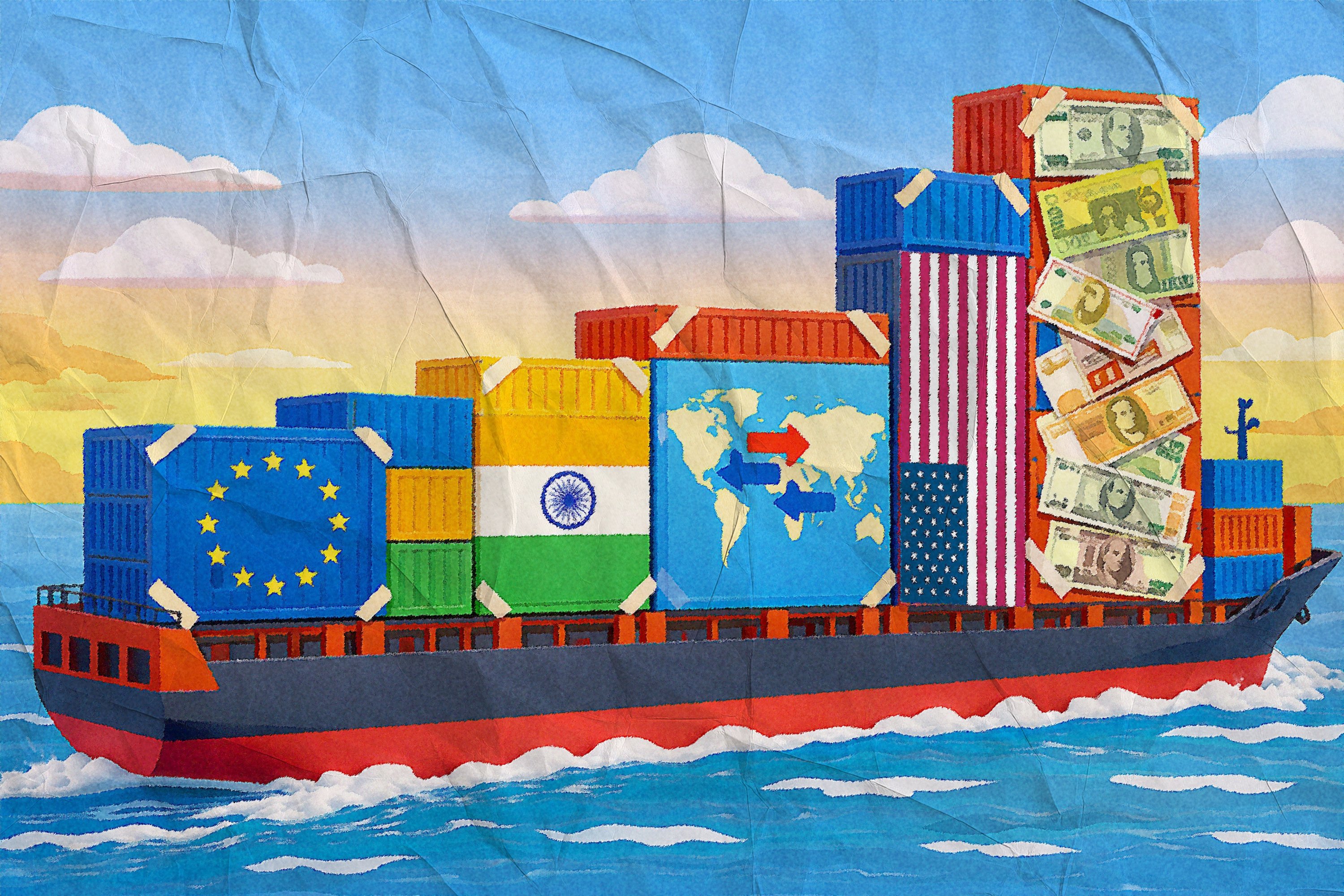
For years, global trade deals felt like mirages – always discussed, endlessly negotiated, little progress but never quite arriving. This year, that changed. Suddenly, agreements long assumed to be impossible are being signed, partnerships upgraded and economic lines redrawn. What once looked stalled is now moving at speed.
The most striking feature of 2026 so far is not a single agreement, but the sheer volume of closures. Deals that had lingered for decades are finally being sealed, revealing a world economy quietly reorganizing itself, less dependent on Washington, more interconnected across regions, and increasingly centered on the Global South.
The European Union’s long-stalled agreement with Mercosur, finalized in January after more than 25 years, was the first signal. The pact creates one of the world’s largest free-trade zones, linking over 700 million people across Europe and South America. Days later came the far bigger shock: the “Mother of All Deals.” Brussels and New Delhi broke nearly 20 years of deadlock, connecting 2 billion people and aiming to double EU exports to India by 2032. Tariffs on European cars will fall from a punishing 110% to just 10%. Wine, spirits and industrial goods will follow. Soon after, the EU upgraded its strategic partnership with Vietnam, reinforcing Southeast Asia as a central pillar of Europe’s diversification strategy.
These agreements were always possible. What changed is the global calculation of risk, and the U.S. now sits at the center of it.
Individual European countries are moving just as decisively. German Chancellor Friedrich Merz is in Riyadh this week, signaling a break from old defense export taboos by discussing potential sales of Airbus A400M aircraft to Saudi Arabia and Qatar. Berlin is eager to reduce reliance on both Russian supplies and the uncertainty of American liquefied natural gas (LNG).
Meanwhile, Ankara is deepening ties with long-standing regional partners. A fresh $2 billion energy investment agreement between Türkiye and Saudi Arabia – focused on solar and wind – highlights how regional stability and green growth are becoming mutually reinforcing goals.
Those highlight how regionalization is becoming a hedge against external disruption, not a retreat from globalization. This logic now extends far beyond Europe and the Middle East.
We are seeing a massive "South-South" trade boom. For the first time, trade between developing nations is becoming the engine of growth, while traditional U.S.-Europe-China routes face more friction. As of early 2026, Nigeria and South Africa have cleared the final barriers to trade under the African Continental Free Trade Area.
China, long portrayed as increasingly isolated, is seeing a steady return of Western leaders. In late January, U.K. Prime Minister Keir Starmer made the first visit to Beijing by a British leader in eight years. AstraZeneca announced a $15 billion investment in China, citing the strength of its research and development ecosystem, choosing stability over ideological alignment.
Leaders from Canada, South Korea, Finland and Ireland have also visited Beijing this year. Isolating China is a luxury many economies can no longer afford, especially when the U.S. is no longer seen as a consistently reliable partner. Despite a last-minute U.S. effort to lower tariffs for New Delhi, China reclaimed its position as India’s largest trading partner in late 2025. Pragmatism is winning over politics.
Across capitals, governments are acting on the same assumption: U.S. trade policy is no longer predictable, durable or insulated from domestic politics. Tariffs can reappear overnight. Deals can be scrapped between election cycles. Long-term planning has become guesswork.
South Korea learned this lesson in late January, when Washington abruptly raised tariffs on Korean cars and technology from 15% to 25% over a delayed investment deal. Seoul immediately responded, accelerated talks with the Comprehensive and Progressive Agreement for Trans-Pacific Partnership (CPTPP) and deepened trade ties with the Association of Southeast Asian Nations (ASEAN). Japan, facing similar exposure, has pushed ahead with expanding the CPTPP to include Uruguay and the United Arab Emirates (UAE), into what is increasingly a U.S.-free trade bloc.
This is not a world turning against the U.S. None of these agreements announces a break with Washington. No communique denounces American leadership. Instead, something more consequential is happening. Trade is being routed around uncertainty, not in protest, but in precaution. The system is adjusting its plumbing.
By the time the shift becomes visible in lost market share, weakened standards-setting power or a sanctions regime that no longer bites as it once did, the choices that produced it will already be locked in. Influence rarely disappears with a bang. More often, it leaks – deal by deal, corridor by corridor – until one day it is simply no longer there to be exercised.