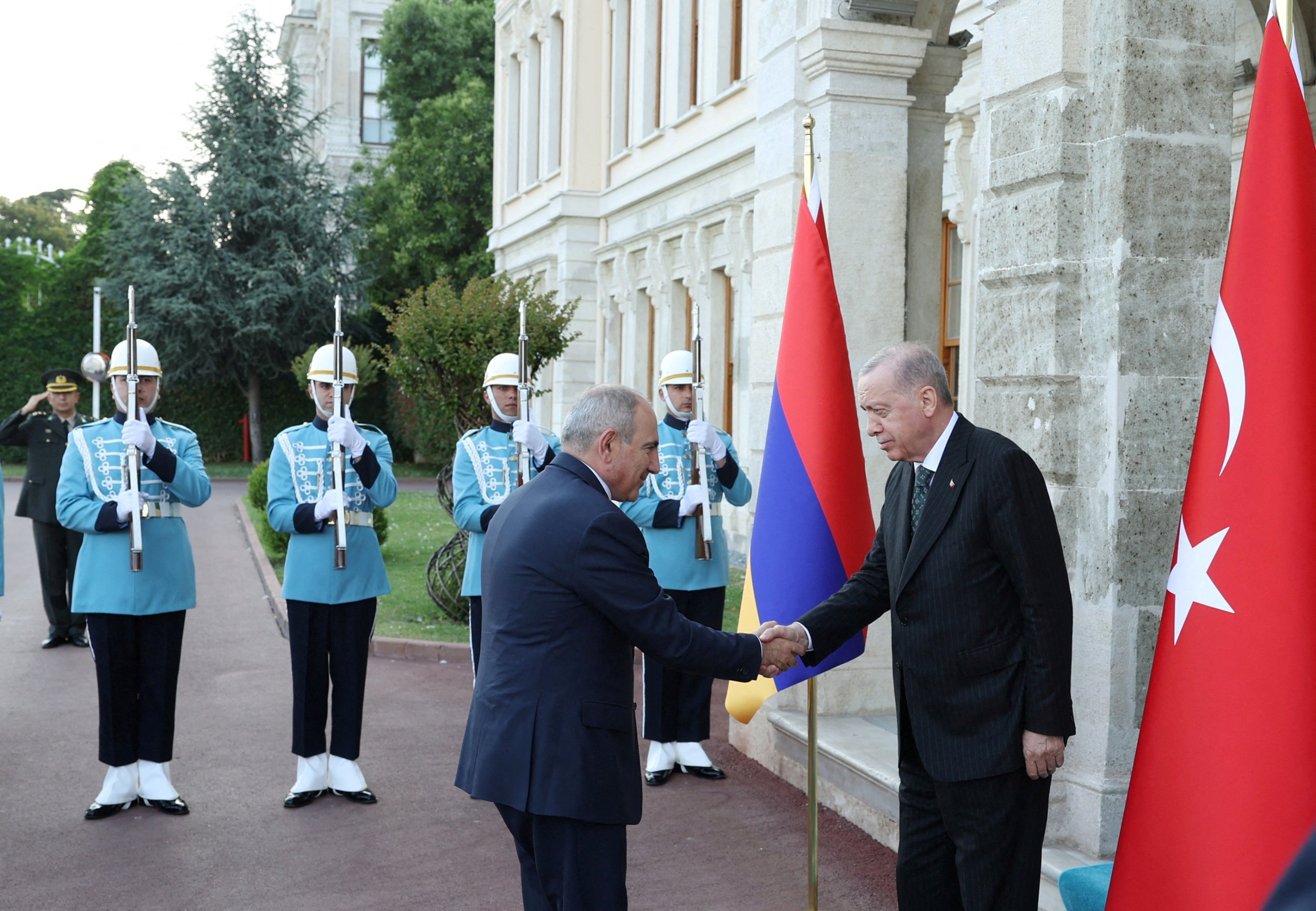
Türkiye occupies a highly sensitive geopolitical position, surrounded by a range of regional crises. In response to these challenges, Ankara has developed a grand strategy grounded in two fundamental principles: the establishment of regional peace and security, and the promotion of economic development and prosperity in its neighborhood. This strategic outlook also guides Türkiye’s policy in the Caucasus. Armenia’s aggressive posture in the region has been the most significant obstacle to the realization of Türkiye's peaceful Caucasus policy for the last three decades. However, the “working visit” of Armenian Prime Minister Nikol Pashinyan to Ankara on June 20, 2025, marked a significant turning point in the Türkiye-Armenia relations. The visit is particularly noteworthy as it marks the first of its kind (both in terms of level and nature) by an Armenian leader to Türkiye since the First Karabakh War.
President Recep Tayyip Erdoğan received Pashinyan in Ankara, with Foreign Minister Hakan Fidan and Armenian Foreign Minister Ararat Mirzoyan also attending the meeting. The main agenda of the talks was, without a doubt, regional stability in the South Caucasus and, in particular, the establishment of a lasting peace between Armenia and Azerbaijan. During the meeting, President Erdoğan emphasized the importance of the agreements reached in the ongoing peace negotiations between Azerbaijan and Armenia in the current regional context. He also reaffirmed Türkiye’s continued commitment to supporting all efforts aimed at fostering prosperity in the region through a win-win approach.
Following the dissolution of the Soviet Union in 1991, Armenia’s territorial claims gave rise to a regional conflict known as the First Karabakh War, which took place between 1992 and 1994. In response to Armenia’s occupation of Azerbaijan’s Kelbajar region in April 1993, Türkiye closed its borders with Armenia and suspended diplomatic relations. Backed by Russia, Armenia managed to sustain the regional status quo in the South Caucasus for over a quarter of a century. This status quo, rooted in the unresolved Karabakh conflict, was maintained under the oversight of international organizations such as the Organization for Security and Co-operation in Europe (OSCE) Minsk Group and the Collective Security Treaty Organization (CSTO).
Another artificial issue shaping Armenia’s stance toward Türkiye has been the so-called genocide claims, which have long been promoted, particularly by the Armenian diaspora. These claims have posed a significant barrier to Armenia’s engagement with Ankara. Collectively, the unresolved conflict and historical allegations have prevented Yerevan from building constructive relations with one of its most important neighbors and have left the country struggling with prolonged economic hardship.
The normalization process initiated between Türkiye and Armenia in 2008–2009 was a significant diplomatic initiative aimed at contributing to regional peace. The protocols signed in Zurich envisioned the establishment of diplomatic relations and the opening of the shared border between the two countries. However, the process was disrupted when Armenia imposed constitutional reservations on the protocols and reignited debates surrounding the so-called 1915 events. The initiative officially reached an impasse in 2010 when Yerevan suspended the ratification process.
One of the most notable consequences of this initiative was a temporary strain in Türkiye-Azerbaijan relations. The absence of any reference to the Nagorno-Karabakh issue in the protocols caused deep concern in Azerbaijan. Political authorities and the public alike feared that normalization would strengthen Armenia economically and legitimize its occupation of Azerbaijani territories. President Ilham Aliyev and other Azerbaijani officials strongly urged Türkiye to reconsider its position. In response, Ankara, taking into account Baku’s sensitivities, refrained from bringing the protocols to the Turkish Grand National Assembly and effectively halted the process. This episode not only reflected Türkiye’s pursuit of a “multi-dimensional balance” in its foreign policy, but also underscored that diplomatic initiatives in the South Caucasus are not solely bilateral endeavors, they are inherently linked to the strategic expectations and security concerns of regional actors. The failure of the first regional normalization attempt demonstrated that rapprochement with Armenia, in the absence of a resolution to the Karabakh conflict, would not align with the region’s geopolitical realities.
In 2020, with Türkiye’s military and diplomatic support, the Nagorno-Karabakh conflict was resolved in accordance with international law. This development effectively eliminated one of the key regional obstacles that had previously hindered normalization efforts between Türkiye and Armenia. Although Azerbaijan’s victory in the Second Karabakh War has not, at least for now, ensured what Galtung (1996) describes as “positive peace” between Baku and Yerevan, it has nonetheless laid the groundwork for rapprochement between Türkiye and Armenia. In this process, Türkiye has synchronized its normalization steps with Armenia in line with Azerbaijan’s expectations for a lasting peace.
In 2022, the appointment of special envoys by both Türkiye and Armenia, followed by meetings between President Recep Tayyip Erdoğan and Armenian Prime Minister Nikol Pashinyan on the margins of various international forums, helped lay the foundations for a new and more enduring normalization process. Pashinyan’s attendance at Erdoğan’s presidential inauguration ceremony in 2023 further accelerated this process and carried strong symbolic significance.
Currently, Türkiye and Armenia are experiencing what can be described as another historical turning point in their bilateral relations. However, in the aftermath of Pashinyan's recent visit on June 20, various Armenian and Russian media outlets broadcasting in Russian portrayed the development in a predominantly negative light. This indicates the presence of groups that remain uncomfortable with the normalization process between Türkiye and Armenia. Moreover, the visit took place under the shadow of the then-heightened tensions between Israel and Iran, suggesting that broader geopolitical calculations were also at play.
Unlike previous normalization attempts, Türkiye has pursued this process in close coordination with Azerbaijan, an approach that constitutes one of the key factors for its potential success. Indeed, the most concrete evidence of this coordination was the visit of Azerbaijani President Ilham Aliyev to Ankara just two days before Pashinyan’s arrival. Despite challenges, for Armenia, normalizing relations with a country like Türkiye, one of the region's significant actors in military, diplomatic and economic terms, represents a major strategic gain. From Ankara’s perspective, assuming a leading role in advancing lasting peace in the Caucasus enhances its diplomatic influence in the region. Ultimately, just as there can be no good war, there can be no bad peace.