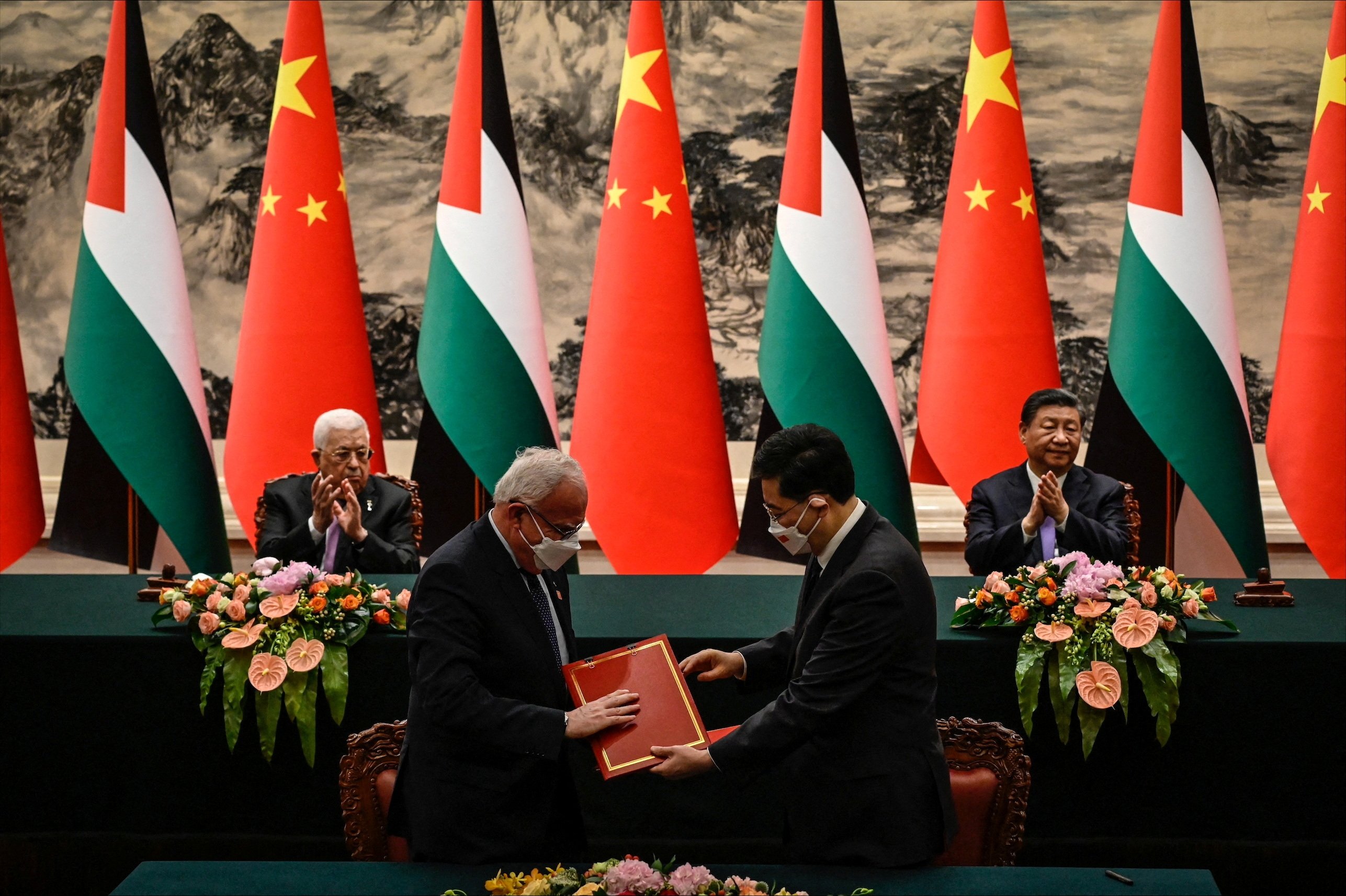
The growing involvement of China in the Middle East continues to raise intriguing questions. It all started with Chinese President Xi Jinping's attendance at the Gulf Cooperation Council Summit (GCC) with fanfare in December 2022. Following that meeting, Xi succeeded in mediating between archenemies Saudi Arabia and Iran in March 2023, signing a series of lucrative deals in the region.
Afterward, Chinese Foreign Minister Qin Gang's mediation proposal for a two-state solution to the Israeli-Palestinian conflict fuelled new debates about whether China could solve this enduring Gordian knot. Some pundits quickly praised the Chinese leadership, stating that Beijing is getting closer to Middle Eastern nations. However, it is too early for "optimism" at this stage. China's mediation proposal is not the first, nor will it be the last. Beijing seems more driven by the high economic gains and image-building prospects than any other considerations.
Becoming a peacemaker is one of the most cost-effective ways to assert prestige in the international arena. China's resounding success in thawing the tensions between Tehran and Riyadh led to the reopening of embassies. While it is premature to say that this step resulted in a comprehensive de-escalation in the region, China has certainly stolen the limelight.
Some Palestinian forces hope to tap into this diplomatic reservoir, lauding China's long-held pro-Palestinian stance and its encouraging call to end the conflict. From Beijing's perspective, the Palestinian cause stands at the forefront of global struggles against injustice and could be an excellent image booster for China. This move aligns well with Xi Jinping's "yinlingzhe" (leading state) theme, a proactive foreign policy posture that diverges significantly from China's traditional diplomacy based on non-interference.
Beijing is also encouraged by the failure of the Western-led international mechanism, such as the United Nations, U.N. Security Council and International Court of Justice (ICJ), which have proven ineffective and not gone beyond providing caution and advice regarding the Palestinian issue. This situation allows China to establish itself as a global leader in addressing global injustices and be perceived as a promising alternative to the rules-based order.
As articulated by Xi Jinping, China's foreign policy vision emphasizes concepts like peace, noninterference, respect for sovereignty and territorial integrity for rhetorical purposes. However, beneath these seemingly noble principles lies a clear intention to exclude the United States.
The other determining factor in this complex equation is Israel. It is wishful thinking to believe that Israel can decouple from Washington any time soon, thus jeopardizing such exclusionary ambitions.
Furthermore, the notion that China's leadership can fill the void left by the U.S. withdrawal from the region is an illusion. It is like a bluff poker move for Mr. Xi, where he stands to win regardless of the outcome. Accepting his proposal would solve a major conundrum and skyrocket his prestige, while rejection or ambivalence would only enhance his image as someone who seeks peace and conflict resolution.
Concurrently, China's economic cooperation with Israel is booming. Regarding trade, China is Israel's second-largest customer, with a $4.68 billion export share in 2022, and Israel's largest import destination, with a volume of $19.45 billion. Bilateral trade is primarily shaped by infrastructure, high-tech, and agricultural technology, and the technology and defense industry facets of this trade represent the biggest concern for Washington. This worry is heightened because of the incidents of PHALCON in 2000 and IAI HARPY in 2004, in which Israel faced immense pressure from the U.S. not to sell air defense products to China.
However, apart from these red lines, commercial ties grew stronger as Netanyahu prioritized national security concerns and diversified the country's export markets, enhancing commerce with Beijing without alienating Washington.
Meanwhile, in the evolving international system toward multipolarity, China's initiatives in the Middle East are driven by a rhetorical emphasis on economic cooperation, a win-win situation and common prosperity. This rhetoric expands China's soft power as Beijing knocks on the region's door, aiming to sustain its long-term interests without jeopardizing its gains.
While China's offer of mediation in the Israel-Palestine conflict is not novel, it does not rank high among its primary regional objectives. China focuses mainly on the contours of the international system and those who draw these contours rather than specific conflict zones or political actors.
Even if Beijing were to achieve the seemingly impossible task of persuading Tel Aviv to come to the negotiating table, the complexity of the opposing side remains challenging, and it is highly unlikely that Xi's mediation methods would be inclusive enough to grant seats to Hamas and Palestinian Islamic Jihad or any other significant groups.
Hence, one can say that China's reiterated calls for reconciliation and Palestinian President Mahmoud Abbas's visit are merely calculated moves to score some points at the expense of the Palestinian cause.