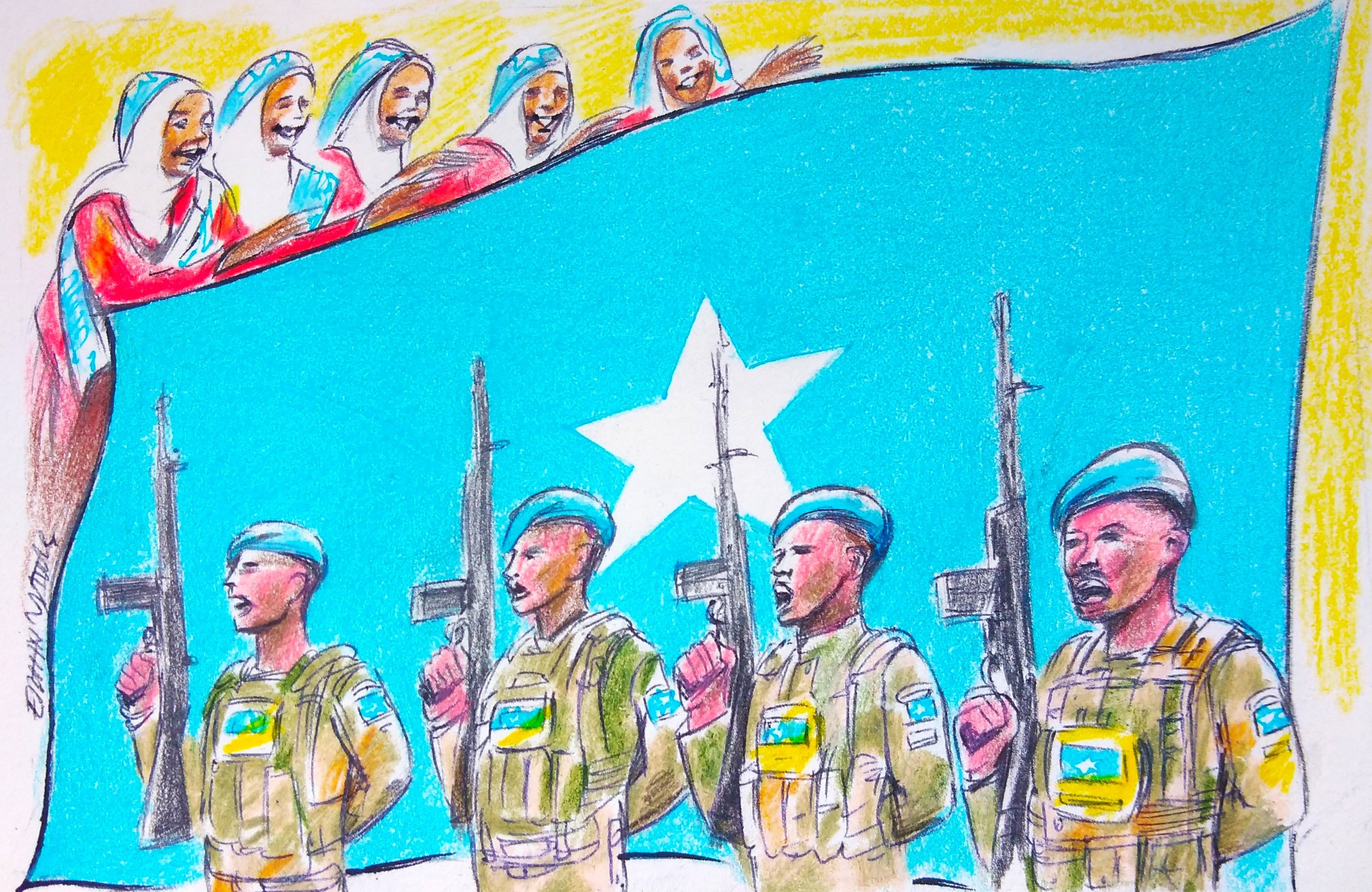
On July 1, when the United States informed the African Union it would no longer finance the United Nations Support Office in Somalia (UNSOS), the logistical backbone of the African Union Support and Stabilization Mission in Somalia (AUSSOM), beyond December 2026, the reaction was immediate. One prediction dominated: Somalia was about to become a crisis zone like Afghanistan. Others argued the opposite, that the Somali National Army (SNA) has matured enough to assume full responsibility for national security. Both arguments ask the wrong question.
The debate is not whether Somalia will collapse once AUSSOM ends, nor whether the SNA can already replace nearly two decades of international assistance, but whether Somalia can transition from externally guaranteed to nationally sustained security. Peacekeeping missions are not designed to last forever. Their purpose is to create space for national institutions to develop, not to substitute for the state indefinitely. Whether Somalia succeeds after AUSSOM will depend less on the departure of foreign troops than on the institutions left behind, which requires understanding the three transitions Somalia has passed through, and why the third is proving hardest.
Few peace operations have shaped a country's political trajectory as profoundly as the African Union mission has shaped Somalia's, yet the real measure of a peacekeeping mission's success is not whether it stays forever but whether the state can stand without it.
When the African Union Mission in Somalia (AMISOM) deployed in 2007, Somalia was rebuilding a state that had collapsed 16 years earlier: the government had ceased functioning in 1991, institutions had disintegrated, and Al-Shabaab had emerged as one of the Horn's most formidable militant organizations, controlling territory and threatening the Transitional Federal Government. AMISOM's mandate was not optional; it was preventing collapse while enabling Somali forces to reclaim territory.
Its first phase succeeded: African Union troops, alongside Somali forces, liberated Mogadishu and expanded government control to cities such as Baidoa, Beledweyne, Kismayo and others, enabling the federal government of Somalia's establishment in 2012. Ironically, that success transformed the mission's own purpose.
Much of today's debate assumes the African Union mission has pursued a single objective since 2007. It has not. Somalia's transition can be better understood through three security transitions.
The first, from roughly 2007 to 2014, was international protection: Somalia lacked the capacity to defend itself, so peacekeepers assumed primary responsibility for securing population centers and fighting Al-Shabaab, since no national alternative existed.
The second was shared responsibility. As Al-Shabaab lost urban centers, the mission shifted from offensive operations toward stabilization and mentoring. Successive reforms transformed AMISOM into the African Union Transition Mission in Somalia (ATMIS) and later AUSSOM, not because the threat disappeared, but because the objective changed. The aim was no longer defeating Al-Shabaab, but preparing Somalia for its own security. This is often overlooked. Many critics still evaluate AUSSOM as though territorial liberation remains its mission, when for over a decade it has functioned as a mechanism to reduce, not perpetuate, dependence.
The third transition, now beginning, is the most consequential: sovereign security. For the first time since the state's collapse, the question is not whether international forces can stabilize Somalia, but whether Somali institutions can sustain that stability alone.
Washington's decision should not be read as merely an announcement about funding; it is a diplomatic assessment of Somalia's political transition. The U.S. has not opposed an African Union mission continuing, nor announced broader disengagement; it has reaffirmed bilateral security cooperation and vigilance against terrorist threats. Its objection is specific: Washington will no longer support UNSOS after its authorization expires in December 2026, arguing that after two decades and billions invested, Somalia has yet to show sufficient progress.
The SNA lacks the capacity originally envisioned; political fragmentation among Somali actors has weakened the fight against Al-Shabaab; and the international model has remained unchanged despite 20 years of support, when peace operations are meant to facilitate national ownership, not substitute for it. Analytically, this signals that Somalia's greatest challenge is now political, not military.
No comparison has dominated the debate more than Afghanistan, yet the analogy is the wrong lens. Afghanistan's 2021 collapse reflected a security architecture deeply dependent on U.S. airpower, intelligence and financial support; when these systems disappeared overnight, so did much of the Afghan military's capacity.
Somalia is different. Al-Shabaab remains one of Africa's most resilient insurgencies, yet Somalia has spent the past decade transitioning security responsibilities to its own institutions while diversifying partnerships. Its architecture no longer depends on a single actor: Türkiye, Western and African partners each contribute through different models. Somalia's challenge is no longer primarily territorial but institutional: not whether Al-Shabaab will launch new offensives, but whether Somali institutions can absorb those pressures without collapsing.
The debate has also exposed a deeper question: has the international model unintentionally delayed the transition it sought? This is what might be called the Dependency Paradox. For years, funding has sustained two parallel systems – a well-funded peacekeeping mission and a national military expected eventually to replace it. Front-line Somali soldiers have often earned $200 to $400 monthly in combat, while African Union peacekeepers have received substantially higher compensation. This is not to diminish African Union sacrifices, but to ask whether the model prioritized the peacekeeping architecture over the development and welfare of Somali forces. If the objective has always been Somali ownership, investment should follow it through either toward salaries, logistics, and education, rather than indefinitely financing external deployments.
The end of AUSSOM should not force Somalia to choose between self-reliance and dependence. Modern security partnerships are measured not by troop numbers but by the institutions they build: what scholars call Security Sector Reform, developing accountable institutions capable of replacing external guarantees.
In this regard, Türkiye represents an increasingly important model: unlike traditional peacekeeping, Ankara's engagement has focused so far on building Somali military capacity through the TURKSOM Military Training Center, officer education, naval cooperation and counterterrorism training. As a NATO member with decades of experience, Türkiye offers institutional expertise, not just military assistance: sustainable security is built less by deploying foreign soldiers than by developing national ones. Yet Türkiye alone cannot secure Somalia's future. The same applies to the U.S., the European Union, and other partners. Somalia's future architecture should rest on diversified partnerships that strengthen ownership, not dependence on one actor.
History will probably not remember the end of AUSSOM as the moment Somalia succeeded or failed, but as the moment it was asked the question no peacekeeping mission could answer for it: can the Somali state secure itself?
That answer will depend not on the withdrawal of international support or the strength of Al-Shabaab, but on whether Somalia's leaders can transform two decades of external assistance into sustainable institutions. The first transition saved the Somali state from collapse; the second created space to rebuild it; the third, and hardest, will determine whether it can stand on its own.
Success will require more than a capable army. Political consensus, accountable institutions, professional forces, sustainable financing, and partnerships that reinforce ownership rather than replace it. If Somalia succeeds, the end of AUSSOM will mark not the end of a mission but the completion of one of Africa's longest state-building transitions. If it fails, the lesson will be that no peacekeeping mission can substitute for national political leadership.
The future of Somalia will not be decided in Addis Ababa, New York, Brussels, Ankara or Washington, but in Mogadishu. The African Union mission helped Somalia survive; the next chapter is whether it can sustain itself. The end of AUSSOM is not the end of Somalia. It is the beginning of Somalia's toughest security test.