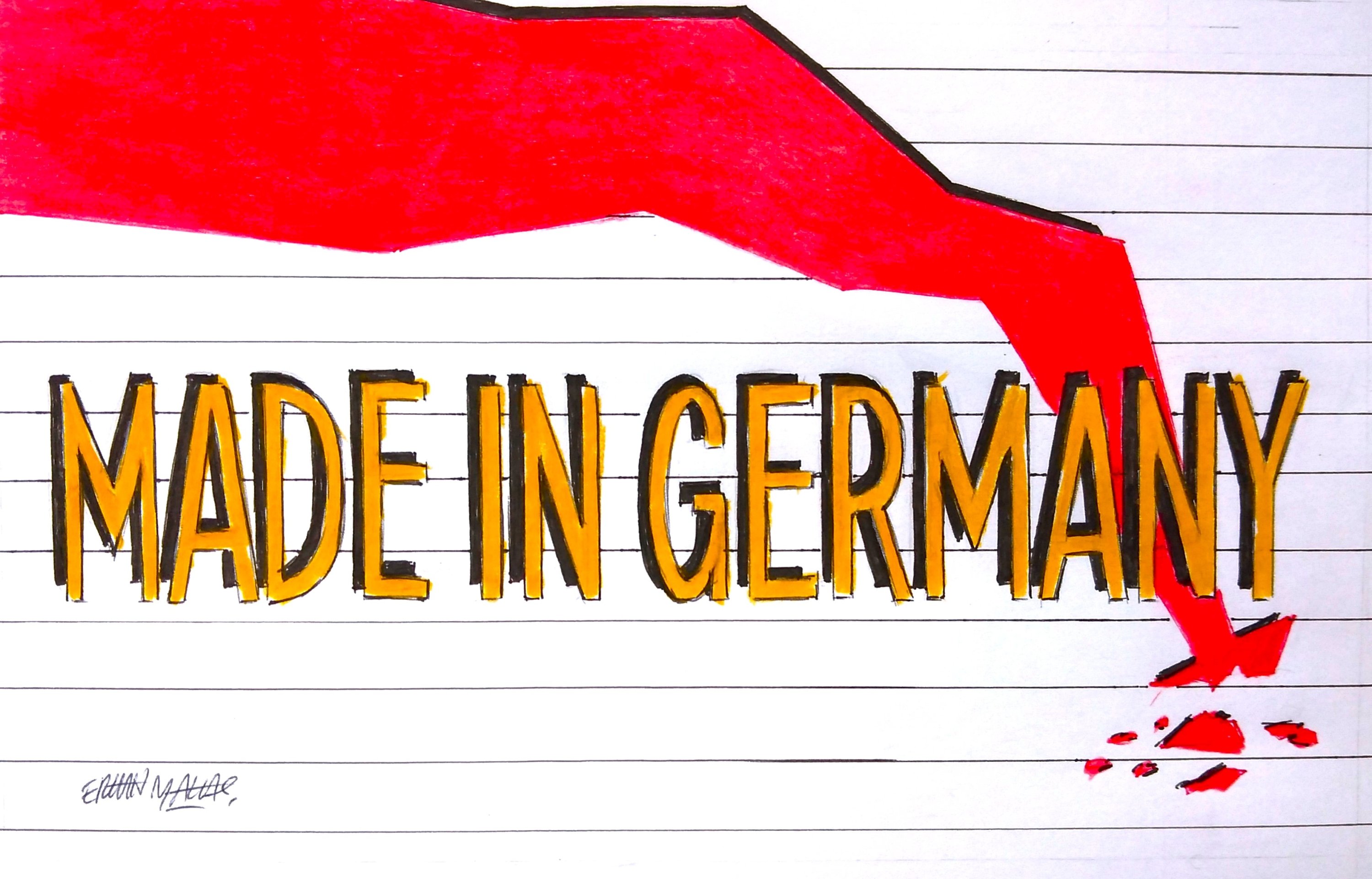
The automotive industry, once the symbol of Germany's economic strength, is now experiencing one of the deepest crises in its history. Giants such as Mercedes-Benz, BMW and Volkswagen had for decades represented global standards of quality, durability and engineering excellence. Yet, this traditional superiority is now being seriously shaken.
Accounting for roughly one-fifth of Germany's manufacturing output and about 6% of its gross domestic product (GDP), this vast sector has long been more than just an economic domain; it has been a cornerstone of the nation's social identity and welfare model. The current crisis, therefore, calls into question not only the future of an industrial sector but also the very foundations of Germany's development paradigm.
Automobile production in Germany has declined dramatically in recent years. From 5.6 million units in 2017, production fell to below 4 million in 2024, and this downward trend is expected to continue into 2025. In the first half of 2025, Mercedes-Benz’s profits dropped by 56%, while Porsche’s operating profit plunged by an alarming 91%. BMW’s profits also declined by one-third in the second quarter. This picture signals not merely a short-term contraction but a long-term crisis of competitiveness and transformation. The sharp decline in sales in China – traditionally a crucial market for German cars – has further exposed the fragility of Germany’s export-dependent economic model.
The factors driving Germany’s automotive sector into a deep crisis are multifaceted. First and foremost, Germany was far too late in transitioning to electromobility. For years, German manufacturers relied excessively on their technical superiority in internal combustion engines and failed to take the electric vehicle revolution led by Tesla and Chinese producers seriously enough. The removal of government incentives for electric vehicles at the end of 2023 led to a significant decline in domestic demand. Insufficient charging infrastructure, high prices and the withdrawal of state support severely undermined consumer confidence.
In addition, the energy crisis has had a profound impact on the sector. Following the Russia-Ukraine war, Germany lost access to cheap energy, while the closure of nuclear power plants rapidly drove up energy costs. Industrial electricity prices, now several times higher than those in the U.S. or China, have pushed production expenses to uncompetitive levels.
Another major factor is technological lag. While Germany remains strong in engineering excellence, it has fallen behind its rivals in software development, digital integration and AI-assisted driving technologies. Brands like Tesla and BYD have redefined their vehicles as “digital platforms,” whereas German manufacturers remained locked for too long in a traditional paradigm centered on mechanical quality. Today, a car’s power is measured not merely by engine performance but by the sophistication of its digital ecosystem.
Throughout this process, government indecision has further deepened the crisis. Bureaucratic hurdles, the slow pace of the energy transition, delayed tax reforms, and high labor costs have all eroded the sector’s competitiveness.
The external pressures facing Germany’s automotive industry are compounding its internal structural weaknesses. Today, China is not only the world's largest producer of electric vehicles but also a global leader in battery technology and a key player in state-backed industrial incentives. Chinese manufacturers are rapidly entering the European market by offering high technology at low cost. This dynamic makes the German model of high price and high quality increasingly unsustainable.
Meanwhile, the reelection of Donald Trump as the U.S. President has intensified trade pressures on Germany. The Trump administration has raised tariffs on German cars and openly accused the European Union of engaging in “unfair trade practices.” These measures pose a serious threat to Germany’s dependence on the U.S. market. Approximately 13% of Germany’s exports are directed to the U.S., which means that higher tariffs directly impact the sector’s profitability.
Trapped between these two external powers, China and the U.S., Germany is gradually losing its strategic autonomy. While China has become decisive in terms of technology and production, the U.S. is imposing economic constraints that limit market access. Moreover, the saturation of the European market has severely limited Germany’s potential for growth through its traditional sales channels. This situation compels the German automotive industry to redefine both its production and export strategies fundamentally.
The crisis is increasingly revealing not only its economic dimension but also its social one. In Germany, the automotive sector forms an ecosystem that provides livelihoods for millions of people, directly or indirectly. As production declines and profits fall, the loss of thousands of jobs has become inevitable. Several major manufacturers and supplier companies are accelerating their plans to relocate production to Eastern Europe or Asia.
This trend brings with it the risk of deindustrialization. The weakening of Germany’s historically industry-based welfare model could lead to more profound social inequalities in the long run. Rising unemployment, especially in former industrial regions, is fueling support for far-right parties such as the Alternative for Germany (AfD). Economic insecurity combined with political populism creates a volatile equation that threatens Germany's democratic stability.
To grasp the scale of this challenge, the concept of the “Nokia syndrome,” frequently cited in the technology literature, is particularly instructive. Once the undisputed leader of the mobile phone market, Nokia failed to recognize the profound technological shift, the smartphone revolution. The company possessed engineering excellence but lacked the vision to perceive a paradigm change. Today, German automotive giants are making a similar mistake. When traditional engineering perfection is not coupled with the capacity to anticipate technological transformation, past achievements no longer guarantee future success. Germany’s mastery of the internal combustion engine, much like Nokia's hardware expertise, no longer constitutes a competitive advantage. Thus, Germany’s current crisis must be understood not merely as an economic downturn but as a manifestation of strategic foresight failure.
Regaining global competitiveness in Germany’s automotive industry will only be possible through a comprehensive restructuring process. This transformation requires both a renewal of industrial policies and a fundamental shift in the production paradigm.
First and foremost, Germany must commit decisively to electromobility and digitalization. Developing electric vehicles that appeal not only to the luxury segment but also to middle-income consumers has become an absolute necessity. In this regard, government incentives should be applied not as short-term stimuli but as long-term, stable policies. Strategic partnerships with technology companies in areas such as software, battery technology and autonomous driving could help the German automotive sector regain momentum.
A broad transformation is also imperative in the area of energy costs. Germany is losing competitiveness due to its high electricity prices. Therefore, a long-term industrial electricity pricing policy based on renewable energy sources must be developed. Accelerating and expanding existing investments in green hydrogen, wind, and solar energy is not only an environmental imperative but an economic necessity. Moreover, as is being debated today, postponing the closure of nuclear power plants remains an important consideration.
At the same time, Germany’s excessive dependence on exports must be re-evaluated. Volatility in the Chinese and U.S. markets leaves the country vulnerable. Expanding into new markets in Africa, South America and Southeast Asia would enhance the geographical diversification of exports. Strategic initiatives within the EU, such as joint battery production facilities or “battery alliances,” should also be supported.
Finally, the innovation ecosystem must be strengthened. Closer collaboration among universities, research institutions and the private sector should accelerate the commercialization of new technologies. Increasing incentives for startups and green innovation could be the key to enabling Germany to lead a new industrial revolution once again.
Today, Germany’s automotive industry is facing not merely an economic crisis but an identity crisis. Long associated with “engineering excellence,” the sector is now being tested by the demands of “technological creativity” and “flexibility.” If Germany fails to manage this transformation, the automotive giant of the 20th century may well become the technological periphery of the 21st. Yet, the crisis also presents an opportunity. Germany still retains the potential to remain the “engine of Europe,” but only if it succeeds in combining its engineering strength with digital innovation.
The decisive question now is whether to cling to past achievements or to build the industrial model of the future. For the issue at stake is no longer merely the transformation of automobiles, but of Germany itself. Germany’s new industrial model must be defined not by engineering perfection, but by flexibility, digital innovation, creativity and its capacity to attract global talent.