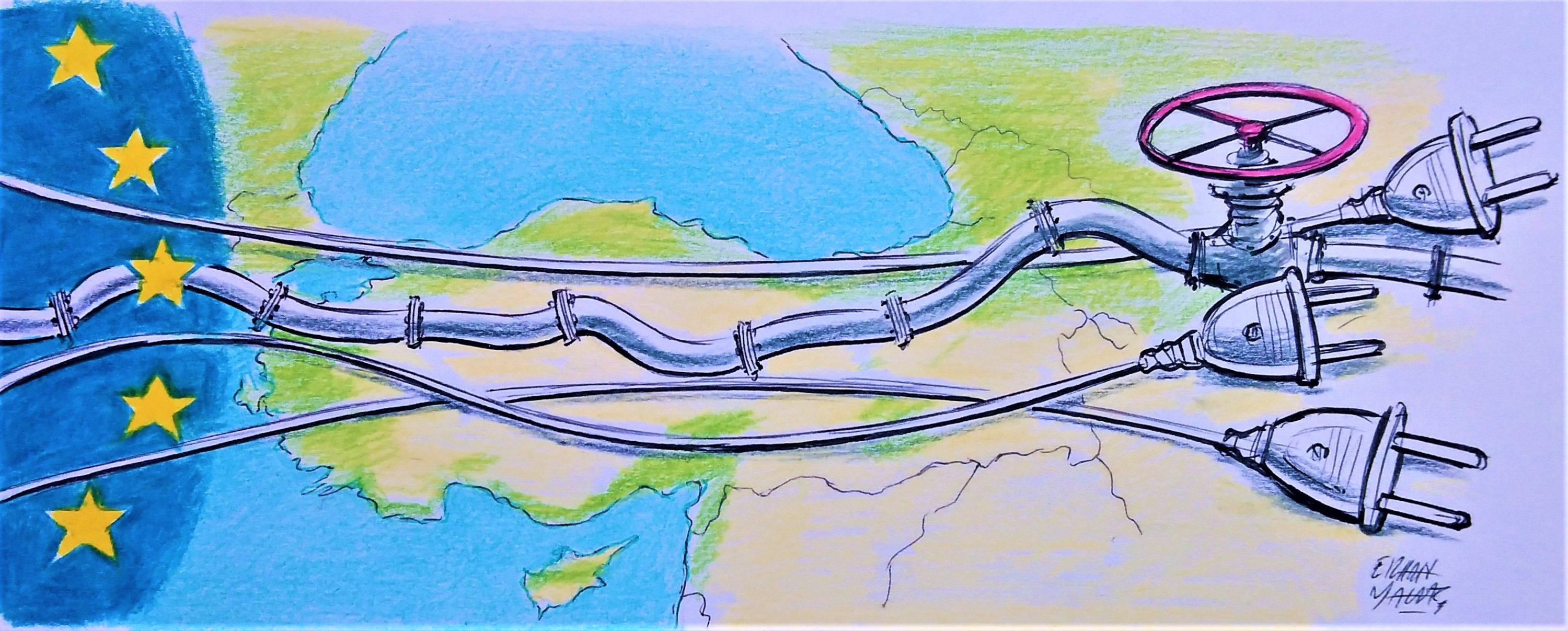
Central Asia is a strategically important region that has recently been the focus of increased attention from the European Union. The EU's engagement with Central Asia has been driven by various factors, including the region's vast energy resources, its strategic location at the crossroads of Europe and Asia, and the shared interest in promoting stability and security in the region.
European nations recognize the importance of fostering constructive relations between their yearslong partner Türkiye and its Turkic counterparts, adopting a pragmatic approach that fosters mutual understanding and regional integration. Acknowledging historical, cultural and economic similarities, Europe endeavors to create a cohesive structure that enables a long-lasting engagement and harmonic collaboration among these interdependent entities. Amid this momentum, however, the energy issue notably influences Europe as it strives for energy security, diversification and sustainability.
With a keen eye on geopolitical opportunities, Europe acknowledges the immense economic potential stemming from broadening its cooperation with the Central Asia countries. Türkiye's strategic location as a transcontinental link renders it an essential gateway for European nations to access the Central Asian region. The Turkic states boast abundant natural resources, presenting a lucrative prospect for investment and diversification. The EU endeavors to enhance economic bonds through trade agreements, infrastructure development and joint ventures, aiming to work toward a more integrated and prosperous region.
Beyond the areas of cooperation, energy remains at the forefront of Europe's needs as the continent aims to secure its energy supply. Deepening links with Central Asia allows Türkiye to diversify its energy sources and minimize reliance on a single supplier, boosting European energy security. This becomes particularly crucial considering the emerging mutual endeavors between Türkiye and the Central Asia states, which seem as a critical component.
Energy security stands at the forefront of Europe's energy strategy. The continent's heavy reliance on external suppliers and geopolitical uncertainties necessitates diversifying sources and supply routes. The Turkic states possess substantial resources, including oil, natural gas and renewables, making them significant potential European suppliers. Projects such as the Southern Gas Corridor (SGC) and the expansion of cross-border electricity interconnections enhance the continent's energy security by diversifying supply sources and transit routes. The strong bonds also allow Europe to reduce its vulnerability to supply disruptions.
The energy strategy places great importance on infrastructure development and connectivity. The efficient transport of energy resources requires a robust network of pipelines, interconnectors and storage facilities. The development of infrastructure projects, such as the Trans-Anatolian Natural Gas Pipeline (TANAP) and the Trans-Caspian Fiber Optic Cable, strengthens physical connectivity and facilitates the exchange of energy resources and information.
Europe's energy strategy is closely aligned with its commitment to renewable energy transition. The Turkic states possess significant renewable energy potential, particularly in solar, wind and hydropower. The field of renewable energy allows for sharing of best practices, technology transfer, and joint research and development initiatives. This partnership facilitates the acceleration of the clean energy transition, reduces greenhouse gas emissions, and contributes to global efforts to combat climate change.
The EU's strategy for Central Asia is related to the individual countries' commitment to reform and strengthen democracy, human rights, the rule of law and economic diversity. Through funding from the Development Cooperation Instrument (DCI), the EU has played a substantial role in supporting regional development and reforms, particularly emphasizing education, regional security, natural resource management and socioeconomic development. Furthermore, the EU has worked with specific Central Asian nations to address concerns such as trade, human rights and economic cooperation through extensive accords and dialogues.
Central Asia has long been one of the vital aspects of Polish foreign policy, as evidenced by the establishment of critical departments within the Ministry of Foreign Affairs to deal with post-Soviet states, mainly Central Asian countries.
Poland values the advancement of human rights, decent administration and the rule of law in Central Asia. It actively promotes regional democratization by participating in international organizations such as the OSCE and the EU. Kazakhstan, in particular, has been the center of Poland's engagement, including assistance in political system development and knowledge transfer stemming from its transformation period.
With the decline of bloc politics and the rise of multipolar realities, partners can now enhance their cooperation more easily, transcending geographical barriers and traditional political divisions. The evolution of world diplomacy has created a scenario where every nation can engage in negotiations and partnerships across various regions. This contemporary understanding is increasingly evident from Central Asia to the Middle East and Latin America to Africa.
Turkish officials have consistently emphasized their goal of strengthening ties with their "brothers and sisters in Central Asia," a sentiment echoed by representatives from Central Asia. They have expressed openness and support for necessary policies and projects to meet their energy needs. As a result, the future holds promising prospects for improved relations among all three entities in the short, medium and long term.
In conclusion, relations between the EU and Turkic states have been evolving over the past two decades, reflecting the changing priorities of both sides. The EU has been an essential partner for the region in terms of economic, political and cultural cooperation. The EU's focus on trade, energy, connectivity and security highlights the importance of cooperation between the two regions. The two sides have been working together to promote regional stability and prosperity, increase energy security, and enhance human rights and the rule of law.