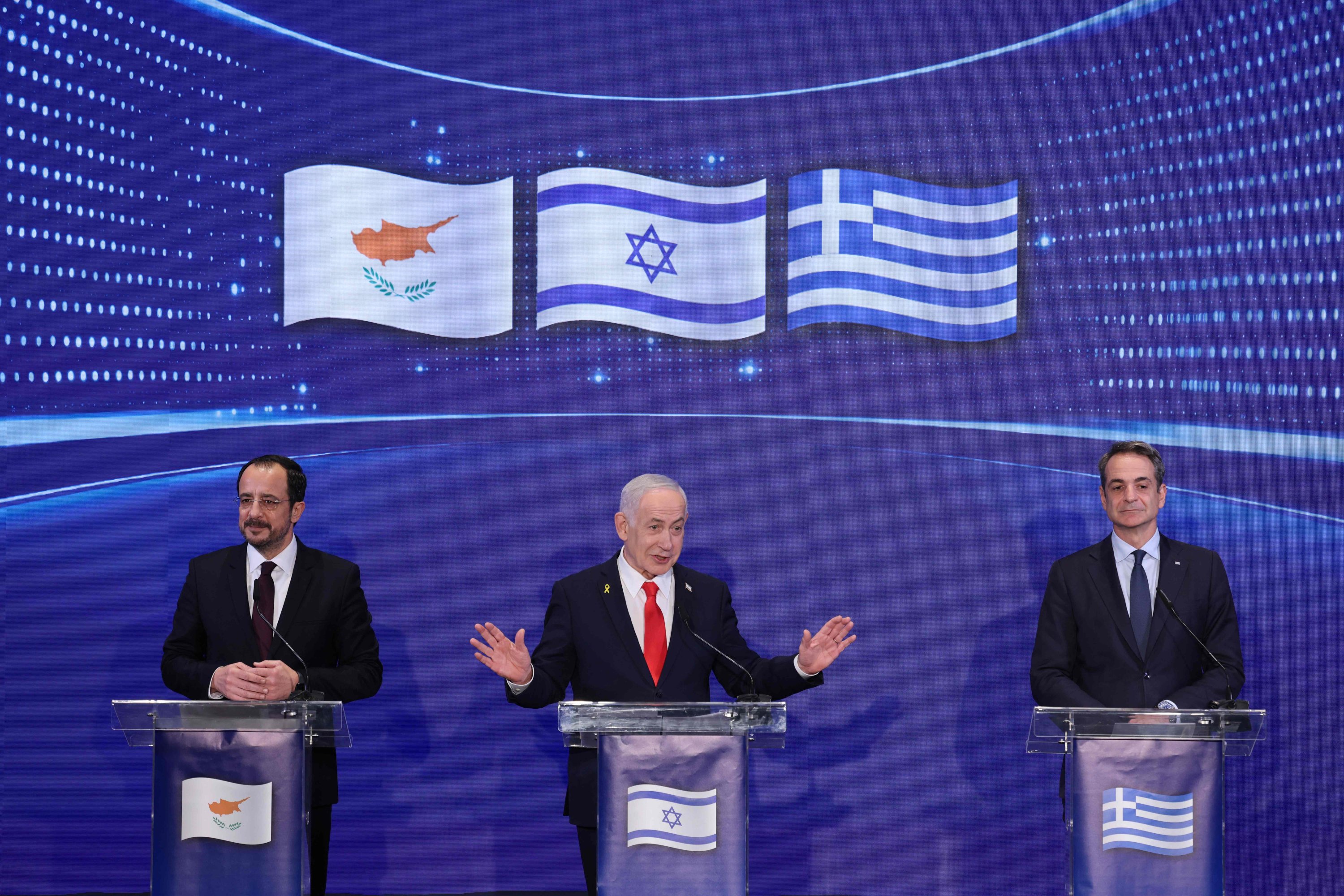
There is a moment in every geopolitical redesign when the architects begin to speak too much. Do not argue, but explain. Explain why nothing unusual is happening, why cooperation is purely defensive, and why the maps are not being redrawn even as the ink dries. The Eastern Mediterranean has entered that moment.
Over recent months, Greece and Israel have developed an impressive aversion to silence. Statements multiply. Military cooperation is announced, clarified, expanded and then announced again. Energy projects are resurrected with ceremonial urgency. Egypt joins the chorus. Eastern Libya, in a feat of sudden intellectual awakening, discovers maritime law. The Greek Cypriot administration is invoked with ritual regularity, as a bridge, an anchor and a proof of virtue.
This is not diplomatic noise. It is a system announcing itself.
The trilateral summit of Dec. 22, 2025, bringing together Israel, Greece and the Greek Cypriot administration, was therefore not a beginning. It was a rehearsed unveiling. The subject of the choreography was never named. It did not need to be.
It was Türkiye, not as an enemy to be confronted, but as a variable to be engineered around. Alongside it, quietly removed from the political equation, stood the Turkish Cypriots, whose existence complicates every claim of legality the system prefers to keep tidy.
The alliance describes itself as "Western," "democratic" and "rule-based." These words are not arguments; they are ambience. They reassure donors, editors and policy panels. They do not restrain behavior. What restrains behavior, when restraint is desired, is architecture.
Greece’s deployment of advanced military systems to the Aegean islands is marketed as "defensive modernization." This would be more persuasive if those islands were not governed by treaties explicitly designed to prevent precisely this condition. The Treaty of Lausanne and the Paris Peace Treaties did not imagine demilitarization as a "choice of lifestyle," they codified it as a structural safeguard against escalation born of proximity.
The contemporary Western solution to this inconvenience is elegant: interpretation replaces compliance. International law remains sacred in principle, flexible in application, and obedient to the phrase “changing security environments” – now the most efficient solvent in modern diplomacy.
What changes is not the law, but its addressee. Identical acts acquire different legal meanings depending on who performs them. Compliance becomes a discipline for some and an interpretive privilege for others. This asymmetry is not accidental; it is functional.
The same method governs maritime claims. Under the United Nations Convention on the Law of the Sea, equitable principles – not maximalist cartography – are meant to prevail where geography produces distortion. Small islands are not designed to generate continental-scale maritime zones. Equity, proportionality and relevant circumstances are not footnotes; they are foundations.
Yet in the Eastern Mediterranean, islands are encouraged to imagine themselves as empires. A rock acquires a continental shelf. A map becomes a moral argument. Türkiye’s insistence on equity is recast as aggression, while its exclusion is celebrated as stability.
Israel’s role here is decisive. As a defense exporter, Israel does not merely sell hardware; it exports doctrine. Pre-emption becomes prudence. Permanent threat perception becomes realism. Exception becomes normal. What partners acquire is not just capability, but a worldview in which legality is navigated, not obeyed.
Most commentary still treats Cyprus as a problem awaiting resolution. This is analytically obsolete.
Cyprus has been repurposed. It now functions as a modular asset within a broader Eastern Mediterranean security regime, valuable precisely because it is unresolved, legally serviceable and politically divisible.
It performs four roles simultaneously. The first is a projection without attribution. The British Sovereign Base Areas – among others, and also used by other Western actors – enable sustained operations across the Middle East. Europe and the European Union enjoy the posture of restraint while Cyprus absorbs the operational reality. Values remain immaculate; aircraft do not.
The second can be named as surveillance density. Cyprus sits on an observational ridgeline spanning Anatolia, the Levant and North Africa. Intelligence infrastructure transforms the island from a “bridge” into a sensor hub. Stability is not created here; it is indexed, categorized and exported.
The island is also a subsea leverage. Electricity interconnectors, gas pipelines and data cables marketed as green transitions have become strategic terrain. Control of the seabed means control of dependency. Maritime law, once intended to prevent conflict, is now instrumentalized to consolidate it.
Lastly, it is befitting for legal sanitization. Routing projects exclusively through the Greek Cypriot administration does more than simplify paperwork; it establishes a hierarchy of legitimacy. One side’s maximalist sovereignty claim, despite the collapse of the bi-communal constitutional order of 1960, is treated as settled law, while the political equality of Turkish Cypriots becomes administratively invisible.
This is not biased. It is system efficiency. The law is not violated; it is selectively enforced. And this, in turn, is not neglect. It is institutional design.
An order that advertises democracy while erasing an entire people from energy governance, maritime delimitation and revenue sharing is not inconsistent. It is efficient. Turkish Cypriots are not rejected because their claims lack a legal basis. They are excluded because their inclusion would require negotiation. And negotiation would reintroduce uncertainty into a system that prefers spreadsheets to settlements. Their removal is presented as a matter of procedural neutrality. It is, in fact, political engineering. Democracy here is not participatory. It is selective.
Israel’s contribution to this architecture deserves more scrutiny than it receives.
Israel operates under a permanent state of exception while presenting itself as a stabilizing democracy. Its leadership, headed by a prime minister wanted by the International Criminal Court, is treated not as a liability but as a technical partner. Gaza becomes context. Civilian deaths become complex. Accountability becomes optional.
This is not hypocrisy. It is hierarchical morality. And hierarchical morality is not a contradiction of the system. It is its stabilizer.
Israel’s annexation of East Jerusalem, settlement expansion in the West Bank, and recurrent cross-border military operations are not suspended from legal judgment by accident, but by utility. Prohibitions become contextual; treaty obligations elastic. What would constitute a violation elsewhere is reframed here as a necessity.
This elasticity does not remain local. It is exported. Partners acquire not only weapons, but permission structures, an understanding that legality is something to be managed, not submitted to.
When warnings are issued about “imperial fantasies” directed at Türkiye, projection performs its finest work. One’s own territorial revisionism is rebranded as a security necessity. Expansion is recoded as defense. The accusation collapses under inspection, but inspection is not encouraged.
What ultimately holds this architecture together is not shared norms, but differentiated judgment.
The same behaviors, militarization, territorial revision and legal maximalism are condemned or normalized not by their substance, but by the actor executing them. Some states are disciplined by international law. Others interpret it. A select few operate above it, provided they remain strategically useful.
International law does not disappear here. It is tiered.
With eastern Libya’s rhetorical alignment, the architecture completes itself. From the Aegean through Cyprus and Israel to North Africa, a continuous belt emerges, harmonizing maritime claims, energy corridors and security narratives.
It is never described as anti-Turkish. It does not need to be. Its geometry is sufficient.
From Ankara’s perspective, this is not rivalry. It is strategic compression, containment without confrontation, exclusion without declaration. States tolerate enemies more easily than they tolerate irrelevance.
Against this backdrop, accusations of “Ottoman ambition” directed at Türkiye do not persuade. They perform. In the last century, not Türkiye but Israel has expanded its borders through annexation. Its insistence on equity is pathologized precisely because it disrupts a system built on selective legality.
This system rests on a fragile assumption: that complex architectures can indefinitely substitute for political settlement. They cannot. Systems that eliminate ambiguity eliminate flexibility. Architectures that exclude generate counter-architectures. Orders built on exception invite disruption. Türkiye is not reacting emotionally. It is reacting structurally.
What is labeled assertiveness is, in fact, resistance to erasure. Türkiye’s response will be consequential across the region, beginning in the Aegean and Cyprus – where international law, in each case, supports its position.
The Eastern Mediterranean is not becoming militarized. It is becoming rationalized, rendered legible to dashboards, interoperability frameworks and risk-management models. Cyprus is not a victim. It is a mechanism. Israel is not a stabilizer. It is a multiplier of exception. Western values are not betrayed. They are proceduralized until they no longer interfere.
In the past, empires marched. This one installs itself, politely, legally and with excellent news conferences. The maps already understand this. The communiques will catch up later.