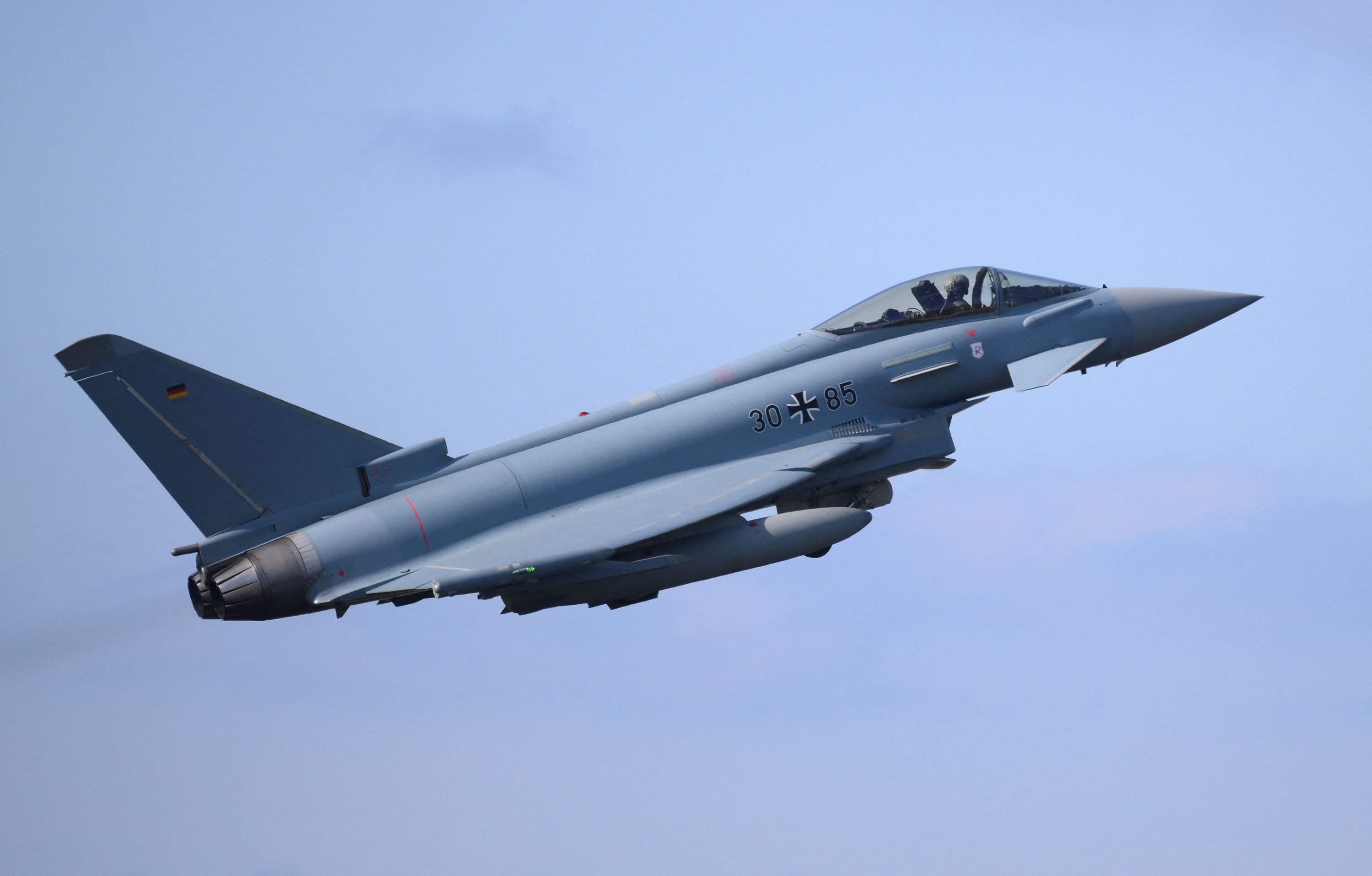
On July 23, during the 17th International Defense Industry Fair (IDEF 2025) in Istanbul, Defense Minister Yaşar Güler and U.K. Defense Secretary John Healey signed a memorandum of understanding regarding Türkiye’s purchase of Eurofighter Typhoon fighter jets.
While the Eurofighter jets had long been on Türkiye’s procurement agenda, the deal had stalled due to Germany’s reluctance to approve the sale. Although the U.K. had expressed willingness to deliver 40 aircraft, the transaction required the consent of all members of the Eurofighter consortium, namely the U.K., Germany, Spain and Italy.
For years, relations between Ankara and Berlin were strained, particularly under the Social Democratic Party (SPD)-led coalition government of Olaf Scholz. However, with the new conservative government under Chancellor Friedrich Merz, there are signs of a strategic realignment.
The Eurofighter agreement could mark a turning point in Turkish-German relations, signaling a shift away from emotionally charged tensions and toward a more pragmatic, interest-based partnership.
The Eurofighter agreement comes at a critical time for Türkiye’s air defense strategy. Following its exclusion from the F-35 program in 2019 due to the S-400 crisis with the United States, Türkiye has faced a growing capability gap in its air force. Its current F-16 fleet is aging, and while Ankara has requested 40 new F-16V aircraft from the U.S. and continues upgrading older models through the domestic Özgür program, progress has been slow and politically complicated.
Until the domestically produced Kaan fighter reaches full operational capability – expected sometime in the 2030s – Türkiye needs reliable interim solutions. In this context, the Eurofighter Typhoon represents more than just a procurement: it is a strategic stopgap that reinforces Türkiye’s deterrent posture.
For NATO, this deal strengthens the alliance’s southeastern flank by ensuring Türkiye remains militarily interoperable and less dependent on non-NATO defense systems such as Russian platforms. It also signals Ankara’s willingness to remain anchored in Western defense frameworks despite previous tensions.
Under the previous SPD-led coalition government, relations between Berlin and Ankara were frequently strained, particularly due to the stance of the Green Party, which held key ministries, including the Foreign Office under Annalena Baerbock. As a result, meaningful bilateral cooperation, especially in the security and defense domain, remained elusive.
Although Chancellor Olaf Scholz expressed support for the Eurofighter deal during a meeting with President Recep Tayyip Erdoğan in October 2024, Germany ultimately withdrew its approval in April 2025, citing domestic developments in Türkiye. This signaled a political reluctance to decouple strategic interests from ideological concerns.
With the election of Chancellor Friedrich Merz and the Christian Democratic Union (CDU)-led government, a shift toward pragmatic engagement was already foreseeable. Merz emphasized Türkiye’s vital role within NATO, not only due to its geographical proximity but also because of its military capacity, strategic relevance in regional crises and influence in key areas such as migration, counterterrorism and Middle Eastern stability.
Merz has advocated for a rational and interest-based partnership with Ankara, recognizing Türkiye as a central actor in Europe’s security architecture. His administration has also called for closer cooperation on the reconstruction of Syria and has signaled a readiness to engage in strategic dialogue on regional crises, including the war in Ukraine.
This reorientation is reflected in the governing coalition agreement between the CDU/Christian Social Union (CSU) and the SPD, which defines Türkiye as a “strategic partner within NATO, neighbor of the EU, and influential actor in the Middle East.” While values like human rights and the rule of law remain on the agenda, they are no longer treated as preconditions, but rather as long-term goals, marking a shift toward a more pragmatic and interest-driven foreign policy.
The appointment of Johann Wadephul as Germany’s new foreign minister brings a notable shift in tone to Berlin’s policy toward Türkiye. As a senior figure within the CDU, Wadephul has long advocated for a more respectful and strategic dialogue with Ankara. His past statements suggest a balanced approach, grounded in NATO solidarity, diplomatic prudence and mutual respect.
In July 2022, Wadephul openly criticized then-Foreign Minister Annalena Baerbock for publicly confronting Türkiye during a visit to Athens, calling it an “unhelpful” move. He underscored that both Greece and Türkiye are indispensable NATO allies and that diplomacy should be conducted through direct and constructive engagement, not public reprimands.
More recently, in February 2025, Wadephul emphasized Türkiye’s critical role on NATO’s southeastern flank, describing it as an indispensable security partner for Germany. He acknowledged Ankara’s legitimate security concerns – particularly regarding attacks near its Syrian border – while also stressing the need for proportional responses within the framework of international law.
Wadephul has maintained a principled distance from some of President Erdoğan’s foreign policy actions, such as Türkiye’s military operations in northern Syria and northern Iraq, which he sees as complicating bilateral ties. Still, he insists that these disagreements should not undermine the broader partnership – a stance reflecting a pragmatic and structured foreign policy orientation.
His nuanced and rational approach signals a departure from the ideological rigidity of the previous government. Under Wadephul, German-Turkish relations may become more stable, predictable, and anchored in open strategic dialogue.
The Eurofighter agreement may well be more than a defense procurement. It could mark the beginning of a renewed, more pragmatic era in Turkish-German relations. At a time of growing geopolitical instability, with wars in Ukraine and Gaza and rising tensions across the Middle East and Eastern Europe, NATO can ill afford internal fragmentation or the alienation of key members like Türkiye.
Strengthening trust and cooperation between Berlin and Ankara will be essential for ensuring the alliance’s operational effectiveness and strategic cohesion. If sustained, this new diplomatic tone, marked by realism, mutual respect and a focus on shared security interests, could lay the groundwork for a more resilient and forward-looking transatlantic partnership.