I grew up in a house my parents built in a small neighborhood at the top of the hilly part of Sarajevo’s Old Town. My mum and dad, practicing Muslims who fought for Bosnia’s independence, struggled a lot during communism, and found it extremely difficult to buy a decent piece of land in the city. This was the best they could do at the time. They spent every cent they had building a large family house, divided into three floors, one for each child. “At least they will each have a small apartment to start from,” my mother would often say when speaking with friends, uncertain of what future awaited Muslims in our country, in the very heart of Europe.
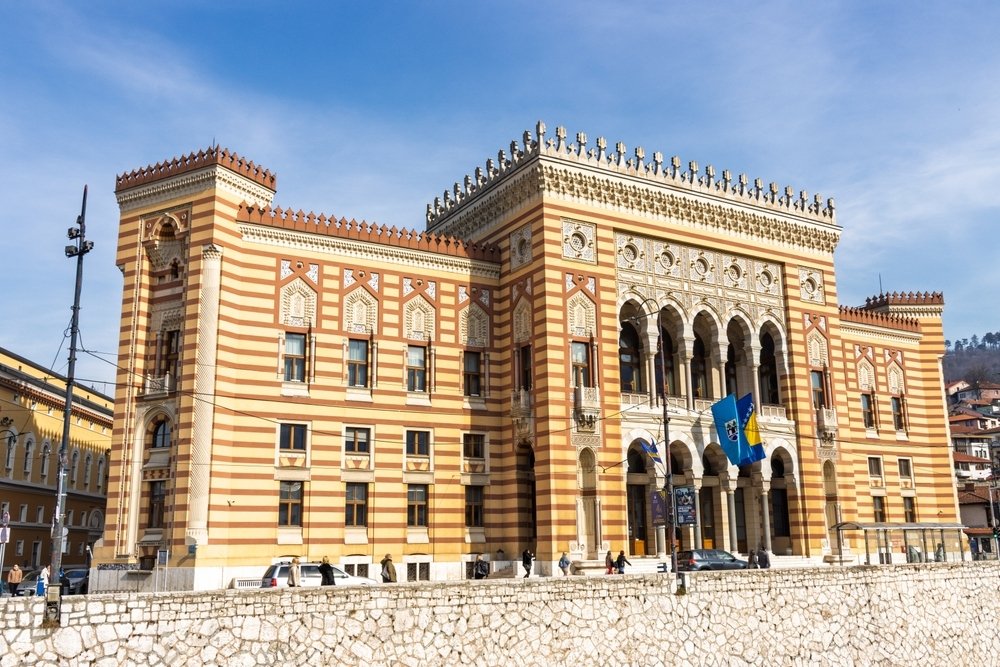
My brothers and I hated the long, steep walks home from school, especially in winter, when Sarajevo turns bitterly cold and the streets are icy. Sometimes so icy that mum would leave the car at the bottom of the hill and walk the rest of the way. But the view from the balconies made up for it. From there, we could see the Sarajevo City Hall, Vijecnica, one of the city’s most recognizable landmarks, built in 1896 on the site of Mustaj-pasa’s Square, once home to the Ottoman governor’s palace. That view was an important part of my childhood.
Our house survived the siege of Sarajevo and aggression by Bosnian Serbs during the 1990s, serving as a sanctuary for refugees my father welcomed after my mother, brothers and I fled to Slovenia. When we returned, the house needed repairs, but the view had changed even more than the home itself. The City Hall was a skeleton. The blackened walls stood as scars of the largest human-made fire Sarajevo had ever seen. They were visible even from the highest hills. It was as if the building itself was crying out its pain. On the night of Aug. 25-26, 1992, the self-proclaimed Bosnian Serb army, driven by nationalist and far-right ideologies, shelled the library. Flames devoured more than 2 million books, manuscripts, religious texts and unique archives, around 80% of Bosnia’s written history, while the world watched. The goal was not just the destruction of books, but the erasure of a people’s memory, culture, and faith.
It was not the first time far-right nationalism left its mark on Sarajevo. Just a few meters away from the Library, a Bosnian Serb nationalist assassinated Archduke Franz Ferdinand and his wife Sophie in 1914, triggering the First World War. Far-right ideas did not die there. They continue to resurface across Europe.
Bosnians have been part of Europe for centuries. Many of us converted to Islam after 1463, when Ottoman Sultan Mehmed II conquered Bosnia and the Balkans became part of the Ottoman Empire. That encounter gave the region its unique cultural character. Later, under Austro-Hungarian rule, Sarajevo’s City Hall was built by the new empire in pseudo-Moorish style, blending influences from East and West. It symbolized Bosnia-Herzegovina, which connects Islam, Christianity, Judaism and Europe’s many traditions.
For a while, I believed Europe had learned the lessons of Bosnia’s war. Thirty years later, talk of democracy, tolerance and reconciliation seemed to grow louder. But the rise of far-right rhetoric has shaken that belief. In 2011, Anders Breivik murdered 77 people in Norway, citing anti-Muslim hatred as his inspiration. In 2019, the Christchurch attacker in New Zealand livestreamed the massacre of 51 Muslims in mosques, also praising Bosnian Serb nationalists. In the Netherlands, far-right politician Geert Wilders repeatedly called for the Quran to be banned, equating it with Hitler’s "Mein Kampf." And in January 2023, Rasmus Paludan, a Swedish-Danish extremist, burned a copy of the Quran outside the Turkish Embassy in Stockholm – with police approval, under the guise of free speech.
I live in Türkiye now, but I visit Sarajevo very often. After getting married, I moved to the other side of the Miljacka river, to the house where my husband grew up, just meters from the library. When I visit my parents, I still notice Vijecnica in the background of my father’s study window. Today, it stands rebuilt, restored to its place in the Old Town. The reconstruction process began in 1996, but due to the scale of destruction and the financial burden, it took almost 18 years to complete. The restoration was carried out in several phases and involved multiple donors, including the European Union and Türkiye.
The total cost of reconstruction is estimated at 25-30 million euros ($30-35 million), with the EU as the single largest donor. However, Türkiye played a crucial role throughout the project. It not only provided financial support but also contributed expertise and construction companies to carry out restoration works. Turkish institutions, architects, and builders were directly involved in reviving the City Hall’s distinctive pseudo-Moorish architecture, which had originally been inspired by Ottoman and Andalusian styles.
The City Hall was finally reopened on May 9, 2014 – symbolically on Europe Day and the Day of Victory over Fascism – restoring one of Sarajevo’s most important landmarks and cultural symbols.
Despite fear and uncertainty, we – Bosnian Muslims, Europeans – are still here. Bosnia is an EU candidate, and Brussels has promised a speedier process in the wake of the war in Ukraine. And no matter how “Christian” the bloc may present itself, Europe must find a way to include us truly. Like the eclectic architecture of Vijecnica, Europe’s strength lies in blending diverse elements into something original. That requires respecting our faith and our Holy Book, not tolerating those who burn it. Because we are part of Europe’s history – and we are not going anywhere.