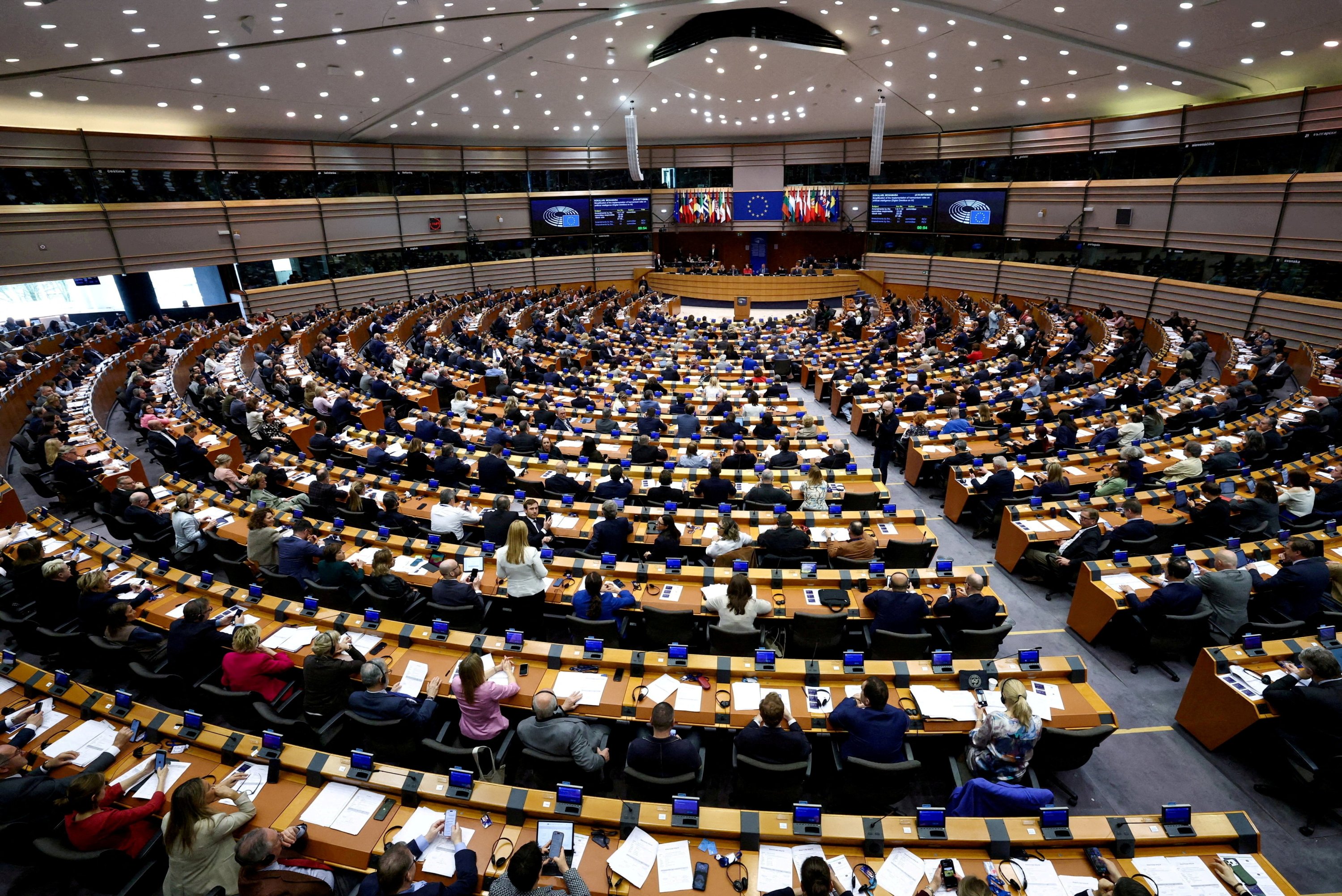
The European Parliament’s latest report on Türkiye once again raises an uncomfortable question: Is the Parliament genuinely interested in strengthening Europe’s relationship with a key strategic partner, or has it become trapped in a cycle of ideological posturing disconnected from geopolitical realities?
The report adopted on June 17 reflects a familiar pattern. It contains sweeping political judgments, selective interpretations of domestic developments and recommendations that exceed the institution’s practical influence while offering little that can contribute to a constructive Türkiye-European Union agenda.
This is not a new phenomenon. For more than a decade, successive EP reports on Türkiye have increasingly evolved from objective assessments into political declarations shaped by partisan preferences and ideological assumptions. As a result, their credibility has steadily eroded among large segments of Turkish society, including many who remain committed to Türkiye’s European vocation.
The fundamental problem is structural. Unlike the European Commission, which is tasked with managing accession negotiations and maintaining institutional dialogue, the EP is inherently political. Its resolutions often reflect the domestic agendas of political groups, election cycles and ideological alignments rather than a balanced evaluation of candidate countries.
I recognized this reality years ago while serving as Türkiye’s Minister for EU Affairs and Chief Negotiator. Throughout my tenure, I argued that progress reports should not be treated as political report cards imposed upon sovereign nations. In response to recurring concerns about objectivity, Türkiye even prepared alternative progress reports to present a broader picture of reforms and developments that were often overlooked in Brussels. Whether one agreed with every aspect of that initiative or not, it highlighted an important truth: assessment mechanisms lose legitimacy when they are perceived as one-sided.
The latest report illustrates this problem vividly. Particularly troubling is the inclusion of language targeting Türkiye’s Minister of Justice, Akın Gürlek, and commenting on ongoing judicial processes. Such interventions risk crossing the line between legitimate political observation and direct involvement in domestic judicial matters.
No democratic state would welcome foreign political institutions attempting to shape or prejudge active legal proceedings. Judicial independence cannot simultaneously be defended and undermined. If European institutions genuinely support the rule of law, they should respect the principle that courts, not political assemblies, are responsible for determining legal outcomes.
Beyond these specific concerns lies a larger strategic contradiction.
Europe today faces unprecedented challenges. Russia’s war against Ukraine continues to reshape the continent’s security architecture. Instability across the Middle East directly affects European security and migration management. Energy diversification remains a pressing necessity. Competition among major powers is intensifying. Supply chains are being reconfigured. Defence capabilities are being reassessed.
In virtually every one of these areas, Türkiye is not a peripheral actor but a central stakeholder.
As NATO’s second-largest military force, a critical energy transit hub, a key partner in migration management, and a major regional diplomatic actor, Türkiye occupies a strategic position that Europe cannot simply ignore. Increasingly, European leaders themselves acknowledge this reality in both public statements and private discussions.
Yet the EP’s approach often appears detached from these geopolitical facts. Instead of asking how Türkiye and the EU can jointly address common challenges, parliamentary debates frequently become forums for symbolic condemnations that generate headlines but produce no meaningful policy outcomes.
Unfortunately, certain members of the EP appear more interested in political signaling and are determined to substitute ideological activism for strategic thinking, often without recognizing the long-term costs such behavior imposes on European interests.
This disconnect weakens both sides.
For Türkiye, such reports reinforce perceptions that certain European institutions remain unwilling to engage with the country on an equal footing. For Europe, they undermine the credibility of an institution that should be helping shape a coherent long-term strategy toward one of the continent’s most important partners.
Criticism, when fair and balanced, is both legitimate and necessary. No democracy is above scrutiny. Türkiye itself benefits from constructive engagement with European institutions and from maintaining high standards of democratic governance, judicial effectiveness and fundamental rights.
However, constructive engagement requires consistency, objectivity and mutual respect. Reports driven by political agendas rather than strategic analysis serve neither Türkiye nor Europe.
The future of Türkiye-EU relations cannot be built on annual rituals of condemnation, political symbolism and mutual frustration. It requires strategic vision, intellectual honesty and recognition of shared interests.
Europe’s challenge today is not deciding whether it agrees with every policy adopted by Türkiye. The real challenge is determining whether it is prepared to engage with one of its most important partners as a serious geopolitical actor.
History will not judge Europe by the resolutions it passes. It will judge Europe by the partnerships it builds.
The time has come to replace symbolic politics with strategic statesmanship.