German philosopher Martin Heidegger once said in an interview (1966) with Der Spiegel that when humans first went to the moon and saw the Earth from space, he was shocked and also terrified. He felt that humanity had become “deterrestrialized.” His impression of technological progress was this: We are everywhere and can see everything, yet we are also nowhere, because we are no longer grounded where we stand. For him, this was frightening, an experience of rootlessness, even a critique of early globalization. But what if Heidegger were a young person in 2025, experiencing social media, artificial intelligence and algorithmic manipulation?
I take my phone, open Instagram or TikTok. Physically, I am in Istanbul, but mentally I am in Bali drinking a smoothie made of exotic fruits at a meditation workshop. Or I’m dreaming of a honeymoon in Paris, a selfie in New York and make-up hacks from an influencer in Dubai. I want everything I see: videos and photos that disconnect me from my own reality. We start desiring things that do not belong to us. We begin to feel that our identity belongs elsewhere.
Until recently, young people mostly saw the “fancy” side of globalization. They were almost hypnotized, believing the world was only what they saw on their screens.
This changed when the brave journalists and cameramen of Gaza risked their lives and showed us the “non-fancy” side of globalization: shattered bodies, starving babies. With Gaza, the world entered a process of decolonization. Until then, most massacres around the world had been presented to us as “civil wars.” But this time, for more than two years, every single day, we witnessed innocent civilians being killed by what the world calls “the most moral army” of “the only democracy” in the Middle East. We saw how international institutions remained silent, how they played the three monkeys.
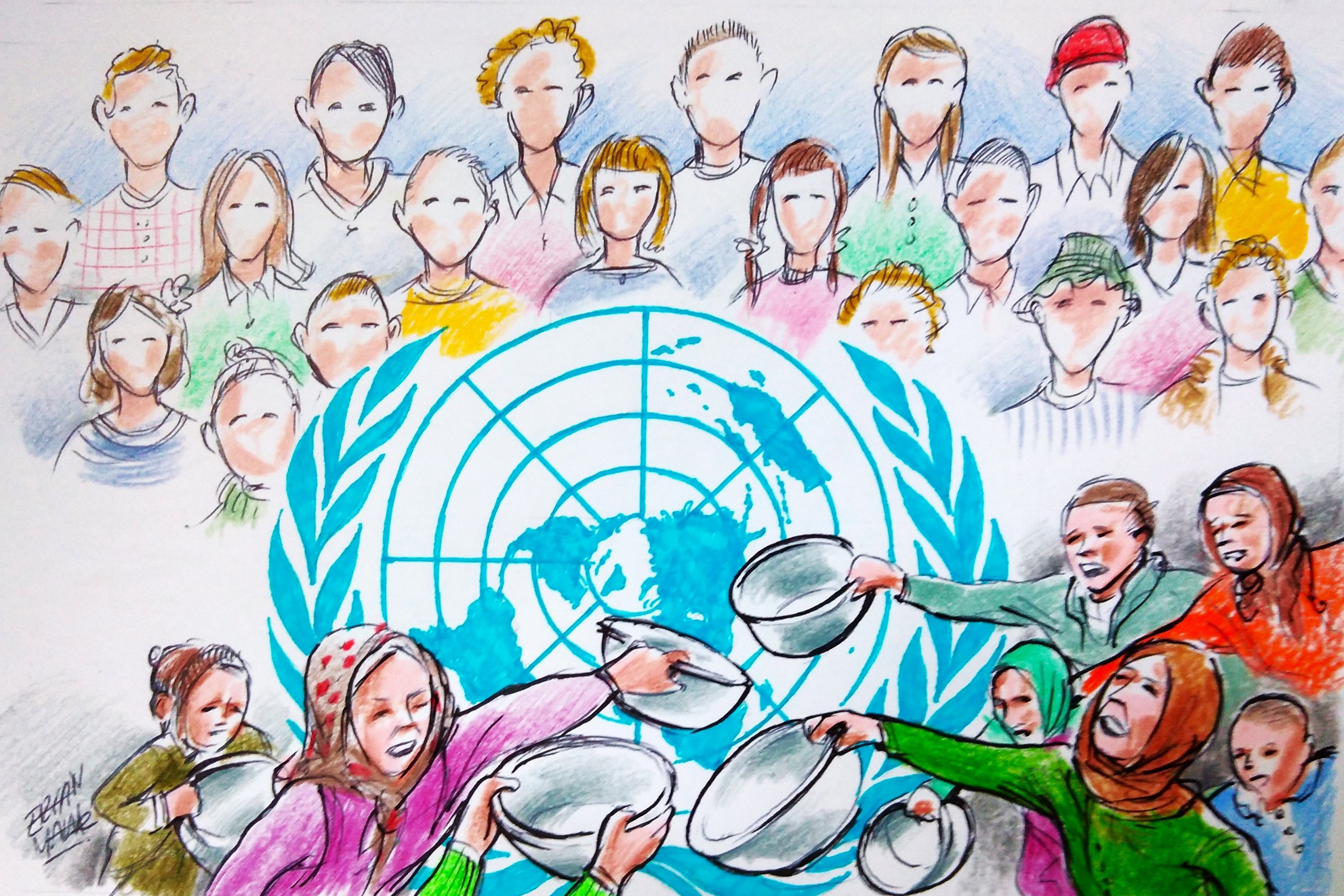
There are nearly 200 countries in the world. Yet, only five are permanent members of the United Nations Security Council: the United States, China, Russia, the United Kingdom and France. They hold the world hostage. Just to give an example, the U.S. has vetoed more than 45 resolutions against Israel, an unprecedented number. The Zionist regime, which is violent, criminal and illegitimate, has always been protected by other imperial powers. Colonial powers depend on each other; the fall of one threatens the others, which is why they hold onto Israel so tightly.
This means that even if 193 U.N. member states agree on something, a single “no” from one of these five powers can block all action and prevent any global response to Israel. Because of this veto system, they decide who gets bombed, who receives aid, which wars are ignored, and what is or isn’t called genocide. We learned that imperial interests, hidden behind diplomatic language, shape real lives.
Young people saw all of this with their own eyes. And after Oct. 7, one slogan rose from their voices: “The world is bigger than five.”
Their demands were simple: a fair and equal life for everyone, East, West, North and South, and a universal right to justice and dignity, against dehumanization.
The awakening triggered by Gaza also made the injustices in Sudan, Congo and other oppressed regions more visible. Due to the conscious and active use of social media by young people, the world has begun to see a clearer, less glamorous global reality.
We entered a new era: something similar to the post-Vietnam, post-1968 period, where both civic action and intellectual movements are rising again.
Let us first talk about the youth in the West. Ordinarily, many people in the U.S. could not even locate Israel or Palestine on a map. Yet suddenly, students from leading universities like Columbia, Harvard and others began protesting against Zionism and white supremacy. This movement quickly spread to European universities as well.
Since the legacy of colonialism shaped both Western and non-Western societies, decolonization must involve everyone. We saw this clearly. Another example is the Christmas dinner culture in Western families. These gatherings usually bring together three generations: father, son and grandson. And often, older generations speak freely and openly with racist language. Before attending these gatherings, many young people now read articles from anti-racist pedagogy and psychology platforms, even seeking counseling, just to manage the racist behavior they will face at home. Their goal is to decolonize the psyche: to transform psychological frameworks that misrepresent non-Western societies.
Because these young people also suffer from the colonial mentality imposed by older generations and reinforced by Western media, they are also victims.
So “decolonizing Western youth” does not mean erasing their identity or changing who they are. Decolonization does not destroy a culture. It reveals invisible privileges and strengthens critical consciousness.
In broader terms, yes: Western education, history and knowledge systems still carry colonial traces. Western youth must recognize that their education is Western-centric and learn to question it. So, decolonization is a mental, cultural and epistemic process.
This transformation is still not widespread, partly because official colonial education systems remain strong. Many young people, however, began educating themselves by reading alternative sources and joining new communities. In this process, diaspora communities in the West played a major role. They stood with anti-racist Western youth, offering psychological support and helping deconstruct the colonial narratives taught in schools.
I am a member of the Sumud Flotilla, which is often presented as a Western-led movement. But we should not forget: more than half of Sumud participants are ethnically from the Global South: the Middle East, Türkiye, North Africa, South Asia and Latin America. Young people in the Global South are victims of both the capitalist world and traditional social structures.
Since capitalism did not originate in our lands, it appeared to us as something to admire and imitate. This created obsession, brand addiction, consumerism and the need to buy the newest of everything. These patterns I see in the Global South are far more than in Western countries. Our youth is being numbed. They also carry the trauma of colonization and the pain of not having equal access to opportunities. Africa, for example, has the world’s youngest population, yet African youth still lack access to global opportunities.
Moreover, traditional family structures often prevent them from developing self-confidence the way Western youth can. In many Global South families, respect is demanded from children but rarely given to them. Families also need to self-reflect. We must start recognizing children as individuals. We must let go of the mindset of “my child is mine.” Otherwise, our youth loses its survival instincts because they think someone will always protect them.
In this hierarchical structure, young people become lost. Instead of giving them the right to lead, to try, to initiate, we treat them like a group that must always be controlled. We still struggle to combine experience with dynamism. We do not fully believe that our youth can achieve something, produce projects, or change the world. At least, we do not motivate them enough to believe this.
Global South youth offer great hope and potential, but the world is entering a difficult era where tyrants show their cruelty openly. So we must ask ourselves: Is our youth ready for this era? Is our education system ready for it?
Unfortunately, our education systems are not preparing young people for the struggles ahead. Our youth is not ready to fight. We must strengthen their confidence, dignity and global awareness. We must equip them with knowledge that goes beyond their own country.
Yes, our own history and ancestors are important. But the world today operates through psychological warfare and anti-propaganda. When these young people go to the West and hear criticisms of their own countries, they cannot respond. They do not know how those same Western powers, while lecturing the Global South about democracy and human rights, have colonized other nations.
We need an education system that prevents our youth from feeling ashamed of their identity, that keeps them from developing an inferiority complex, that doesn’t turn them, using a British expression, into “coconuts.”
I once spoke with a young Kenyan student who had never heard of Thomas Sankara, one of the founders of Pan-Africanism. This shocked me. The only reason was the regional limitation of his education system.
Appreciating our regional history is important, but not enough. The world is becoming more international but also more brutal. For our youth to survive, they must learn the history of all Western colonialism: A Turkish youth should know about the Algerian genocide. An African youth should know what happened in Hiroshima. A Kashmiri youth should know about the Native American genocide. An Iraqi youth should understand the apartheid system in South Africa.
Let me end with a quote from Thomas Sankara: “You cannot carry out fundamental change without a certain amount of madness in courage, in honesty, and in the desire to constantly improve yourself.”